
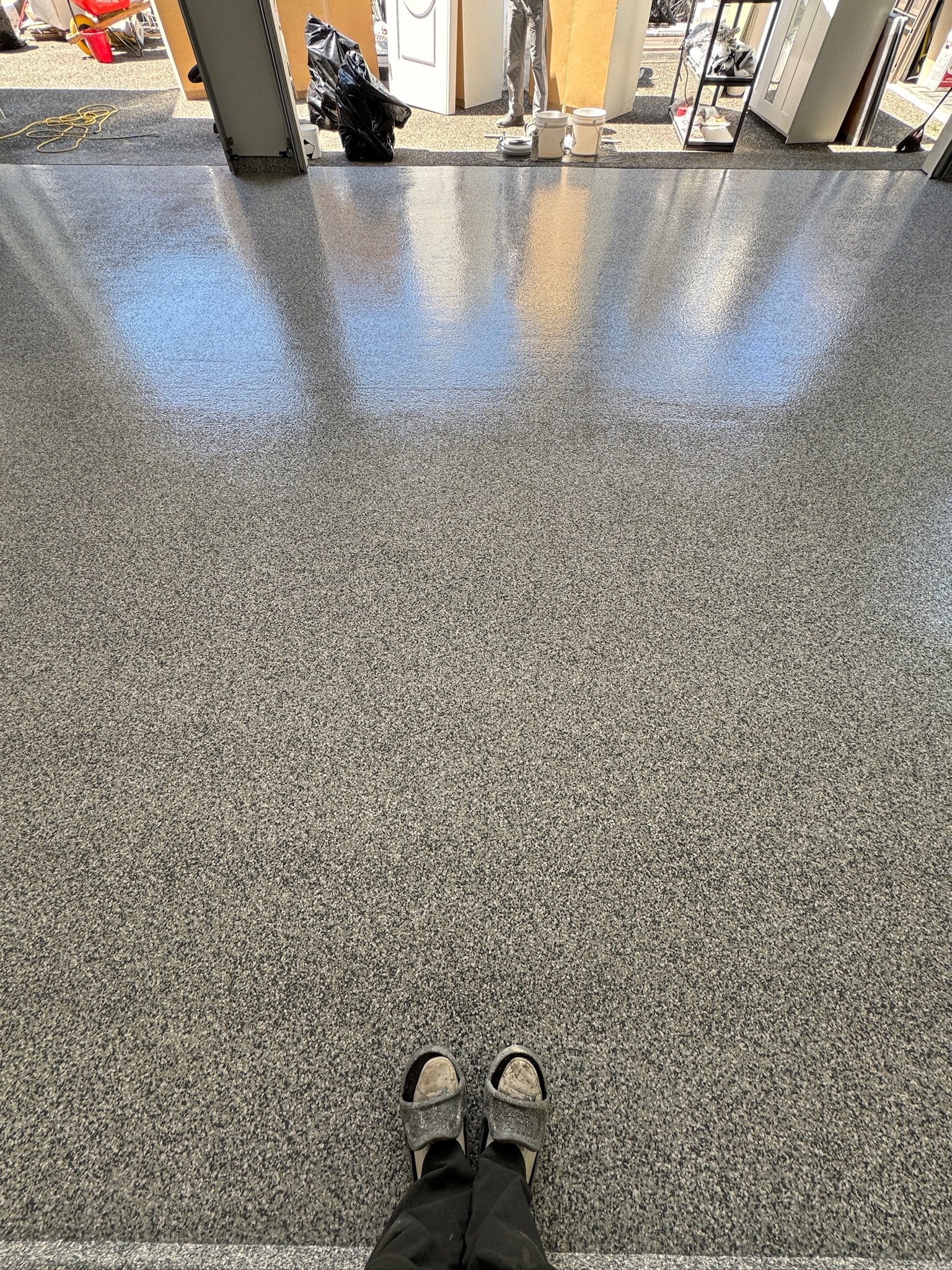
How to Vet an Epoxy Garage Floor Installer in BC
TLDR — What to Know Before You Search
- Surface preparation is what separates a lasting epoxy floor from one that peels within months
- Metro Vancouver's climate — humidity, moisture from grade-level slabs, temperature swings — makes professional prep more important than in drier regions
- Asking the right questions before you sign a quote protects you from shortcuts you won't notice until it's too late
- A quality installer will walk your floor, assess the substrate, and explain their process before giving you a number
When you search for epoxy garage floor installers near you in the Lower Mainland or Fraser Valley, the results range from dedicated resinous flooring contractors to painters who've added epoxy to their service list. The difference in quality isn't always obvious from a website or a price — it shows up in how the floor performs two or three years down the road.
What Makes an Epoxy Garage Floor Installer Worth Hiring?
The most important thing any epoxy contractor does happens before the product ever opens. Surface preparation — mechanical grinding or shot blasting the concrete to open its pores and remove contaminants — is what determines whether the coating bonds properly or eventually peels away.
A contractor who can explain their prep process in plain terms, and tell you why they chose it for your floor, is already ahead of one who just quotes a price per square foot. Ask what equipment they use, how they handle cracks and divots, and whether they test for moisture before applying any product.
Why Does Moisture Matter So Much in BC Garages?
Concrete breathes. Moisture vapor moves up through a slab from the ground, and if the emission rate is too high for the coating system being applied, the epoxy can delaminate — bubble, lift, or peel — sometimes within a season.
In Metro Vancouver and the Fraser Valley, grade-level garage slabs are common, and soil moisture can be higher than in drier parts of the province. A professional installer tests vapor emission before committing to a product system. If the reading is elevated, there are moisture-tolerant primers and specialized epoxy formulations designed for that condition — options you won't find in a consumer kit from a hardware store.
If you're in Langley, Surrey, or elsewhere in the Lower Mainland, it's worth asking specifically whether the contractor has experience with grade-level slabs in your area.
What Questions Should You Ask Before Getting a Quote?
Getting multiple quotes isn't just about price — it's about understanding who you're dealing with. Here are the questions that matter most:
- How do you prepare the surface? Shot blasting or diamond grinding is the professional standard. Acid etching alone is less reliable on dense or previously sealed concrete.
- Do you test for moisture? This is a baseline step. An installer skipping it is cutting corners where it counts.
- What product system are you applying? The brand, formulation, number of coats, and topcoat type all affect how the floor holds up over time.
- What's the cure schedule before I can park on it? A quality installation needs time. If the timeline sounds unusually fast, ask why.
- Can you show examples of similar work in the area? Local references or project photos confirm the contractor's familiarity with BC slab conditions.
A confident, experienced installer will answer all of these without hesitation. Vague or evasive responses tell you what you need to know.
Is DIY Epoxy Realistic for a Vancouver-Area Garage?
Consumer epoxy kits work, within limits. They're designed for simplicity, which often means less tolerance for slab imperfections, moisture variation, or prep shortcuts. The instructions assume a reasonably clean, dry, unpainted floor — conditions that don't always exist in Lower Mainland garages.
Older slabs, floors with previous coatings, and concrete with any history of moisture issues are all harder to coat successfully without professional equipment. For a floor that sees regular vehicle traffic, the cost difference between DIY and professional installation often narrows considerably once failures are factored in.
What Does a Professional Epoxy Installation Actually Involve?
Understanding the process helps you evaluate the contractor you're talking to. Here's what a professional garage epoxy floor installation typically involves:
- Inspection and moisture testing — The installer walks the slab, checks for previous coatings, looks for cracks or damage, and tests moisture vapor emission.
- Mechanical surface preparation — Diamond grinding or shot blasting removes contamination and opens the concrete's pores for proper adhesion. Cracks and divots are filled.
- Primer application — A penetrating epoxy primer goes down first, especially important for porous or moisture-prone slabs.
- Base coat — The main epoxy layer is applied, along with any decorative elements such as colour flakes or metallic pigments. Some systems use multiple coats.
- Topcoat — A polyurethane or polyaspartic clear coat adds surface hardness, UV resistance, and protection against hot tire pickup.
- Cure time — Most systems require at least 24 hours before light foot traffic and several days before vehicles should be parked on the floor.
Each step builds on the one before it. A rushed prep or skipped primer creates a weak point that typically shows up within a year or two of installation.
How Should You Evaluate a Flooring Quote?
Epoxy flooring quotes in the Lower Mainland vary based on the size of the space, the coating system selected, the amount of surface repair needed, and the contractor's process. A quote that comes in significantly lower than the others is worth examining closely — the difference is usually in what's been left out.
Ask for an itemized quote so you can compare what's included. General factors that affect pricing in any epoxy project include:
- Square footage of the area
- Surface preparation method and equipment used
- Coating system — epoxy only versus epoxy with a polyurethane or polyaspartic topcoat
- Decorative options such as solid colour, colour flakes, or metallic effects
- Concrete repair required before coating begins
Actual costs vary based on project scope, substrate condition, and site access — contact FraserPlus Epoxy for a personalized assessment.
What Are the Most Common Epoxy Floor Failure Modes?
Most epoxy floor problems trace back to a handful of root causes. Knowing them helps you ask smarter questions before work begins:
- Peeling and delamination — Almost always a preparation failure: insufficient grinding, moisture trapped below the coating, or contaminants left on the slab. A properly prepared and primed floor shouldn't peel.
- Hot tire pickup — Standard epoxy can soften under the heat of a parked vehicle's tires and pull away when the car moves. A polyaspartic or polyurethane topcoat significantly reduces this risk.
- Yellowing — Most epoxies are not UV-stable. In a garage with windows or an open door, direct sunlight causes colour shift over time. A UV-stable topcoat, or selecting a colour that doesn't show yellowing, is the practical fix.
- Bubbling during application — Caused by outgassing from the concrete, common in warm weather or on freshly poured slabs. Experienced installers time their work and choose products suited to the conditions.
Ready to Get a Quote on Your Garage Floor?
FraserPlus Epoxy installs epoxy and resinous flooring across Metro Vancouver and the Fraser Valley. Our full range of services covers residential garage floors, commercial spaces, metallic epoxy, and polished concrete. If you're ready to talk through your project, get in touch for a free assessment.
Frequently Asked Questions
How long does an epoxy garage floor last?
A properly installed system — with professional surface preparation and a quality topcoat — can last many years under normal residential garage use. Longevity depends on the coating system, prep quality, and how the floor is maintained. Harsh chemicals, heavy abrasion, and UV exposure without a protective clear coat will shorten the service life.
Can epoxy be applied over an existing painted concrete floor?
In most cases, existing paint or coatings need to be removed before epoxy is applied. Old paint can block adhesion, and any coating that isn't fully bonded to the slab will take the new epoxy down with it. A professional installer will test adhesion first and either grind the existing coating off or advise on the best approach for your specific floor.
How do I know if my garage slab has a moisture problem?
A basic field test involves taping plastic sheeting to the concrete and leaving it in place for 24 to 48 hours. Condensation under the plastic indicates moisture vapor moving through the slab. Professional installers use calibrated test kits for a precise reading and to determine whether a moisture-tolerant primer or vapor mitigation system is needed.
Is metallic epoxy a practical choice for a garage floor?
Metallic epoxy systems are visually distinctive and durable, but they're generally better suited to spaces with moderate traffic. In a high-use garage with multiple vehicles parked daily, a decorative chip system with a polyaspartic topcoat often holds up better over time. A contractor familiar with both options can help you choose based on how your space is actually used.
Follow FraserPlus Epoxy on Google — be the first to know about floor coatings, maintenance guides, and project ideas across Metro Vancouver.
Make us your preferred source on Google