
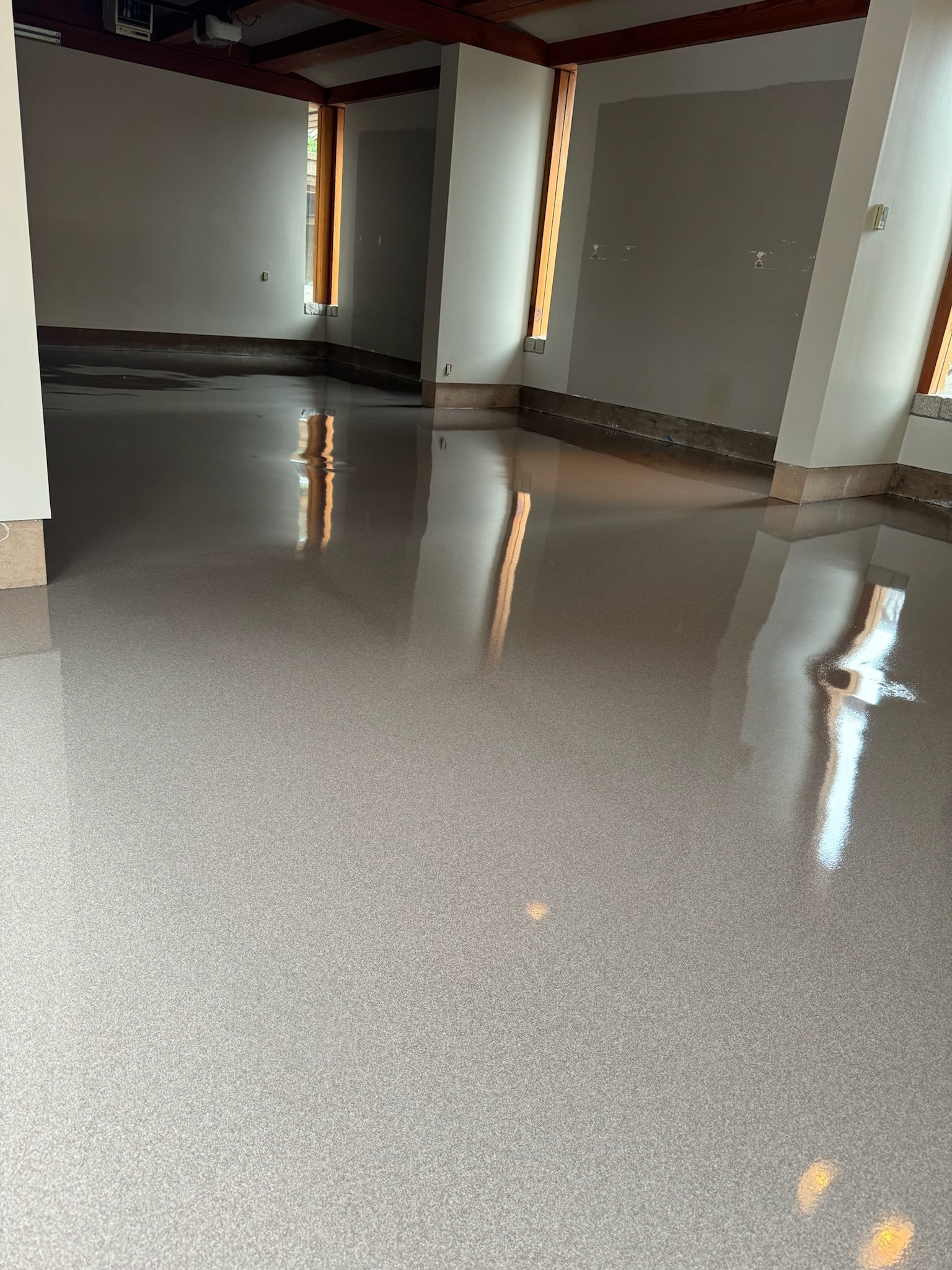
Best Garage Concrete Flooring Services in Surrey, BC
Quick Takeaways
- Garage concrete flooring in Surrey ranges from chip broadcast epoxy to metallic resin systems — the right choice depends on how you use the space and the condition of your existing slab.
- Quality prep — diamond grinding, moisture testing, and crack repair — is the biggest factor in how long any coating lasts.
- BC's wet winters and freeze-thaw cycles create real moisture challenges; UV-stable polyaspartic topcoats hold up better than bare epoxy under variable weather.
- Always get a written quote that breaks down labour, materials, prep, and warranty terms separately so you're comparing bids fairly.
If you're searching for garage concrete flooring services in Surrey, you're probably dealing with a floor that's stained, cracked, or just hard to keep clean. Concrete is porous — it absorbs oil, moisture, and road grime — and BC's climate makes bare garage floors even harder to maintain. A resinous coating changes that, but the quality of the service matters as much as the product itself.
What does a garage concrete flooring service actually include?
A proper install isn't just rolling a product onto concrete. It starts with preparation: diamond grinding the surface to open the concrete's pores, filling cracks and low spots, and testing for moisture vapor transmission. Prep is the most important part of the job, and it's typically where cheaper quotes cut corners.
After prep, a professional applies a primer or base coat, then the chosen system — solid epoxy, a decorative chip broadcast, metallic resin, or a polyaspartic topcoat. Each layer needs adequate cure time before the next goes on. A thorough service also addresses edges, transitions, floor drains, and any penetrations in the slab.
If you're unsure what a standard installation covers, our garage epoxy flooring service page walks through what a typical Surrey residential job includes.
Which type of coating is right for a Surrey garage?
There's no single best option — it depends on how you use the space, the condition of your slab, and what you want the finished floor to look like.
Solid epoxy with decorative chip broadcast is the most common residential choice. You get a hard, chemical-resistant surface with a flake layer that adds grip and hides minor surface imperfections. It's practical for daily-use garages, workshops, and spaces where easy cleaning matters more than a high-gloss appearance.
Metallic epoxy uses pigmented metallic powder in the resin to create a glossy, three-dimensional effect. It's a strong match for showrooms, home gyms, or garages where appearance is the priority. Because the installer works the pigment by hand, no two metallic floors look exactly alike. See our metallic epoxy flooring service for details on what this option involves.
Polyaspartic coatings cure faster than standard epoxy and resist UV yellowing better — important if your garage door stays open often or sunlight hits the floor. Many contractors apply polyaspartic as the topcoat over an epoxy base, combining epoxy's adhesion with polyaspartic's UV resistance and durability.
Polished concrete takes a different approach: instead of a coating on top, the slab itself is mechanically ground and polished to a hard, reflective surface. It's extremely durable and low-maintenance, but it requires a structurally sound slab without significant cracking or contamination from oils or chemicals.
How does BC's climate affect garage coating performance?
Surrey's climate — wet winters, occasional frost, and warm dry summers — puts real stress on concrete slabs. Freeze-thaw cycles cause concrete to expand and contract, which stresses any coating bonded to it. Moisture is the more persistent day-to-day problem.
Moisture vapor rises through concrete from the ground below. When it gets trapped under an epoxy coating, the coating blisters and lifts — sometimes within months of installation. A professional contractor will test the moisture vapor emission rate of your slab before applying any product. If readings are elevated — common in older Surrey homes and in areas with higher water tables — they'll use a moisture-tolerant primer or address the source before proceeding.
Road salt and de-icing chemicals tracked in from BC's winter roads are also hard on bare concrete. Epoxy and polyaspartic coatings resist these chemicals far better than uncoated concrete, so cleanup after winter driving becomes much simpler.
What prep questions should you ask before hiring a contractor?
The quality of surface preparation determines whether a coating lasts years or peels within months. Before you hire anyone, ask these questions directly:
- Do you use diamond grinding or acid etching? Mechanical grinding is the professional standard. Acid etching is a shortcut that produces inconsistent surface profiles and weaker adhesion.
- Do you test for moisture vapor before starting? And if the readings are high, do you change primers, delay the job, or proceed anyway?
- How do you handle existing cracks and control joints? Settled shrinkage cracks and actively moving cracks need different treatment.
- What ambient temperature and humidity do you need for installation? This matters in BC's spring and fall shoulder seasons, when conditions can be marginal for coatings.
A contractor who answers these questions clearly understands the work. One who can't — or dismisses them — is giving you useful information either way.
How do you compare quotes fairly when the numbers vary widely?
When getting quotes for garage flooring in Surrey, make sure each one clearly spells out the following:
- The exact product system: brand, product line, number of coats, and topcoat type
- Whether prep work — grinding, crack filling, and moisture testing — is included or quoted separately
- Square footage covered, and whether pricing adjusts if the actual floor area differs from the estimate
- Warranty terms: what's covered, how long it runs, and what voids it
- Installation timeline: prep day, coating day, cure time before foot traffic, and cure time before parking vehicles
Actual costs vary based on project scope, substrate condition, and site access — contact FraserPlus Epoxy for a personalized assessment.
A quote that looks significantly cheaper than the others usually means prep has been skipped or a lower-grade product is being used. A floor that peels in year one costs more to fix than whatever you saved upfront.
How long does installation take, and when can you use the floor again?
For a typical two-car garage in Surrey, installation generally runs one to two days depending on the chosen system. Day one is usually prep — grinding, repairs, and allowing the surface to dry if needed. Coatings go on once the surface is ready, with each layer curing before the next is applied.
Cure timelines vary by product. Polyaspartic topcoats are fast-curing systems that can accept light foot traffic within hours and vehicle traffic within approximately 24 hours under good conditions. Standard epoxy systems need longer — typically several days before heavy vehicle traffic. Your contractor should give you a specific timeline based on what they're actually installing, not a general estimate.
Temperature and humidity affect curing in BC. An install done in cool, damp October conditions may need more cure time than the same job in July. Build in a buffer if you're timing the project around a vehicle, business operation, or upcoming event.
Frequently Asked Questions About Garage Concrete Flooring in Surrey
How long does a professional epoxy garage floor typically last?
With proper prep and a good topcoat, a professionally installed epoxy floor under normal residential use can last many years. The main factors that shorten its service life are inadequate surface prep, a skipped topcoat, heavy chemical exposure, and physical impact from sharp or heavy equipment. Polyaspartic topcoats generally extend service life compared to epoxy alone.
Can you coat a concrete floor that already has cracks?
Minor shrinkage cracks — the kind that appear as concrete dries and settles — can usually be filled before coating. Structural cracks that are still moving, or damage caused by heaving or roots, need to be assessed first. A reputable contractor will tell you honestly whether the slab is a good candidate as-is or whether repairs are needed before any product goes down.
Is metallic epoxy a practical choice for an everyday garage?
It can be, depending on how the space is used. Metallic epoxy is durable and chemically resistant, but its high-gloss surface shows fine scratches and scuff marks more visibly than a chip broadcast system. For a daily-driver garage or a workspace with frequent tool movement, chip systems are often the more practical choice. For a display space, showroom, or home gym, metallic is hard to match on appearance.
What's the real difference between epoxy and polyaspartic coatings?
Epoxy is a two-part resin that bonds tightly to concrete and resists chemicals well, but it cures slowly and can yellow with prolonged UV exposure. Polyaspartic is a fast-curing coating with strong UV stability, typically used as the topcoat layer in professional systems. Most quality installs use an epoxy base for adhesion and a polyaspartic topcoat for durability — you get the strengths of both products in one system.
Follow FraserPlus Epoxy on Google — be the first to know about floor coatings, maintenance guides, and project ideas across Metro Vancouver.
Make us your preferred source on Google