
Burnaby Epoxy Floor Coating: What You Need to Know
TLDR
- Epoxy floor coatings bond chemically to concrete, creating a hard, cleanable surface suited to Burnaby garages, warehouses, and commercial spaces.
- BC's humidity and moisture transmission through concrete slabs affect adhesion — proper surface prep and moisture testing are essential before any coating goes down.
- Coating systems range from basic chip-system garage floors to multi-layer metallic and commercial-grade applications depending on use and traffic load.
- Getting an accurate quote from a local contractor is the only reliable way to understand cost for your specific slab, site conditions, and finish.
What is epoxy floor coating, and is it a good fit for Burnaby properties?
Epoxy floor coating is a two-part system — a resin and a hardener — that chemically bonds to a concrete substrate when mixed and applied. Once cured, it creates a hard, non-porous surface that holds up to vehicle traffic, foot traffic, chemical spills, and heavy loads.
Burnaby properties — from residential garages in established neighbourhoods to commercial units in business parks and light industrial corridors — are strong candidates for epoxy because most are built on concrete slabs. If you've got concrete, you've got a surface that can be coated.
That said, not every slab is immediately ready. Moisture transmission through concrete is a common issue in the Lower Mainland, and it needs to be assessed and addressed before any coating goes down. A contractor who skips that step is setting you up for premature delamination.
How does Metro Vancouver's climate affect epoxy floor coating performance?
The Lower Mainland gets significant rainfall and moderate temperature swings throughout the year. Concrete slabs absorb moisture from the ground below and from surface condensation, and that moisture needs somewhere to go. If it migrates upward through a non-permeable coating, the bond can fail — bubbles, peeling, and whitening are all signs of moisture-related delamination.
A pre-installation moisture vapour emission rate (MVER) test tells an applicator whether the slab is ready or whether a moisture-tolerant primer is needed first. In BC's wet climate, this step matters more than in drier regions.
Temperature during application also matters. Most epoxy systems have minimum application temperatures, and BC's cooler shoulder seasons can push unheated garages below those thresholds. A good contractor accounts for this in their scheduling and won't rush a coat onto a cold slab.
What types of epoxy and resinous coatings are available for Burnaby floors?
Epoxy isn't one product — it's a category. The right system depends on how the space is used, how much traffic it sees, and what finish you're after. Here are the main types used in Metro Vancouver residential and commercial settings:
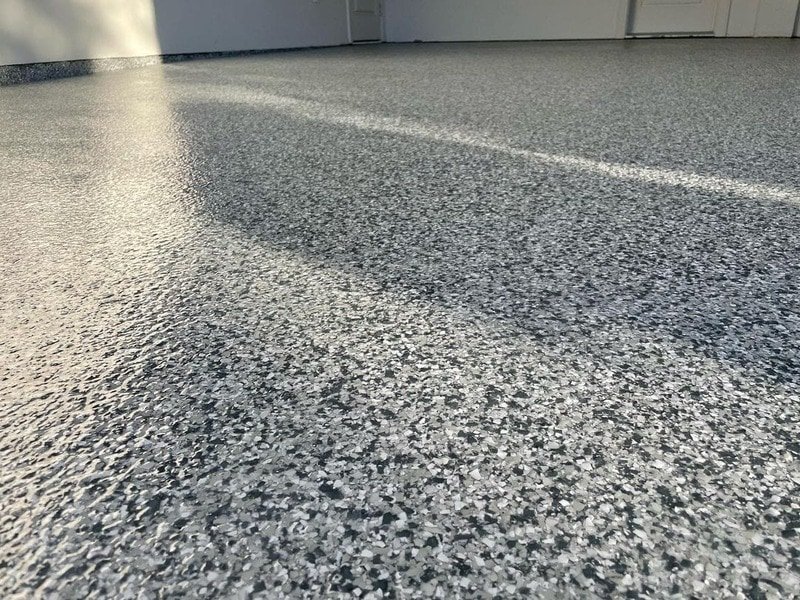
- Solid-colour chip systems — the most common residential application. A pigmented base coat is applied, broadcast with decorative flakes for texture and grip, then sealed with a polyurethane or polyaspartic topcoat. This is the standard approach for garage epoxy flooring installs.
- Metallic epoxy — a specialty system where metallic pigments are worked into a clear or tinted epoxy base while wet, creating a marbled, three-dimensional appearance. Often used in retail, showrooms, and residential spaces where the floor is meant to be a design feature. See our metallic epoxy flooring page for details.
- Commercial-grade systems — thicker coatings with greater compressive and chemical resistance, used in warehouses, food prep areas, and light manufacturing. May include anti-slip aggregates, cove base details at wall junctions, and chemical-resistant topcoats. Learn more on our commercial epoxy flooring page.
- Polyaspartic coatings — a resinous coating that cures faster than standard epoxy and offers strong UV stability. Commonly used as a topcoat in spaces with natural light exposure, or when a fast return-to-service timeline is a priority.
- Polished concrete — not epoxy, but often part of the same conversation. Instead of adding a coating, the concrete is ground and refined to a high-sheen finish. There's no topcoat to peel; once achieved, the surface is essentially permanent.
What does the epoxy floor coating installation process actually involve?
The installation process matters as much as product selection. A quality coating applied over a poorly prepared slab will fail. Here's what a proper installation looks like from start to finish:
- Surface inspection — the contractor checks for cracks, spalling, oil contamination, existing coatings, and moisture. Each affects what prep steps are needed before coating begins.
- Mechanical surface profiling — the concrete is abraded using diamond grinding or shot blasting to create a surface profile the epoxy can bond to. Acid etching alone isn't considered adequate for a bond that needs to last through years of use.
- Crack and defect repair — surface cracks and divots are filled and feathered before coating. Structural cracks need separate assessment; epoxy is a surface system, not a structural repair product.
- Primer or base coat — a penetrating primer or initial coat of epoxy goes down, often followed by a broadcast of decorative chips or aggregates for texture.
- Topcoat — a clear polyurethane or polyaspartic topcoat seals the system. This is the sacrificial wear layer — it takes the scuffs and cleaning chemicals. High-traffic surfaces sometimes get two topcoats for added durability.
- Cure time — standard epoxy systems need at least a full day before foot traffic, and longer before vehicle traffic. Polyaspartic topcoats can often return to vehicle traffic the same day.
How long does an epoxy floor coating last in BC conditions?
With proper prep and a quality product, a residential garage epoxy system can last many years before the topcoat needs refreshing. The topcoat wears first; the base coat beneath it typically stays bonded well past the point the surface looks tired.
What shortens the lifespan most in Lower Mainland conditions:
- Hot tire pickup — vehicle tires heat up during driving, and parking a hot tire on an inadequately formulated or under-cured epoxy can cause the surface to lift. Higher-quality polyaspartic topcoats are significantly more resistant to this.
- Road salt and deicers — tracked in from Burnaby streets after winter treatment. Less of an issue here than in colder regions, but abrasive sand-salt mixes can wear a topcoat faster if they're not cleaned off regularly.
- UV exposure — standard epoxy yellows under direct sunlight. If your garage gets significant UV through an open or glazed door, a UV-stable polyaspartic topcoat is worth specifying.
- Poor original surface prep — the most common failure mode by far. Delamination in the first year or two almost always traces back to inadequate surface profiling or moisture that wasn't properly addressed before the coating went down.
What does epoxy floor coating cost in Burnaby?
Pricing in the Metro Vancouver market varies based on the system specified, the condition of the existing slab, the square footage involved, and site-specific factors like access and scheduling constraints.
In general, a basic chip-system garage floor costs less per square foot than a multi-layer commercial system or a decorative metallic application with a high-gloss finish. Slab repairs, moisture mitigation primers, and expedited timelines can all affect the total.
Actual costs vary based on project scope, substrate condition, and site access — contact FraserPlus Epoxy for a personalized assessment.
When comparing quotes, a very low number can sometimes indicate thinner product, fewer coats, or less rigorous surface prep. It's worth asking any contractor what concrete surface profile they're targeting, whether they test for moisture before installation, and what the mil thickness of the finished system is. The answers tell you a lot about whether you're actually comparing the same thing.
How do you find a reliable epoxy floor coating contractor in Burnaby?
The Metro Vancouver and Fraser Valley market has operators ranging from established resinous flooring contractors to generalists who've completed a handful of kit installs. Here's what to look for when vetting:
- Surface prep method — ask specifically whether they use diamond grinding or shot blasting. Acid etching only is a flag for a less rigorous installation.
- Moisture testing — ask whether they test moisture vapour emission rate before pricing and before application. If they're not familiar with what that is, look elsewhere.
- Product specification in writing — get the actual product brand and system in your quote, not just "epoxy." There's a real performance gap between a commodity floor paint and a commercial-grade two-part system with a specified topcoat.
- Completed project references — local installs with before-and-after photos help you assess workmanship quality for your climate and substrate type.
- Warranty terms — understand what's covered and for how long. Most legitimate contractors warrant against delamination due to workmanship defects for a defined period after installation.
FraserPlus Epoxy serves Burnaby and the broader Metro Vancouver and Fraser Valley area. You can review our full range of floor coating services or get in touch to discuss your project.
FAQ: Epoxy Floor Coating in Burnaby, BC
Can epoxy be applied over an existing coating or paint on a concrete floor?
Yes, but the old coating typically needs to come off first. Applying new epoxy over old, failing paint usually results in the same delamination problem carrying forward. Diamond grinding removes existing coatings while simultaneously creating the surface profile needed for adhesion. Your contractor should assess the existing surface as part of the quoting process.
How do I prepare my garage before the installer arrives?
Clear the entire space — vehicles, shelving, tools, and stored items all need to be out. The installer needs unobstructed access to every part of the floor. If there are significant oil stains, let your contractor know beforehand so they can plan the appropriate degreasing or mechanical removal step. Oil contamination can interfere with adhesion if it's not properly addressed in the prep phase.
Is epoxy floor coating slippery when wet?
A plain high-gloss topcoat can be slippery when wet. Most residential and commercial systems include anti-slip aggregates — typically aluminum oxide or silica broadcast into the topcoat before it cures. In a BC garage where you're walking in with wet boots much of the year, it's worth confirming with your contractor that an anti-slip aggregate is included in the system specification.
Can epoxy be used on outdoor concrete in Burnaby — driveways, patios, or exposed balconies?
Standard epoxy doesn't perform well outdoors. UV exposure causes yellowing and surface breakdown, and exterior slabs experience more temperature-driven movement than interior floors. For outdoor concrete surfaces, polyurea or polyaspartic coatings specifically rated for exterior exposure are a better choice. Ask your contractor to confirm the product is designed for outdoor use if that's part of your project scope.
Follow FraserPlus Epoxy on Google — be the first to know about floor coatings, maintenance guides, and project ideas across Metro Vancouver.
Make us your preferred source on Google