
BC Epoxy Flooring Installation Costs
Quick Takeaways
- Surface preparation — not the product — is the single biggest factor in how long an epoxy floor lasts.
- BC's damp climate means moisture testing before installation isn't optional; it's essential.
- Ask about product specs, system thickness, and cure times before agreeing to any quote.
- A local installer with experience in Metro Vancouver and the Fraser Valley understands the substrate and climate conditions specific to your area.
Searching for epoxy flooring installers near you in Metro Vancouver or the Fraser Valley turns up a lot of names fast. The hard part isn't finding options — it's knowing what separates a floor that holds up for years from one that starts peeling before the second winter. This guide covers what to look for, what questions to ask, and why local experience matters for this type of work.
What Does an Epoxy Flooring Installer Actually Do?
An epoxy flooring installer prepares a concrete substrate and applies one or more layers of resinous coating to create a durable, easy-to-clean surface. The prep work — diamond grinding, shot blasting, crack repair — typically takes more time than the application itself.
A full system usually includes a primer, a build coat, sometimes a decorative broadcast layer (chips, quartz, or metallic pigment), and a clear topcoat. Each layer has a curing window. Skipping steps or rushing the cure is one of the most common causes of early failure, so the sequence matters as much as the product choice.
Why Does It Matter Which Installer You Choose?
Epoxy flooring isn't a licensed trade the way plumbing or electrical work is in BC. That means anyone can call themselves an installer, and the range of quality is wide — from professional-grade commercial systems applied by crews who specialize in resinous flooring, to big-box-store coating kits applied by general contractors who rarely work with the product.
The difference becomes obvious over time. A properly installed floor bonds tightly to the concrete and stays that way through temperature changes, vehicle traffic, and years of cleaning. A poorly prepped surface — or the wrong product for the conditions — tends to bubble, peel, or crack within a few years. The cost of redoing a floor is almost always higher than the cost of getting it right the first time.
For an overview of the systems and services available locally, see the FraserPlus Epoxy services page.
What Should You Ask Before You Book?
A few questions will tell you most of what you need to know about a prospective installer:
- How do you prepare the surface? Mechanical prep — diamond grinding or shot blasting — is the professional standard. Acid etching alone doesn't create the surface profile needed for long-term adhesion.
- What product are you using? Ask for the technical data sheet. A qualified installer won't hesitate to share it.
- What's the total system thickness? The answer should come in mils. Thicker systems handle more traffic and abuse. The right thickness depends on how the space will be used.
- Do you test for moisture? This step is non-negotiable in BC. Concrete that reads above the allowable threshold will cause adhesion failure regardless of product quality.
- What does your warranty cover? Ask specifically what voids it — and what it covers — before work begins.
Getting clear, specific answers — and getting them in writing — gives you real recourse if something goes wrong later.
What's the Difference Between Garage, Commercial, and Metallic Epoxy?
Not all epoxy systems are built for the same environment. Choosing the right one matters more than most people expect going in.
Garage epoxy has to stand up to vehicle traffic, dripping fluids, and the temperature swings that come with an attached or detached garage in BC. A proper garage system uses a moisture-tolerant primer and a UV-stable topcoat so it doesn't yellow from sunlight exposure. See the garage epoxy flooring page for detail on what a full residential system involves.
Commercial epoxy systems are built for heavier demands — forklift loads, chemical spills, food-safe environments, or sustained high foot traffic. The product specs (compressive strength, chemical resistance, slip resistance rating) are more demanding than a residential system. For commercial and industrial applications, the commercial epoxy flooring page covers common use cases in the region.
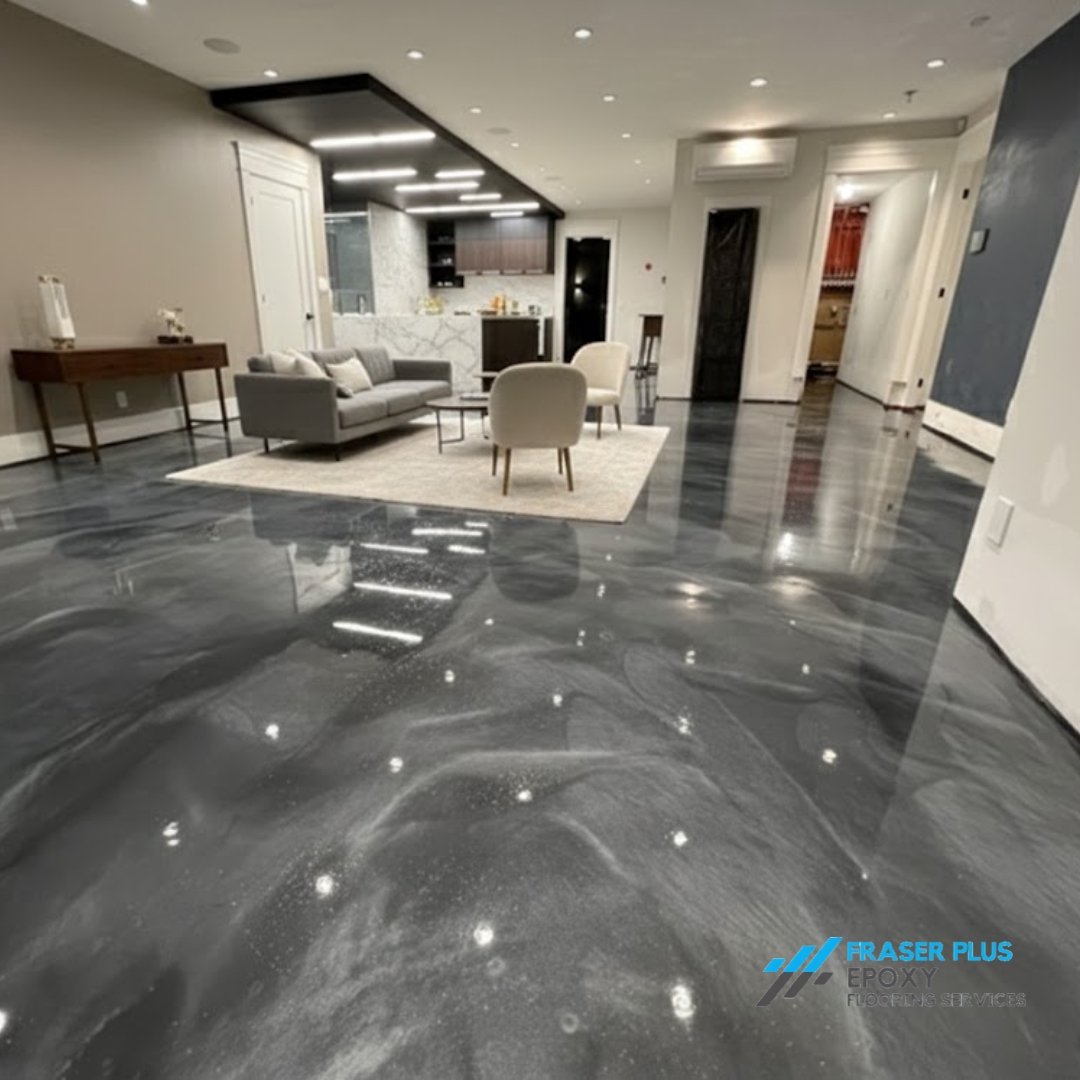
Metallic epoxy uses metallic pigments suspended in resin to create a fluid, three-dimensional appearance. It's popular for showrooms, gyms, and high-end residential spaces. The application technique is more involved than a standard chip or solid-color system, so it requires an installer with hands-on experience in that specific product type.
Polished concrete is a separate category — rather than adding a coating, the slab is ground and honed in progressive stages to reach a desired sheen. It's a strong option for spaces where a natural, low-build look is the goal, provided the existing slab is in reasonable condition to start.
How Does BC's Climate Affect Epoxy Installation?
Metro Vancouver and the Fraser Valley have a damp, temperate climate, and that creates conditions that don't apply in drier regions.
Concrete moisture is the main concern. Slabs in BC — especially in older homes, grade-level pours, or spaces with poor drainage around the foundation — often retain more moisture than contractors in drier climates would expect. Epoxy applied over a slab that reads above the allowable moisture threshold will delaminate. A qualified local installer will run a moisture test before selecting a system or starting any application work.
Temperature also matters. Epoxy products have minimum application temperatures, and an unheated garage in the Fraser Valley in late fall or winter can push close to that limit. An installer who works in this region year-round knows how to handle this — through space heating, adjusted product selection, or scheduling the work in a warmer window. If you're in the South Fraser area, the Surrey service area page has relevant local context on working conditions and coverage.
How Do You Compare Quotes from Different Installers?
If you're getting multiple quotes — which is worth doing — make sure you're comparing like for like. A lower number doesn't always mean a better deal when the scope is different.
Look at what surface prep method is included and how it's described. Ask for the product name and the data sheet if it isn't offered upfront. Check how many coats the system involves, what the finish layer is (epoxy, polyaspartic, and polyurethane all have different wear properties), and what service life the installer expects for that system in your specific use case. A quote that skips mechanical prep or uses a lighter-grade product will often come in lower — and it typically reflects exactly that tradeoff.
Actual costs vary based on project scope, substrate condition, and site access — contact FraserPlus Epoxy for a personalized assessment.
How Do You Maintain an Epoxy Floor After Installation?
One of the main reasons people choose epoxy over bare concrete is how easy it is to keep clean. A few consistent habits go a long way toward keeping the floor looking good long-term.
Sweep or dust-mop regularly. Grit tracked in from outside acts like fine sandpaper on the topcoat over time. For washing, a neutral-pH cleaner and a soft mop are all you need — avoid strong acids or solvents, which can dull the finish. In garages, wipe up oil or chemical spills before they have time to sit on the surface.
In high-use commercial spaces, the topcoat may need refreshing over time — that's by design. It's the sacrificial wear layer, and re-coating it is far less disruptive and expensive than replacing the full system. Your installer should be able to give you a realistic picture of expected service intervals for your specific application and traffic level.
Ready to talk through your project? Contact FraserPlus Epoxy for a no-obligation site assessment.
Frequently Asked Questions
How long does epoxy flooring take to install?
Most residential garage floors take two to three days, including prep, application, and cure time between coats. Larger or more complex commercial projects take longer. Your installer should give you a specific timeline before work starts so you can plan around the space being out of use.
Can epoxy be applied over an existing floor coating?
Generally, no. Most professional installers will grind off any existing coating before applying a new system. Bonding epoxy over an unknown or failing layer creates an adhesion risk that typically shows up later as delamination — and it's a much more involved fix the second time around.
Is epoxy flooring slippery when wet?
A smooth topcoat can be slippery when wet. Anti-slip additives — fine quartz or aluminum oxide — are broadcast into the topcoat during application to add grip without significantly changing the appearance. This is worth asking about for any space near a garage entry, a commercial kitchen, or anywhere that regularly sees water on the floor.
How long does epoxy flooring last?
A properly installed system in a residential garage can last many years with basic maintenance. Commercial floors under heavier traffic see more wear on the topcoat and may need re-coating sooner. The prep quality, product specified, and how the space is used are the main factors in long-term performance — not any single number.
Follow FraserPlus Epoxy on Google — be the first to know about floor coatings, maintenance guides, and project ideas across Metro Vancouver.
Make us your preferred source on Google