
Epoxy Flooring Near Me: A Metro Vancouver Buyer's Guide
Quick Summary
- Epoxy and resinous coatings bond to concrete and create a hard, chemical-resistant surface — well-suited to BC garages, workshops, and commercial spaces.
- Different systems — chip-broadcast epoxy, metallic epoxy, and polished concrete — suit different needs and substrates.
- Proper surface preparation is the single biggest factor in how long a floor coating lasts.
- Because BC's humidity and substrate conditions affect cost and product choice, a local site assessment is more useful than a national price guide.
What Does "Epoxy Flooring Near Me" Actually Mean?
When people search for epoxy flooring near them, they're usually looking for one of a few things: a garage floor that can stand up to oil drips, tire marks, and the salt and grit that comes with BC winters; a commercial space that's hygienic, durable, and looks professional; or a decorative metallic or polished concrete finish for a showroom, basement suite, or renovation project.
"Epoxy flooring" gets used as a catch-all, but the category covers several distinct products — standard two-part epoxy systems, polyaspartic coatings, polyurethane topcoats, and full resinous systems are all part of it. A qualified installer will match the right product to your specific floor, intended use, and budget rather than applying a one-size-fits-all solution.
Why Does Location Matter When Searching for an Epoxy Installer?
Concrete and floor coatings respond to their environment. In Metro Vancouver and the Fraser Valley, that means high ambient humidity for much of the year, significant temperature swings between seasons, and garage slabs that often sit on grade — meaning they're exposed to moisture pressure from below as well as above.
A contractor who understands local conditions knows how to test for moisture vapour transmission before coating, how to time applications around BC's wet seasons, and which products perform well in the kind of damp, grit-tracked-in conditions this climate produces. Hiring locally also makes warranty service and any follow-up visits far more practical than working with a national company whose nearest crew may be hours away.
What Types of Epoxy Flooring Are Available?
The most common options you'll come across when looking for a floor coating installer include:
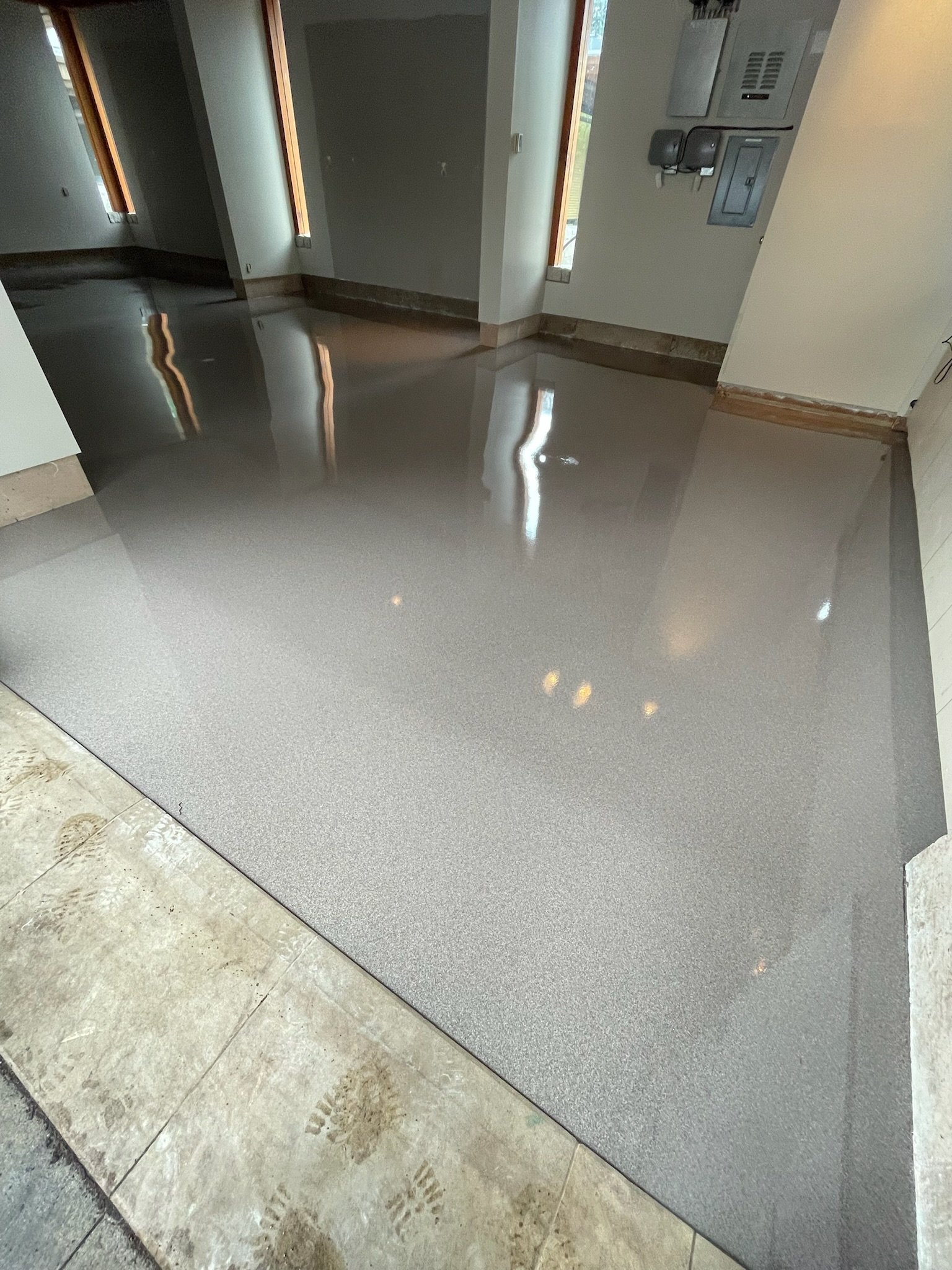
- Standard broadcast epoxy: A base coat, coloured chip broadcast, and clear topcoat. Hard-wearing and straightforward, it's a popular choice for garages and light commercial use. The chips add texture and help disguise minor surface marks over time.
- Metallic epoxy: Metallic pigment suspended in resin creates swirling, three-dimensional visual effects. Commonly used in retail, hospitality, and residential spaces where appearance matters as much as durability.
- Solid-colour epoxy: A clean, uniform finish often specified for commercial kitchens, warehouses, and industrial environments where hygiene or chemical resistance is the priority.
- Polished concrete: The slab itself is ground and refined through progressive diamond-grit passes rather than coated. The result is a low-maintenance surface with a long service life, increasingly common in open-plan commercial builds and modern residential spaces.
- Polyaspartic coatings: Fast-cure, UV-stable products that can be applied in cooler temperatures than standard epoxy — a practical advantage in BC's unpredictable shoulder seasons.
See the full range of flooring systems offered by FraserPlus Epoxy to compare options for your project.
Is My Concrete Slab a Good Candidate for Epoxy Coating?
Most concrete slabs can be coated, but the condition of the substrate directly affects how the coating performs. A slab with active moisture intrusion, significant cracking, or previous coating failures needs to be addressed before any new product goes down. Skipping that step is the most common reason epoxy floors peel or delaminate.
Good indicators that a floor is likely ready for coating:
- No active efflorescence (white salt deposits on the surface)
- Passes a basic water-absorption check — water shouldn't soak in instantly or bead up completely
- No hollow-sounding areas when tapped, which can point to delamination underneath
- Previous coatings have been fully removed or professionally assessed
A site visit before any quote is standard practice with reputable installers. Be cautious of any contractor who provides pricing without seeing the floor — substrate conditions vary too much to quote accurately from a photo or a square footage number alone.
What Should I Ask an Epoxy Contractor Before Hiring?
A few direct questions separate experienced installers from less reliable ones:
- What surface prep is included? Shot blasting or diamond grinding is the professional standard. Acid etching alone is generally considered insufficient for a lasting bond with modern epoxy systems.
- What product system are you specifying? The term "epoxy" covers a wide quality range. Ask for the manufacturer and product line so you can research it independently.
- How do you manage BC's humidity during application? Temperature, dew point, and concrete moisture content all affect adhesion. A knowledgeable contractor will have a specific protocol, not a vague answer.
- What's the cure and recoat window? For garages, you'll need to keep vehicles off the floor for a set period after installation. Know this before you schedule the job.
- Are you insured, and do you offer an installation warranty? An installation warranty — separate from the product manufacturer's warranty — reflects the contractor's confidence in their own workmanship.
What's the Difference Between Garage and Commercial Epoxy Flooring?
Both categories use resinous systems applied to concrete, but the expectations and specifications differ.
Garage epoxy flooring is designed for residential vehicle traffic, chemical exposure from oil, brake fluid, and road de-icers, and everyday domestic foot traffic. Decorative chip broadcasts are popular here — they add grip, hide small surface imperfections, and come in a wide range of colour combinations.
Commercial epoxy installations cover a much wider range: distribution warehouses, food processing facilities, healthcare environments, schools, and retail spaces all carry different hygiene, slip-resistance, and durability requirements. Many commercial projects specify faster-curing products to reduce downtime, and some need to meet specific building or health code standards. Working with a contractor experienced in both residential and commercial projects means you get a system sized correctly for your actual use case.
How Much Does Epoxy Flooring Cost in the Lower Mainland?
Pricing varies considerably based on the system chosen, the size and current condition of the substrate, site access, and design complexity. A basic chip-broadcast garage system typically costs less per square foot than a full metallic or multi-layer commercial system, which requires more product, longer installation time, and more involved preparation. Polished concrete pricing depends heavily on how many grinding stages the slab requires and whether repairs are needed first.
National averages found online are rarely accurate for BC projects, where labour costs, local material pricing, and substrate conditions don't match those in other markets.
Actual costs vary based on project scope, substrate condition, and site access — contact FraserPlus Epoxy for a personalized assessment.
Why Choose a Local Fraser Valley or Lower Mainland Installer?
A contractor based in the Lower Mainland or Fraser Valley brings direct, practical knowledge of the building stock, slab types, and climate conditions that affect floor coatings here. They're also reachable for follow-up, warranty service, or advice on long-term care — which matters more than it might seem once your floor is actually in use.
National franchise systems often subcontract to local crews, which can mean variability in installer experience and a more complicated path back to accountability if something goes wrong. With a dedicated local installer, you know who's on-site and who to call with questions after the job is done.
Whether you're in Langley, Surrey, Burnaby, Coquitlam, or elsewhere in the Fraser Valley, reach out to FraserPlus Epoxy for a no-obligation site visit and assessment.
Frequently Asked Questions
How long does epoxy flooring last?
With proper surface prep and a quality product system, epoxy and resinous coatings can give many years of service in both residential and commercial settings. Longevity depends most on how well the substrate was prepared, the volume and type of traffic the floor sees, and how consistently it's maintained — not the coating brand alone.
Can epoxy be applied in winter in BC?
Most standard epoxy systems require minimum temperature and dew point conditions to cure correctly. Polyaspartic coatings are formulated to handle cooler temperatures and can extend the installation season. Your installer should assess concrete temperature and ambient humidity on the day of application — not just air temperature — before proceeding.
Is epoxy flooring slippery when wet?
A smooth-finish epoxy can be slippery when wet. Broadcast chip systems naturally add some texture, and anti-slip aggregate can be added to any clear topcoat for additional grip. For commercial kitchens, bathrooms, or any space with frequent wet conditions, slip resistance should be specified before the job starts rather than addressed after.
What's the best way to maintain an epoxy floor?
Day-to-day care is straightforward: sweep or vacuum regularly to remove grit that can scratch the surface, and damp-mop with a pH-neutral cleaner when needed. Avoid harsh solvents unless the product is specifically rated for them. For high-traffic garage floors, entry mats help reduce the amount of fine stone and debris tracked in from driveways and roads.