
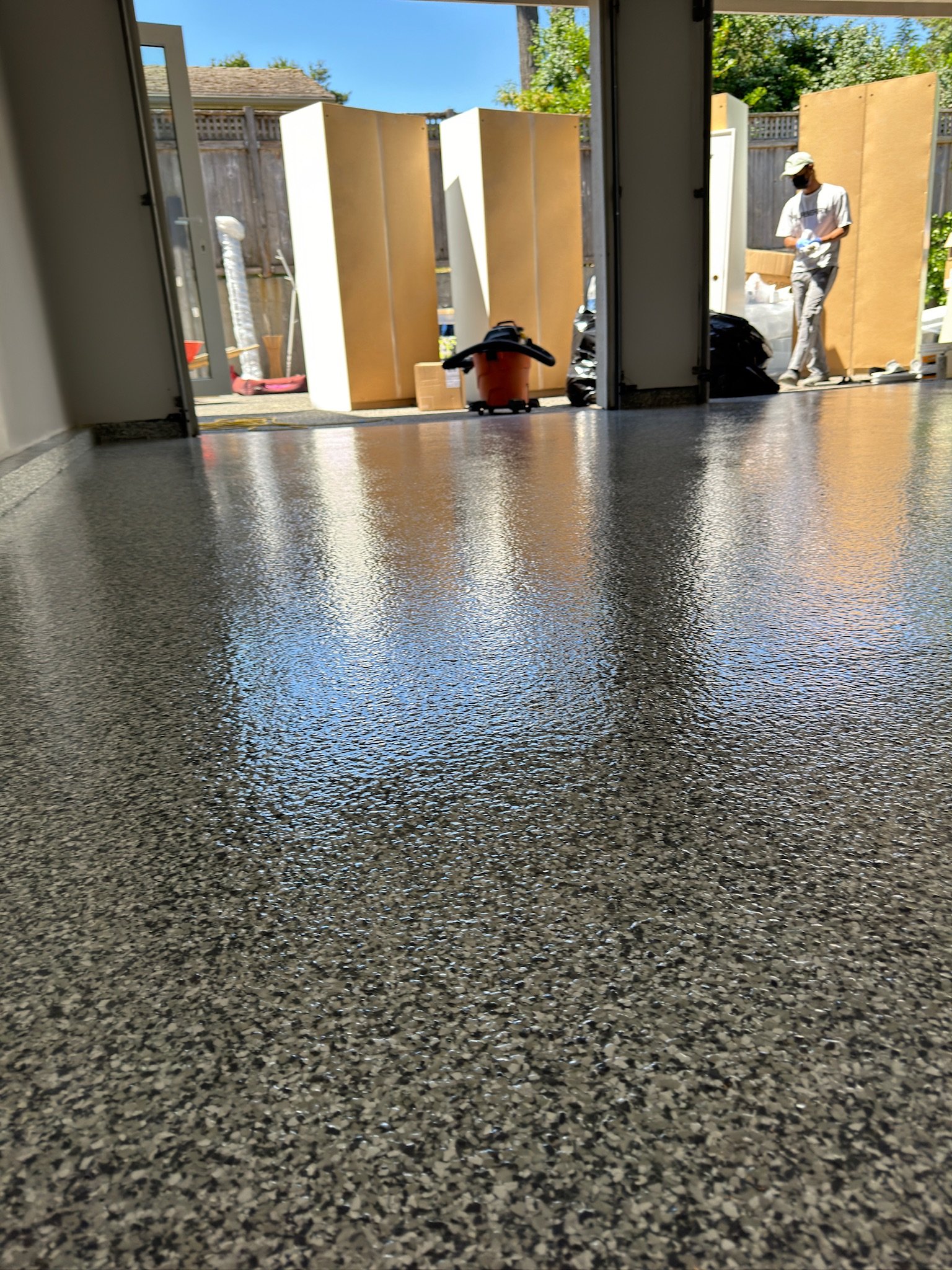
Best Epoxy Flooring in Vancouver: What to Look For
TLDR
- Epoxy flooring in Metro Vancouver requires moisture testing before any coating goes down — BC's wet climate makes slab moisture the top cause of early failures.
- Product quality varies widely; coating thickness and resin chemistry matter more than brand names.
- Professional installation includes diamond-grinding the concrete and applying multiple layers — steps that DIY kits consistently skip.
- FraserPlus Epoxy installs garage epoxy, commercial coatings, metallic epoxy, and polished concrete across Metro Vancouver and the Fraser Valley.
Searching for the best epoxy flooring in Vancouver quickly turns up a long list of options — and not much guidance on how to tell them apart. A garage floor coating that looks sharp on day one can peel, bubble, or delaminate within a single season if the prep work was skipped or the product wasn't matched to local conditions.
This guide covers what actually separates a durable epoxy floor from one that fails early, what to ask a contractor before signing anything, and what a professional installation should look like from start to finish.
What Makes Epoxy Flooring a Good Choice for Vancouver Homes and Businesses?
Epoxy flooring is a chemically cured resin system applied directly to a concrete substrate. Unlike paint, which sits on the surface, epoxy bonds into the concrete at a molecular level — which is what gives it durability under heavy foot traffic, vehicle loads, and chemical exposure.
In Metro Vancouver, epoxy floors are common in garages, commercial kitchens, retail spaces, warehouses, and auto shops. The surface handles wet boots, road salt, and motor oil that come with BC driving seasons. It's also easy to clean, which matters in commercial environments where health and safety codes apply.
For homeowners, a properly installed garage epoxy floor transforms a damp, dusty concrete slab into a finished surface that holds up to daily use and is significantly easier to maintain than bare concrete.
How Does BC's Climate Affect Epoxy Flooring Performance?
BC's Lower Mainland has one of the most moisture-intensive climates in Canada. Rainy winters, high ambient humidity, and concrete slabs sitting at or near grade all create conditions where moisture vapour transmission through the slab becomes a real concern.
Moisture in or beneath a concrete slab is the most common cause of epoxy delamination. When moisture vapour pushes up through the slab after the coating cures, it breaks the bond between epoxy and concrete — and the floor bubbles, peels, and eventually fails, regardless of how the product was priced.
Before any coating goes down, a qualified installer should perform a moisture vapour emission rate test or a calcium chloride test on the slab. If moisture levels are elevated, the system needs a moisture-tolerant primer or a dedicated mitigation layer before the topcoat. Skipping this step in the Lower Mainland is a significant installation risk that shows up months later — not on day one.
Temperature is also a factor. Epoxy is sensitive during cure. Most systems require the slab and ambient air to stay above a minimum threshold for the chemistry to complete correctly. In Fraser Valley and Metro Vancouver winters, scheduling installs with temperature control in mind is part of any professional plan.
What's the Difference Between Garage Epoxy and Commercial Epoxy Flooring?
Garage epoxy systems are designed for residential use — vehicle traffic, foot traffic, and the chemical exposure that comes with a working garage. A typical residential system is a two- or three-coat build: primer, body coat, and a UV-stable topcoat.
Commercial epoxy flooring is a different category. Systems used in warehouses, commercial kitchens, labs, or high-traffic retail environments are engineered for higher load ratings, more aggressive chemical exposure, and stricter cleanability standards. Thickness, slip ratings, and chemical resistance specs all differ by application.
A common mistake is applying a residential-grade system to a commercial environment. The floor may look fine initially, but it won't hold up under sustained commercial demands. A contractor who works across both categories should specify the right system for the actual environment — not apply the same product to every job.
What Is Metallic Epoxy Flooring, and When Does It Make Sense?
Metallic epoxy uses metallic pigments suspended in a clear or tinted resin carrier. The pigments shift and flow during application, creating a marbled, three-dimensional effect that varies across the surface. No two metallic floors look identical.
It's a popular choice for showrooms, restaurants, retail environments, and residential spaces where the floor is part of the design. The surface is durable and chemical-resistant — it just costs more per square foot than a standard solid-colour system because the application is more labour-intensive and the pigments add material cost.
If you're weighing a metallic epoxy floor for a Metro Vancouver space, the key question is UV exposure. Standard metallic epoxy can yellow under sustained direct sunlight. A UV-stable polyaspartic or polyurethane topcoat is essential in any space with significant natural light or south-facing windows.
What Should You Ask Before Hiring an Epoxy Flooring Contractor in Vancouver?
The quality of an epoxy installation is almost entirely determined by prep work and product selection — not by the brand name on the can. Before hiring anyone, get clear answers to these questions:
- How do you prepare the concrete? The correct answer is mechanical abrasion — diamond grinding or shot blasting. Acid etching alone isn't sufficient for proper adhesion on most residential and commercial slabs.
- Do you test for moisture? Any reputable installer in the Lower Mainland tests before they coat. If the contractor says it isn't necessary, that's a red flag.
- What's the total dry film thickness of the system? Thin coatings fail faster under traffic. A durable system is measured in mils, not just number of coats.
- What products are you specifying? Contractor-grade resins perform differently from DIY store kits. Ask for the product data sheet if you want to compare what you're actually getting.
- What does the warranty cover, and what voids it? Epoxy warranty terms often hinge on installation conditions — moisture levels, ambient temperature, and surface prep at time of application. Know what you're agreeing to before the work starts.
FraserPlus Epoxy serves Surrey, Burnaby, Langley, Coquitlam, Richmond, and the broader Metro Vancouver and Fraser Valley region. You can get a full on-site assessment at the contact page.
What Does a Professional Epoxy Floor Installation Actually Involve?
A properly done installation follows a consistent sequence. Here's what it should include:
- Surface inspection — checking the slab for cracks, spalling, oil contamination, previous coatings, and visible moisture issues.
- Concrete preparation — mechanical grinding with diamond tooling to open the concrete profile and remove contaminants. Cracks and divots are filled and feathered before coating begins.
- Moisture testing — MVER or calcium chloride testing to determine whether a moisture-mitigation primer is needed before the system goes down.
- Primer coat — a penetrating or moisture-tolerant primer establishes the bond layer between the concrete and the body coat.
- Body coat — the main epoxy layer, applied at the specified thickness. Decorative broadcast flake or metallic pigments are added at this stage if specified.
- Topcoat — a polyurethane or polyaspartic topcoat is applied for abrasion resistance, UV stability, and sheen. This layer protects the colour coat and carries most of the system's chemical resistance.
- Cure time — full cure takes several days. Light foot traffic is often possible sooner; vehicle traffic typically waits longer depending on the specific system.
A standard two-car garage typically takes one to two days on-site. Larger commercial projects or multi-system specifications take longer.
What Does Epoxy Flooring Cost in Metro Vancouver?
Pricing depends on several variables: the type of system, the size and condition of the slab, whether moisture mitigation is required, and the complexity of any decorative elements. Metallic and commercial systems generally cost more per square foot than a standard residential garage coating.
Slab condition adds cost when there's significant cracking, a previous coating that needs removal, or high moisture readings that require additional prep or mitigation layers. Getting a quote without an on-site assessment rarely reflects the actual project scope.
Actual costs vary based on project scope, substrate condition, and site access — contact FraserPlus Epoxy for a personalized assessment.
Frequently Asked Questions About Epoxy Flooring in Vancouver
How long does epoxy flooring last?
A properly installed residential garage system can last many years with basic maintenance — sweeping, occasional mopping, and avoiding harsh solvents on the surface. Commercial systems in high-traffic environments typically see more wear. The biggest factors are installation quality, coating thickness, and how the floor is maintained after it cures. Thin or improperly bonded systems fail much sooner regardless of the product used.
Can epoxy be installed over an existing garage floor coating?
In most cases, no. Applying epoxy over an existing coating without removing it creates a bond that can fail independently of the concrete. A proper installation typically requires grinding back to bare concrete. If a previous coating is in good condition and strongly bonded, some systems can go over it — but this needs to be assessed on-site, not assumed based on how the floor looks to the eye.
Is epoxy flooring slippery when wet?
Standard high-gloss epoxy can be slippery when wet, which is a real consideration in Metro Vancouver garages where wet boots and rain are a constant. Anti-slip additives — typically aluminum oxide or fine aggregate — can be broadcast into the topcoat to improve traction without significantly changing the appearance. Most residential and commercial installations in the Lower Mainland include some level of slip-resistance treatment in the spec.
Can a damaged epoxy floor be repaired without recoating the whole thing?
Localized chips or gouges can often be repaired without redoing the entire floor, depending on the system and how well the repair integrates with the surrounding colour. Delamination — where the coating lifts away from the substrate — is a more involved repair that typically requires grinding back to concrete and reapplying the affected section. Repaired areas may show some variation in sheen compared to the original installation, especially on high-gloss metallic systems.
Follow FraserPlus Epoxy on Google — be the first to know about floor coatings, maintenance guides, and project ideas across Metro Vancouver.
Make us your preferred source on Google