
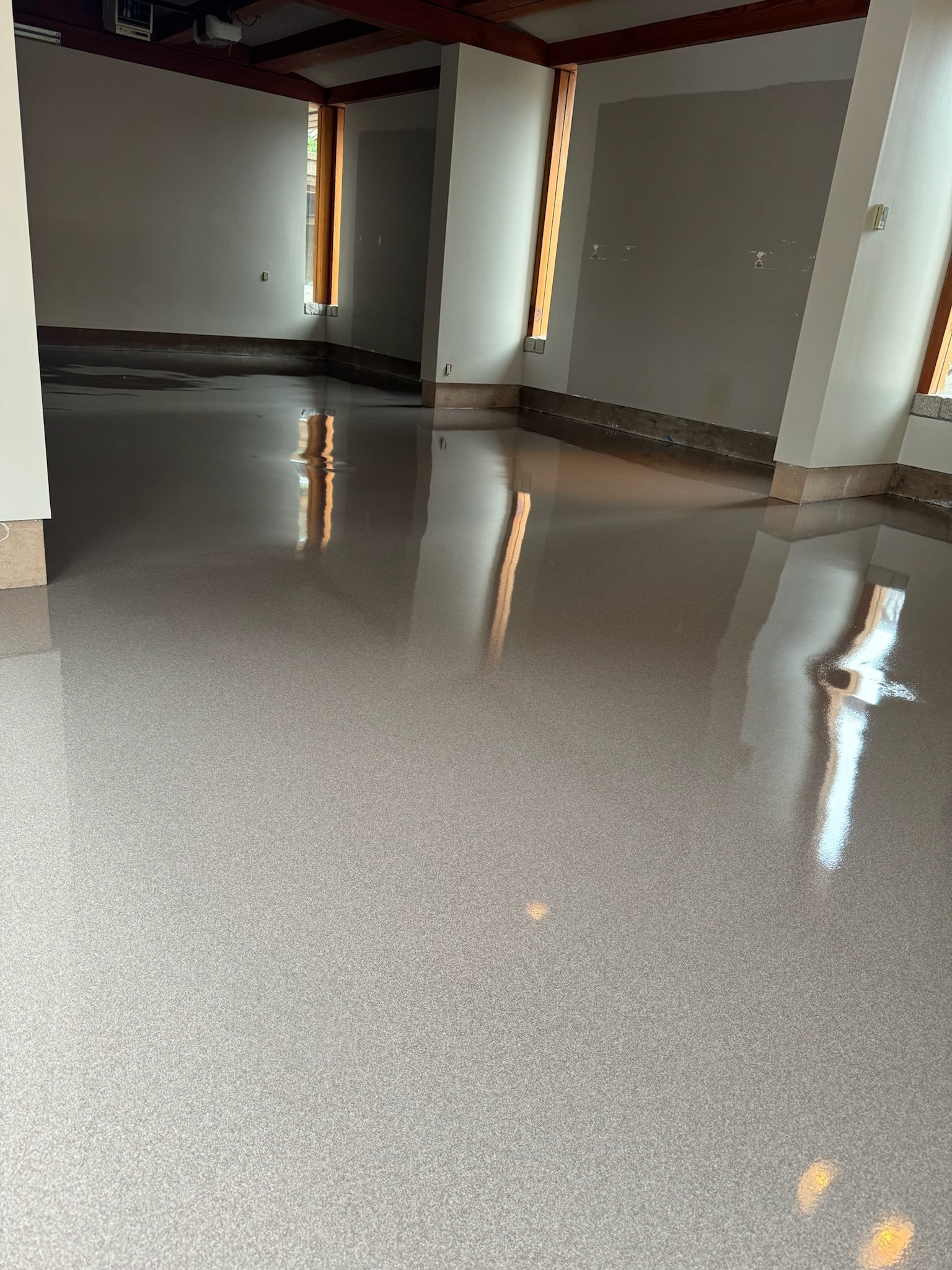
How Chemical Resistant Epoxy Coating Installation Works
Chemical resistant epoxy coating installation turns a plain concrete floor into a surface built to handle oils, solvents, acids, and industrial cleaners without breaking down. It's a different job than a standard showroom or garage epoxy floor — the resin system, the surface prep, and the topcoat all change depending on which chemicals the floor needs to stand up to. Getting the sequence right, and choosing the correct resin system for the specific exposure, is what determines whether a floor holds up for years or starts breaking down within months.
Key Takeaways
- Chemical resistant epoxy isn't one product — the resin system is chosen based on the specific chemicals, concentrations, and exposure time the floor will see.
- Surface preparation, including concrete profiling and moisture testing, has as much influence on long-term performance as the coating itself.
- Installation happens in layers — primer, base coat, and a chemical-resistant topcoat — with cure time between each step.
- A floor can look finished well before it's actually ready for full chemical or vehicle traffic.
What Makes an Epoxy Coating "Chemical Resistant"?
All epoxy coatings resist some level of everyday spills and cleaning products. "Chemical resistant" epoxy refers to formulations built for sustained contact with harsher substances — degreasers, solvents, acids, or caustic cleaning agents — without softening, staining, or delaminating.
Standard epoxy resin handles occasional mild exposure fine. For more aggressive chemical environments, contractors often move to a novolac epoxy or a urethane-based topcoat, which are formulated with different cross-linking chemistry to hold up under repeated harsh exposure. The right system depends on exactly what the floor will be exposed to, not just how much traffic it sees. For commercial and industrial sites, this decision usually gets made as part of a broader commercial epoxy flooring plan rather than picked off a shelf.
Which Floors Actually Need Chemical Resistance?
Chemical resistant coatings show up most often in mechanic and auto repair shops, warehouses, manufacturing floors, food and beverage prep areas, and labs — anywhere a floor regularly contacts degreasers, fuels, solvents, or industrial cleaning chemicals. In a food and beverage facility, that might mean routine exposure to acidic cleaning solutions and steam cleaning; in a lab, it might mean occasional contact with specific reagents. Either way, matching the coating to the actual exposure list is worth confirming before the resin gets ordered.
Home garages can fall into this category too, especially where a homeowner works on vehicles regularly and the floor sees brake fluid, motor oil, or automotive solvents on a routine basis. A standard garage epoxy floor handles typical parking and light DIY use, but heavier automotive work is worth flagging during the quote so the right resin system gets specified up front.
How Does Chemical Resistant Epoxy Coating Installation Work?
The process follows the same general sequence as any epoxy floor system, with extra attention paid to prep and product selection at each stage:
- Assessment — the contractor identifies which chemicals the floor will be exposed to, how often, and at what concentration, since this drives resin selection.
- Surface preparation — mechanical grinding or shot blasting opens the concrete's surface profile so the coating can bond properly, and any existing coating or contamination gets removed.
- Moisture testing — slab moisture is checked before any coating goes down, since trapped vapor is a common cause of delamination later.
- Repairs — cracks, joints, and pitted areas get patched so the new system has a sound base.
- Primer — a bonding or moisture-mitigating primer coat, depending on what the slab testing shows.
- Base coat — the body of the system, sometimes with broadcast aggregate for texture and added thickness.
- Chemical-resistant topcoat — the final layer engineered for the specific chemical exposure identified during assessment.
Application areas typically need ventilation during the process, since resin systems involve some odor and off-gassing until they cure.
What Surface Preparation Does a Chemical Resistant Floor Need?
Prep work matters more on a chemical resistant floor than on a standard decorative one, because a coating that fails to bond properly will fail exactly where it's under the most stress — at chemical contact points.
Diamond grinding or shot blasting creates a surface profile the coating can key into. Any old coating, oil staining, or curing compound left on the slab gets removed at this stage, since none of those bond well with new epoxy. On older slabs, especially those without a vapor barrier, moisture testing — calcium chloride testing or an in-situ relative humidity probe — tells the contractor whether a moisture-mitigating primer is needed before anything else goes down. Metro Vancouver's damp climate makes this step worth taking seriously rather than skipping.
How Long Does Installation and Cure Take?
Cure time depends on the specific product, the number of layers, and the ambient temperature and humidity on site — there's no single timeline that applies to every job. Most systems reach light foot-traffic readiness well before they reach full chemical and vehicle-traffic readiness, so a floor that looks and feels finished may still need more time before it's put back into heavy use.
Cooler, damp conditions — common in the Fraser Valley through fall and winter — can extend cure windows compared to a warm, dry summer install. A contractor working from the specific product's technical data sheet will set the actual schedule, including when the space can reopen for light use versus full operation.
What Does Chemical Resistant Epoxy Coating Installation Cost?
Cost depends on several factors: the resin system required for the chemicals involved, the square footage, how much surface prep and repair the existing slab needs, whether an old coating has to come out first, and how much the job has to work around an active business's schedule and site access. Systems that include broadcast aggregate or added film thickness for heavier-duty environments typically involve more material and labor than a thinner decorative system, which is another variable priced on a site-by-site basis. Actual costs vary based on project scope, substrate condition, and site access — contact FraserPlus Epoxy for a personalized assessment.
How Do Metro Vancouver and Fraser Valley Conditions Affect the Job?
The region's coastal climate means higher ambient humidity for more of the year than many other parts of the country, which is part of why moisture testing and cure scheduling get more attention here than they might in a drier climate. Older commercial and industrial buildings, common across cities like Surrey, often have slabs poured without a modern vapor barrier, so a proper site assessment before quoting matters as much as the coating spec itself.
Industrial and commercial parks throughout the region also see a mix of vehicle traffic, forklift use, and chemical exposure on the same floor, which is another reason the resin system gets matched to the specific site rather than applied as a one-size answer.
FAQ
How long does a chemical resistant epoxy floor need to cure before it's back in use?
It depends on the product and the site's temperature and humidity. Light foot traffic is usually possible sooner than full chemical or vehicle traffic — the contractor's schedule, based on the product's data sheet, is the accurate answer for a given job.
What's the difference between standard epoxy and chemical resistant epoxy?
Standard epoxy holds up fine against everyday foot traffic and occasional mild cleaning products. Chemical resistant formulations, like novolac epoxy or certain urethane topcoats, are built with different resin chemistry to withstand sustained exposure to harsher solvents, acids, or industrial chemicals.
Can a chemical resistant coating go over an existing floor coating?
Sometimes, but it depends on the condition and type of what's already down. In many cases the old coating needs to be mechanically removed or profiled first so the new system bonds correctly — that gets assessed on site rather than assumed, and a mismatched system can fail early.
Does a chemical resistant epoxy floor need special maintenance?
General good practice applies: use cleaning products that are compatible with the coating, avoid letting spills sit longer than necessary, and clean up chemical spills promptly rather than waiting. Checking with the installer for any product-specific cleaning guidance is worth doing before the floor goes into daily use.
For a floor that has to stand up to real chemical exposure, not just occasional spills, the right approach starts with an on-site assessment rather than a generic spec. FraserPlus Epoxy's flooring services cover garage, commercial, and metallic epoxy systems across Metro Vancouver and the Fraser Valley; reach out to talk through what a specific floor needs.
Follow FraserPlus Epoxy on Google — be the first to know about floor coatings, maintenance guides, and project ideas across Metro Vancouver.
Make us your preferred source on Google