
How to Pick an Epoxy Contractor in Metro Vancouver
TL;DR
- Local epoxy companies install resinous coatings and polished concrete for garages, commercial spaces, and industrial floors.
- Surface preparation — not the coating itself — is the biggest predictor of how long an epoxy floor lasts.
- Metro Vancouver's wet climate and concrete moisture levels make substrate assessment an important part of any honest quote.
- Compare contractors on prep method, coating system, and warranty terms, not on price alone.
What Does an Epoxy Company Near Me Actually Do?
Epoxy contractors install resinous floor coatings over concrete substrates. The work covers residential garage floors, commercial warehouses, retail showrooms, industrial facilities, and everything in between. A full installation includes mechanical surface preparation, primer application, the main coating or broadcast system, and a protective topcoat.
In Metro Vancouver and the Fraser Valley, a coated floor also serves a practical purpose tied to the climate. BC's wet winters mean garage floors regularly see tracked-in water, road salt, and de-icing chemicals. A well-installed epoxy floor sheds moisture and resists chemical damage far better than bare concrete.
What Types of Flooring Does an Epoxy Contractor Install?
Most full-service epoxy companies offer several coating systems. The right choice depends on how the space is used, the condition of the slab, and the finish you're after.
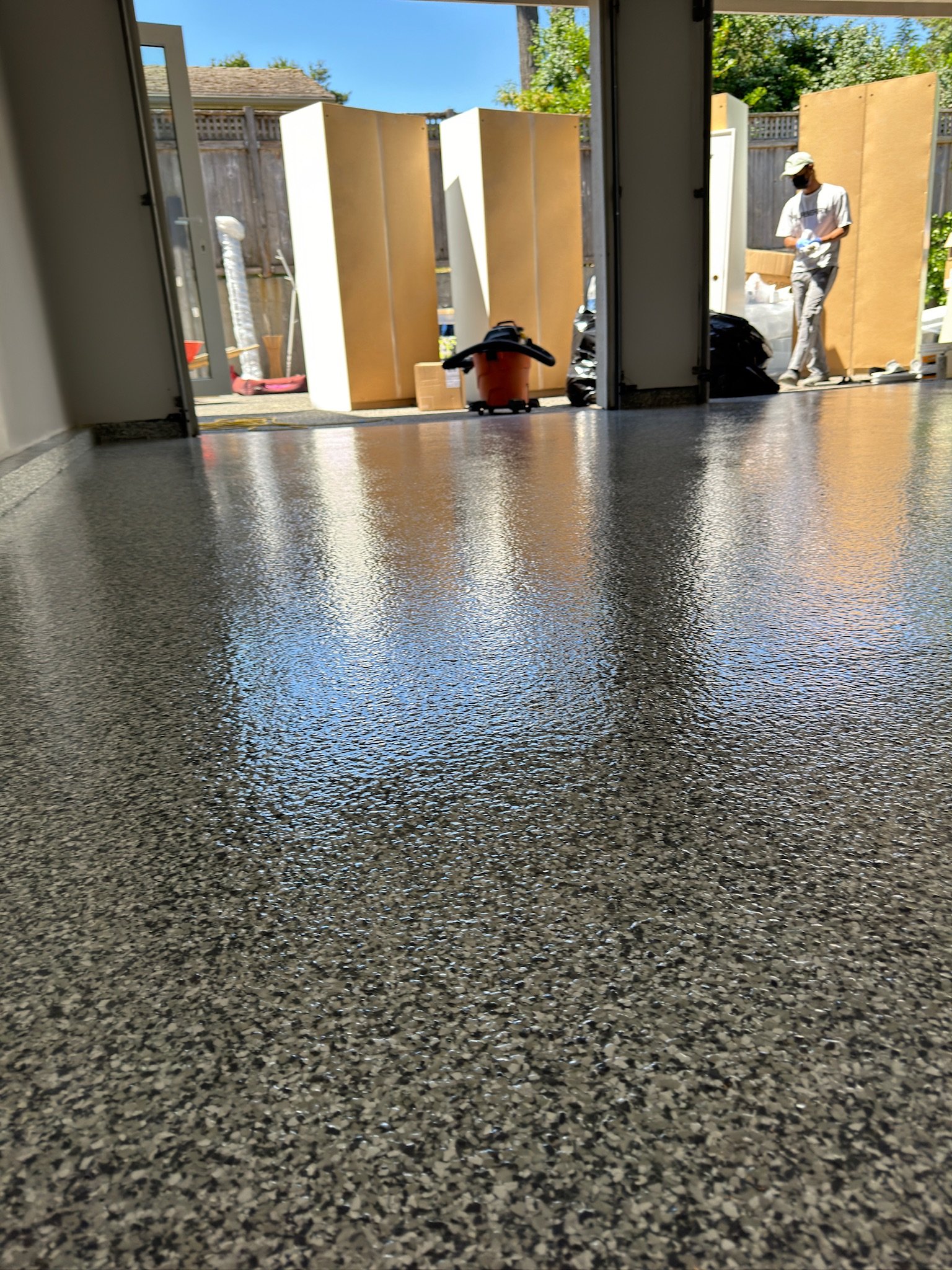
Garage floor epoxy is the most common residential request. Solid-colour systems and decorative flake broadcasts create a finished, easy-to-clean surface that stands up to vehicle traffic, tire marks, and fluid spills. Learn more on our garage epoxy flooring page.
Metallic epoxy uses pigments suspended in a clear epoxy base to produce swirling, three-dimensional visual effects. It's used in showrooms, salons, restaurants, and retail spaces where the floor is part of the design. See our metallic epoxy flooring page for examples of finished work.
Commercial and industrial epoxy systems are built for high-traffic and chemical-resistance needs. Auto shops, food-production facilities, warehouses, and healthcare settings often specify heavier-mil systems, sometimes with slip-resistant aggregates. Our commercial epoxy flooring page covers the most common applications.
Polished concrete is a different process entirely. The slab is mechanically ground and refined with progressively finer diamond tooling, then densified and sealed. No coating film is added. The result is a low-maintenance, high-sheen floor that's popular in retail and open-plan commercial settings.
FraserPlus Epoxy installs all of these systems across Metro Vancouver and the Fraser Valley. You can explore the full range on our flooring services page.
How Do You Evaluate an Epoxy Company Near You?
Not every floor coating contractor follows the same process or uses the same products. Here's what to pay attention to when you're comparing options.
Surface preparation is the most critical factor. A professional installation starts with mechanical prep — diamond grinding or shot-blasting — to open the concrete's pores and create a profile that the coating can bond to. Contractors who skip this step, or rely only on acid etching over previously coated or painted slabs, often produce floors that peel within a year or two. Ask specifically what prep method they use for your slab type and its current condition.
Ask about the coating system itself. "Epoxy" covers a wide range of products. Waterborne systems have lower solids content and thinner film build. Solvent-borne and 100%-solids systems are thicker and generally more durable under heavy use. The right product depends on how the space is used. Ask for the product name and technical data sheet if you want to compare apples to apples.
Moisture is a serious variable in Greater Vancouver. High moisture vapour emissions from slabs — common in older construction and in garages built over crawlspaces — can cause adhesion failures in standard epoxy systems. A qualified contractor will ask about moisture or test the slab before recommending a coating system. This isn't an upsell; it's due diligence.
Get the cure timeline in writing. Epoxy systems require time between coats and full cure before the floor can handle vehicle traffic. If you're coordinating around a business schedule or a move-in date, you need those timelines confirmed before the job starts.
What Should You Ask Before Signing a Quote?
Comparing quotes is easier when you ask consistent questions across all contractors. These cover the essentials:
- What surface preparation method do you use, and how do you handle previous coatings or sealers?
- What's the total dry film thickness of the finished system?
- How many coats are included, and what are the specific products?
- How do you handle concrete cracks, spalling, or uneven areas before coating?
- What does the warranty cover, and who backs it — the installer, the manufacturer, or both?
- What's the expected cure timeline before vehicle traffic is permitted?
Getting clear answers to these questions lets you compare contractors on more than price. Two quotes at similar numbers can represent very different scopes of work and product quality.
How Much Does an Epoxy Floor Cost in Metro Vancouver?
Cost varies based on the coating system, the square footage, the condition of the existing slab, the type of surface preparation required, and any decorative options you choose. A basic single-colour garage system is a different project from a full metallic epoxy commercial installation with broadcast aggregate and a high-build topcoat.
Rather than publish a range that may not reflect your specific slab or situation, we'd rather be direct: every project is quoted after a proper site assessment. Actual costs vary based on project scope, substrate condition, and site access — contact FraserPlus Epoxy for a personalized assessment.
If you're in an early planning stage, getting two or three detailed quotes from local contractors is the most reliable way to understand what a project like yours costs in the current Metro Vancouver market.
Does Concrete Condition Affect Whether Epoxy Will Bond Properly?
Yes, significantly. Epoxy bonds to prepared concrete — not to other coatings, sealers, contamination, or weak surface layers. If your slab has a previous coating, paint, or penetrating sealer, those layers need to be mechanically removed before a new system can be installed correctly.
Cracks, spalling, and uneven areas require attention before any coating goes down. Most contractors can fill hairline and structural cracks as part of the prep process. Deep or actively moving cracks — caused by heaving, tree-root pressure, or settlement — may need a separate structural assessment first. In the Fraser Valley, frost-heave in older slabs is worth flagging early in any conversation with a contractor.
High-moisture slabs may require a moisture-tolerant primer or a dedicated moisture-mitigation layer before standard epoxy can go down. This adds to the project scope but protects the final result. Skipping it to reduce cost typically means a failed floor and a full redo.
How Do You Find a Reputable Local Epoxy Company in BC?
Start with verifiable signals. A contractor with a local project portfolio, a physical address, and a consistent online presence is a reasonable starting point. Look for before-and-after photos that show their actual work — not manufacturer images or computer renders.
Check Google Maps reviews specifically, because they're tied to verified business locations. Look for reviews that mention prep work, project timeline, and how the company handled any issues that came up — not just the overall star rating.
For commercial projects, confirm that the contractor carries general liability insurance appropriate for the job size and that their crew is covered under WorkSafeBC. These are baseline professional standards in BC, not extras.
FraserPlus Epoxy serves homeowners and commercial clients across Metro Vancouver and the Fraser Valley, including Surrey, Langley, Abbotsford, Burnaby, and Coquitlam. If you're ready to get a project assessed, our contact page is the fastest way to start.
Frequently Asked Questions
How long does an epoxy floor last?
Lifespan depends on the system installed, how well the surface was prepared, and how the floor is used day-to-day. Residential garage floors installed over proper mechanical preparation typically hold up for many years under normal use. High-traffic commercial floors may need topcoat refreshing more often. The preparation work is the biggest variable — a properly prepared slab holds a coating far longer than one that was skipped or rushed.
Can epoxy be installed over a damp or previously sealed floor?
It depends on the product and the degree of moisture present. Moisture-tolerant epoxy primers and barrier systems exist for slabs with elevated moisture readings. Previously sealed or painted floors require complete mechanical removal of the old surface layer before a new coating can adhere properly. The right approach starts with an honest assessment of the existing slab, not an assumption that it's ready to coat.
What's the difference between epoxy and polished concrete?
Epoxy is a coating applied on top of the concrete surface. Polished concrete is a process that refines the slab itself — mechanically grinding it to a smooth, dense finish and sealing it without adding a film coating. Polished concrete suits retail and commercial settings where a lower-profile, aggregate-visible look is preferred. Epoxy systems offer more colour options, decorative finishes, and chemical-resistance profiles. Both start with the same substrate; the process and end result are quite different.
How long do I need to stay off the floor after installation?
Cure times vary by product, ambient temperature, and humidity — all factors that shift noticeably across BC's seasons. Most systems allow light foot traffic within roughly 24 hours of the final coat and vehicle traffic within a few days, but the specific window depends on the products used and conditions on site. Your contractor should give you written timelines before the job starts so you can plan the cure period without surprises.
Follow FraserPlus Epoxy on Google — be the first to know about floor coatings, maintenance guides, and project ideas across Metro Vancouver.
Make us your preferred source on Google