
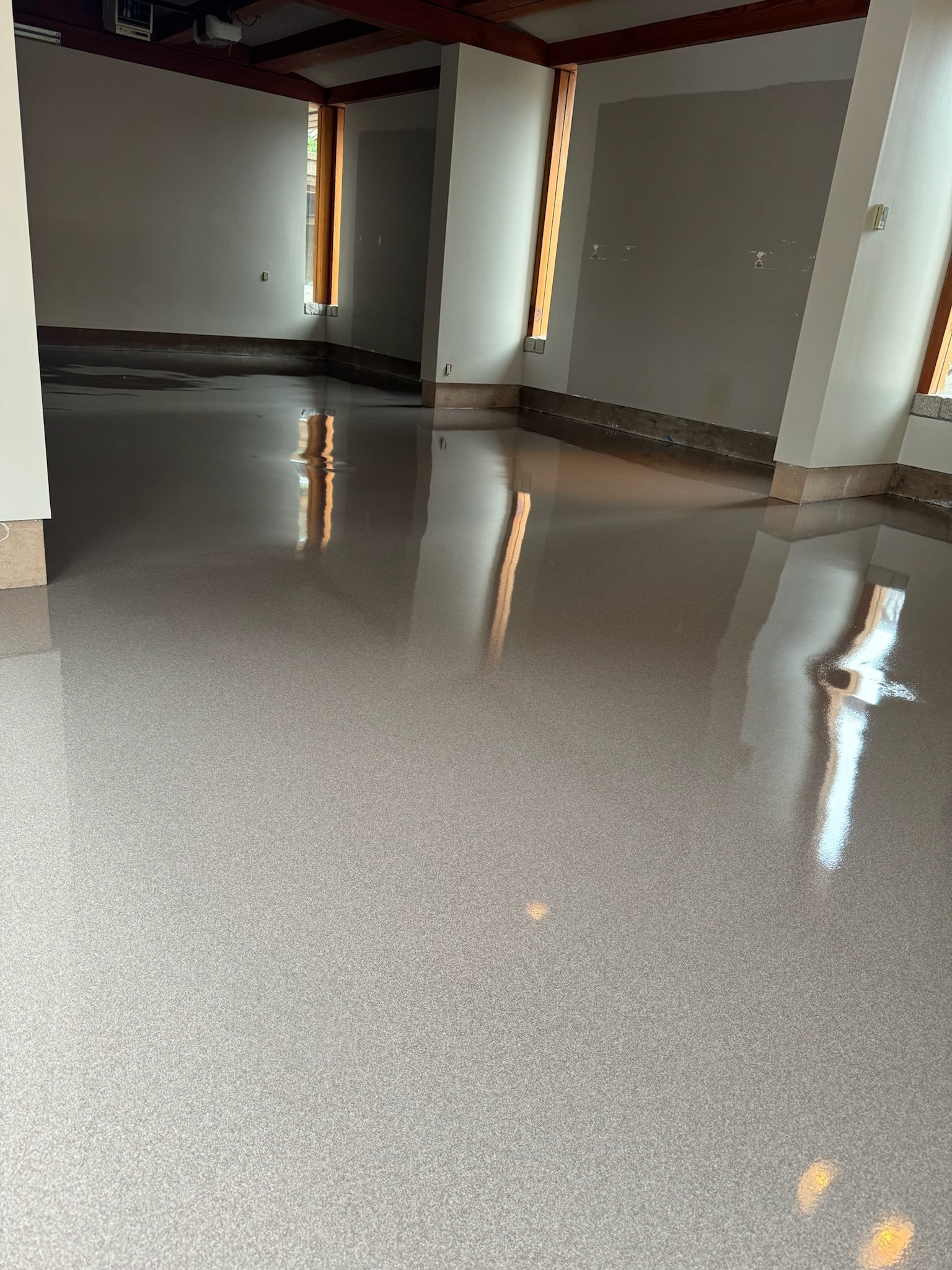
Commercial Epoxy Flooring Contractors: What to Ask
Finding the right commercial epoxy flooring contractor in Metro Vancouver or the Fraser Valley comes down to three things: what system they're installing, how they prepare the surface, and whether they've done comparable commercial work before.
- Ask about film build, product brand, and prep method before comparing quotes — these details separate quality bids from low-effort ones.
- BC's coastal humidity and ground-level slab moisture mean moisture testing should happen before any coating goes down.
- Cost tracks closely with slab condition and system complexity, not just square footage.
- References from similar commercial projects tell you more than star ratings alone.
What Makes Commercial Epoxy Different from Residential?
Commercial spaces put far more strain on flooring than a typical garage. Forklifts, pallet jacks, chemical spills, and constant foot traffic demand a thicker, more durable coating system.
The systems used in warehouses, food processing facilities, retail spaces, and automotive shops are typically multi-layer builds: a primer coat, a body coat, and one or more topcoats. Each layer serves a specific purpose — adhesion, build, and surface protection.
Residential garage coatings can be lighter-weight and applied faster. Commercial jobs usually require more prep, more product, and longer cure times before a space can return to normal operation.
How Do You Find Reputable Commercial Epoxy Flooring Contractors?
A web search is a reasonable starting point, but the results don't tell you much about quality. Here are a few things to evaluate:
- Portfolio of commercial work: Have they done projects similar to yours? A warehouse floor is a different job than a restaurant kitchen or a gym.
- Surface prep approach: Quality contractors grind or shot-blast concrete before applying any coating. Skipping this step leads to peeling and delamination.
- Moisture testing: Concrete in Metro Vancouver holds moisture, especially in ground-level slabs. Ask whether they test for moisture vapour transmission before quoting.
- Product transparency: A reputable contractor can tell you the product line, the expected film build in mils, and whether the system suits your application.
For commercial projects in the Surrey or Burnaby areas, it's worth getting at least two quotes so you can compare scope and methodology, not just price.
What Questions Should You Ask Before Hiring?
These questions help you filter quality bids from low-effort ones:
- What surface prep method do you use? Diamond grinding or shot blasting are the standard. Acid etching alone isn't adequate for most commercial applications.
- What's the total film build? Thicker systems generally last longer under heavy use.
- Will you test for moisture vapour emissions? High MVE causes adhesion failure months after installation.
- What products are you using? Ask for the technical data sheet. A confident contractor will share it.
- What does your warranty cover? Know whether it covers labour, materials, or both — and what voids it.
- Do you have references from commercial clients? Ideally from a similar industry or application type.
You can see the full range of commercial coating systems available at FraserPlus Epoxy's commercial flooring page.
What Types of Commercial Spaces Use Epoxy Coatings?
Epoxy and resinous coatings suit a wide range of business types and applications:
- Industrial and warehouse facilities: High-build systems handle heavy equipment and can be formulated for specific chemical resistance needs.
- Retail and showroom spaces: Decorative options like metallic epoxy create a polished look that holds up to foot traffic and shopping carts.
- Food and beverage facilities: Certain systems are formulated for environments that require easy cleanability and resistance to grease and food acids.
- Automotive shops and dealerships: Chemical resistance to oils, fuels, and brake fluid is a primary specification.
- Healthcare and pharmaceutical spaces: Antimicrobial formulations and unbroken surfaces reduce areas where contaminants can collect.
Not every space needs the same system. A urethane cement might be the right call for a commercial kitchen, while a standard two-part epoxy works well in a dry warehouse. System selection should match the actual demands of the space.
How Does BC's Coastal Climate Affect Epoxy Installation?
Metro Vancouver's humidity and temperature swings create real considerations for coating installations. Most epoxy products have application windows — minimum and maximum temperature ranges, and relative humidity limits.
During the cooler, wetter months common across the Lower Mainland, a qualified contractor manages conditions before and during application. That might mean dehumidifiers, temporary heating, or scheduling around the weather forecast.
Moisture in the slab itself is a separate issue. Ground-level slabs in older commercial buildings in Langley or Coquitlam may have no vapour barrier beneath them. Testing for moisture vapour emissions before application is essential — coating a wet slab without a moisture-tolerant primer is one of the most common causes of premature coating failure.
What Does Commercial Epoxy Flooring Generally Cost?
Cost varies significantly based on the size of the space, the condition of the existing concrete, the system specified, and how much operational downtime the facility can absorb.
A single-colour standard epoxy in a clean, well-prepared warehouse is a different scope than a multi-layer, slip-resistant system in a food processing plant that needs to be installed in phases to keep operations running.
Actual costs vary based on project scope, substrate condition, and site access — contact FraserPlus Epoxy for a personalized assessment.
How Long Does a Commercial Epoxy Floor Last?
Service life depends on the coating system's quality, how well the concrete was prepared, traffic levels, and ongoing maintenance. In well-maintained environments with the right product for the application, epoxy floors can deliver years of reliable service.
High-traffic areas benefit from tougher topcoats. Polyaspartic or polyurethane finishes resist abrasion better than standard epoxy alone. Ask your contractor what topcoat they're specifying and why it suits your traffic type.
Regular cleaning with appropriate products and prompt attention to any surface damage extends the life of any coating. Ask for a maintenance protocol specific to the system being installed.
Is Polished Concrete Worth Considering Instead?
Epoxy and polished concrete serve different purposes, and sometimes one is clearly a better fit than the other.
Polished concrete grinds and densifies the existing slab to create a durable, reflective surface without adding a coating layer that can chip or peel. For spaces with stable, sound concrete, it's a lower-maintenance option long-term.
Epoxy and resinous systems work better when the concrete is damaged or porous, when chemical resistance is required, when you need specific colours or decorative effects, or when the slab has conditions that call for a specialty primer. FraserPlus Epoxy installs both — see the full range at our services page.
Frequently Asked Questions
What's the difference between epoxy coating and epoxy paint?
Epoxy paint is typically a single-component, water-based product that's easy to apply but doesn't deliver the adhesion or film strength of a true two-part epoxy system. Two-part epoxy — resin plus hardener — creates a chemical bond with the concrete and cures to a harder, more wear-resistant surface.
How long does a commercial epoxy installation take?
It depends on the system and the size of the space. Surface prep, application time, and cure time all factor in. Some fast-cure polyaspartic systems can be opened to traffic within a day; multi-layer epoxy builds may need several days before full cure. Your contractor should give you a clear timeline — including expected downtime — before work starts.
Can epoxy be applied over an existing coating?
Sometimes, but it isn't always the right approach. The existing coating needs to be in good condition and properly bonded. In most commercial situations, a quality contractor will remove existing coatings rather than apply over them, to ensure the new system adheres correctly.
Do I need to shut down my business during installation?
Not necessarily. Some projects can be phased to keep part of the facility operational. The scope of any shutdown depends on the size of the job, the system being installed, and ventilation requirements during application. Discuss your operational constraints with the contractor upfront so they can plan the work schedule around your business needs.
Follow FraserPlus Epoxy on Google — be the first to know about floor coatings, maintenance guides, and project ideas across Metro Vancouver.
Make us your preferred source on Google