
Commercial Epoxy Flooring Contractors: What to Know
Searching for commercial epoxy flooring contractors near you means sorting through a wide range of companies — from large industrial flooring firms to smaller regional applicators. Not all of them work with the same materials, processes, or levels of surface preparation. Before you call anyone, it helps to understand what separates a quality installation from one that fails within a year or two.
Quick Summary
- Commercial epoxy flooring is more demanding than residential — prep, thickness, and product selection matter far more at scale.
- Ask every contractor about moisture vapor testing, shot-blasting or grinding prep, and product data sheets before accepting a quote.
- BC's climate — including humidity and seasonal moisture across the Fraser Valley — creates substrate conditions that cut-corner prep will expose over time.
- Actual costs vary based on project scope, substrate condition, and site access — contact FraserPlus Epoxy for a personalized assessment.
What Does a Commercial Epoxy Flooring Contractor Actually Do?
A commercial epoxy flooring contractor applies resinous coating systems to concrete substrates in business environments — warehouses, retail spaces, manufacturing floors, commercial kitchens, healthcare facilities, and more. The work goes well beyond rolling a product onto a floor.
Proper commercial installation involves mechanical surface preparation, moisture vapor testing, primer application, broadcast layers where required, and a topcoat. Each layer has a specific cure window. Skipping or rushing any step shortens the life of the floor significantly.
The contractor also needs to understand how the space will be used. A chemical-resistant system for a commercial kitchen isn't the same as a heavy-traffic broadcast system for a warehouse. Good contractors ask about traffic patterns, chemical exposure, forklift use, and drainage before recommending anything.
How Is Commercial Epoxy Different from Garage or Residential Work?
Garage epoxy systems are typically thinner and designed for lighter vehicle traffic. Commercial systems handle heavier loads, more aggressive chemical exposure, and continuous foot or forklift traffic — often around the clock.
Thickness matters. Many residential systems are applied at lower film builds. Commercial-grade systems often specify higher mil thicknesses to hold up under the demands of active facilities. The product data sheet — or PDS — lists these specifications. Any contractor you're considering should be able to provide one on request.
Surface preparation requirements are also stricter on commercial projects. Grinding or shot-blasting is the standard. Any contractor suggesting a chemical etch as the only prep step on a large commercial floor is worth questioning before you sign anything.
What Should You Ask Before Hiring a Contractor?
Here are the questions worth putting to every contractor before you commit:
- Do you perform moisture vapor emission testing? Concrete releases moisture over time. Without testing, you're guessing — and moisture is one of the leading causes of epoxy delamination in BC's wetter climates.
- What surface preparation method do you use? Shot-blasting or diamond grinding is the industry standard for commercial work. Acid etching alone isn't adequate for most commercial applications.
- Can you provide a product data sheet? A PDS tells you the mil thickness, chemical resistance, cure time, and performance specs. If a contractor can't provide one, that's a concern worth taking seriously.
- Who is actually doing the installation? Some companies quote the job and then subcontract the work. Knowing who applies the coating — and their background — matters for accountability.
- What does the warranty cover, and what voids it? Warranty terms vary widely across the industry. Get them in writing and read the conditions before signing.
- Do you have references from comparable commercial projects in Metro Vancouver or the Fraser Valley? A contractor who works regularly in BC understands local substrate conditions and climate variables that contractors from outside the region may not.
Does BC's Climate Affect Commercial Epoxy Flooring?
It does. Metro Vancouver and the Fraser Valley see significant rainfall, humidity swings, and — particularly in areas like Langley and Abbotsford — freeze-thaw cycles in winter. These conditions affect concrete substrates in ways that shortcuts on prep will make worse over time.
High ambient humidity during application can interfere with curing, especially with moisture-sensitive systems. Reputable contractors monitor temperature and relative humidity before and during installation. If conditions fall outside the product manufacturer's specified application window, a quality contractor will reschedule rather than push through.
In facilities with slab-on-grade construction — common in industrial parks across the Lower Mainland — vapor drive from the ground can be significant, particularly after wet winters. Moisture vapor emission testing isn't optional on commercial projects; it's a baseline step.
What Does the Project Process Typically Look Like?
A standard commercial epoxy flooring project follows a predictable sequence, though timelines depend on floor size, system complexity, and site conditions.
- Site assessment. The contractor walks the floor, checks for cracks, previous coatings, oil contamination, drainage issues, and takes moisture readings.
- Surface preparation. Mechanical prep removes laitance, opens the concrete pores, and creates a surface profile for the coating to bond to. This step often takes as long as the coating work itself.
- Repairs. Cracks, control joints, and spalled areas are filled or treated before any coating goes down.
- Primer coat. A penetrating epoxy primer is applied and allowed to cure fully before subsequent coats are added.
- Body coat or coats. Depending on the system, one or more intermediate coats are applied. Broadcast aggregate — anti-slip or decorative — is embedded here if specified.
- Topcoat. A polyurethane, polyaspartic, or epoxy topcoat seals the system and delivers the final surface characteristics: gloss level, chemical resistance, UV stability.
- Cure and return to service. Most systems need a full cure period before heavy traffic. Your contractor should give you clear timelines for each stage so you can plan around them.
For projects in active facilities, sequencing work around your operations is often necessary. Quality contractors plan for this before the project starts, not after problems arise on-site.
How Do You Compare Quotes Fairly?
Quotes for commercial epoxy flooring can vary considerably, and the lowest number isn't always the best choice. A low bid can reflect thinner product specifications, reduced surface preparation, or lower-quality materials — all of which affect how the floor performs over time.
When reviewing quotes, look for line-item detail. A professional proposal should specify the system by name or product code, the prep method, the number of coats, the dry film thickness, and the warranty terms. Vague scope statements make it difficult to compare proposals on equal footing.
Actual costs vary based on project scope, substrate condition, and site access — contact FraserPlus Epoxy for a personalized assessment. For facilities in Metro Vancouver and the Fraser Valley, also factor in access logistics, any required out-of-hours work, and lead time on specialty materials.
What Types of Commercial Epoxy Systems Are Available?
The most common commercial systems include:
- Standard solid-color epoxy: A reliable workhorse for warehouses, light manufacturing, and utility spaces. Durable and straightforward to maintain.
- Broadcast systems: Anti-slip aggregate — quartz or vinyl flake — is broadcast into a wet coat for texture and traction. Common in commercial kitchens, food processing facilities, and wet-area environments.
- Self-leveling epoxy: Applied at higher film builds to create a smooth, level finish. Frequently specified for labs, healthcare facilities, and areas requiring continuous hygienic surfaces with no joints or seams to trap bacteria.
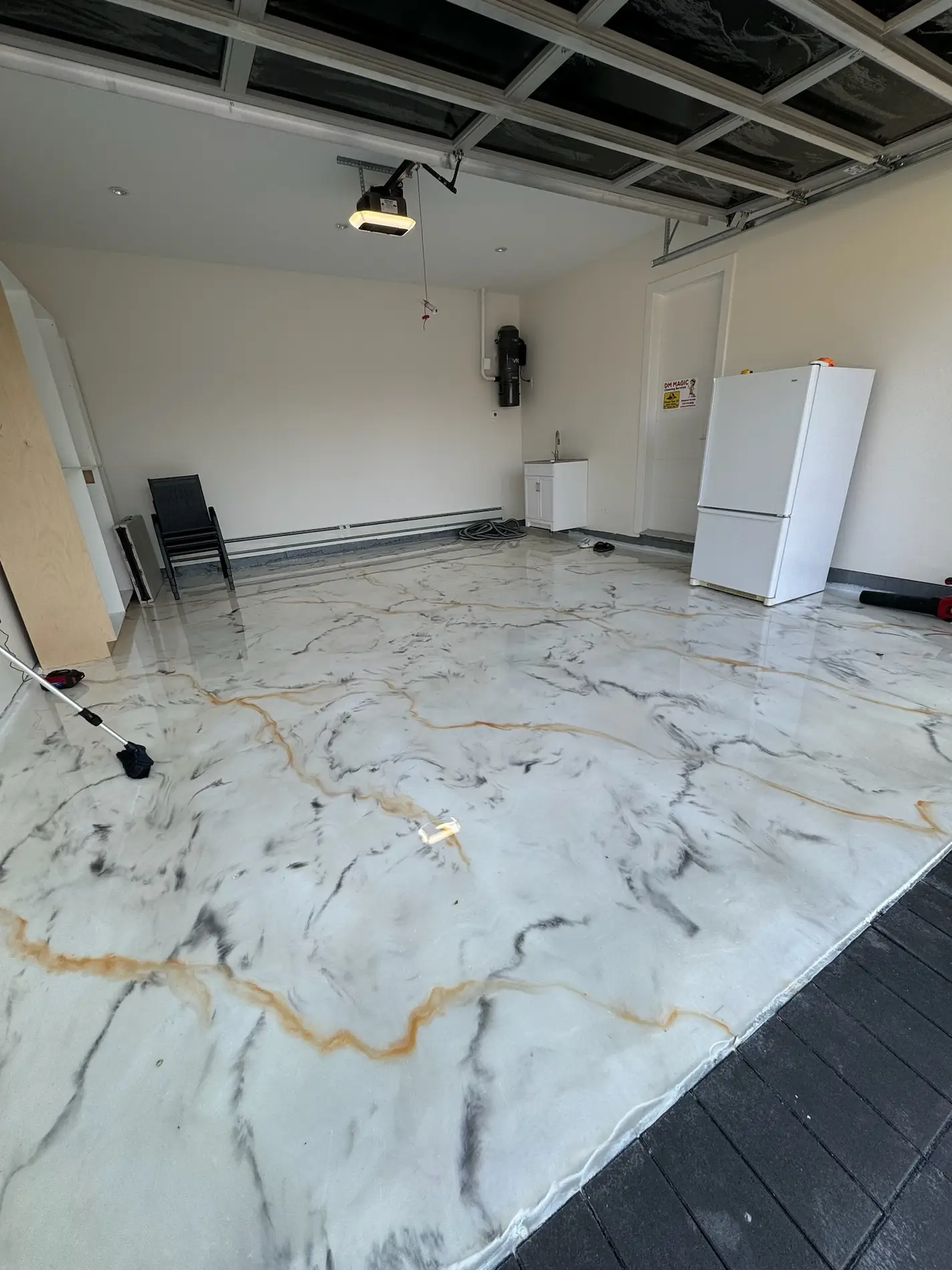
- Metallic epoxy: Pigmented metallic powders create a marbled or dimensional look. More common in retail, hospitality, and showrooms than in heavy industrial settings.
- Polyaspartic coatings: Fast-curing systems that can be applied in cooler temperatures and return to service quickly. Often used as topcoats over epoxy body coats, or as a complete system where conditions allow.
- Polished concrete: Mechanical grinding and polishing of the concrete itself, rather than an applied coating. Increasingly specified alongside or instead of epoxy in certain commercial spaces.
Frequently Asked Questions
How long does commercial epoxy flooring last?
Service life depends on the system specified, the quality of surface preparation, maintenance practices, and the type of traffic the floor sees. Systems installed correctly on properly prepared concrete generally outlast ones where prep or product specification was compromised. There's no single answer because application conditions and use patterns vary too much for a universal number to be meaningful.
Can epoxy be applied over existing concrete in a working facility?
In many cases, yes — but the existing surface needs a proper assessment first. Previous coatings, oil contamination, moisture issues, or structural damage to the slab can all affect what's feasible without additional remediation work. A site visit and moisture test before quoting is a reasonable thing to expect from any professional contractor.
Is epoxy flooring slippery when wet?
Smooth-finish epoxy can be slippery when wet. For commercial kitchens, food processing areas, or any space with regular water exposure, a broadcast aggregate topcoat adds texture and improves traction. Specify anti-slip requirements upfront so the contractor can design the system to meet them.
Do I need to shut down operations during installation?
That depends on the system and the size of the project. Some fast-curing systems allow work to be done in sections with minimal downtime. Traditional epoxy systems require longer cure windows between stages. Most contractors will work with your team to sequence the installation around your operations schedule — ask about this during the quoting process, not after the contract is signed.
Follow FraserPlus Epoxy on Google — be the first to know about floor coatings, maintenance guides, and project ideas across Metro Vancouver.
Make us your preferred source on Google