
Epoxy Company: How to Choose the Right One
TLDR
- Not all epoxy coatings are equal — product quality, surface prep, and installer skill determine how long your floor lasts.
- A local contractor who knows BC's climate and concrete conditions will give you more accurate advice than a national chain.
- Always ask about surface preparation, the number of coats, and what's included in the warranty before signing anything.
- FraserPlus Epoxy serves Metro Vancouver and the Fraser Valley — get a free on-site assessment before you commit.
Why Does "Epoxy Company Near Me" Return So Many Results?
Epoxy flooring has become one of the most searched home-improvement services in Metro Vancouver and the Fraser Valley. Garage makeovers, commercial renovations, and strata common-area upgrades have all driven demand upward, which means more contractors have entered the market.
The problem is that "epoxy company" covers a wide range of skill levels. Some operators are one-person crews applying a big-box store kit. Others are full resinous flooring specialists with dedicated surface-prep equipment and access to commercial-grade coatings. Knowing how to tell them apart saves you from a floor that peels, chips, or yellows within a year or two.
What Makes BC's Climate Hard on Epoxy Floors?
Greater Vancouver and the Fraser Valley experience a lot of moisture — ground-level humidity, wet winters, and temperature swings between summer heat and cold snaps. All of that affects both the installation process and how a finished floor performs over time.
Concrete absorbs moisture from below, and if a floor isn't properly tested and prepared before coating, trapped vapour can cause the epoxy to blister or delaminate. A contractor who works regularly in this climate will know when to use a moisture-tolerant primer, how long to let concrete cure after a wet season, and which products hold up under the freeze-thaw conditions you can get in Langley, Abbotsford, or Chilliwack.
That local knowledge is genuinely hard to replace with a contractor who normally works in a drier climate and is bidding your job remotely.
What Should You Actually Ask an Epoxy Contractor Before Hiring?
Before you get a quote, ask these questions directly. A good contractor will answer without hesitation.
How do you prepare the surface?
This is the single most important factor in whether an epoxy coating lasts. Proper preparation usually involves diamond grinding or shot blasting the concrete to open the pores and remove any existing coatings, oils, or sealers. If a contractor plans to skip mechanical prep and just acid-etch, that's a warning sign — acid etching alone isn't sufficient for most garage or commercial applications.
What products are you using?
There's a significant gap between consumer-grade coatings and the industrial two-part epoxy and polyaspartic systems that professional installers use. Ask the contractor for the product data sheet. A professional will have it and be willing to share it.
How many coats does the system include?
A durable floor coating typically involves at least a base coat and a topcoat, sometimes with a broadcast layer of flakes or quartz in between. Single-coat systems tend to wear through faster in high-traffic areas like garages or retail floors.
What does the warranty cover?
Understand whether the warranty covers labour, materials, or both, and what voids it. Some warranties are voided by improper maintenance or vehicle hot-tire transfer — it's worth knowing before you sign.
What Types of Epoxy Flooring Are Available?
The term "epoxy" gets used loosely to describe several different floor coating systems. Here's a quick breakdown of the main options.
Standard garage epoxy
This is the most common request for residential jobs. A two-part epoxy base coat is applied to prepared concrete, usually with a decorative flake broadcast and a polyaspartic or urethane topcoat for UV and chemical resistance. It's practical, easy to clean, and holds up well to vehicle traffic. Learn more about garage epoxy flooring options.
Metallic epoxy
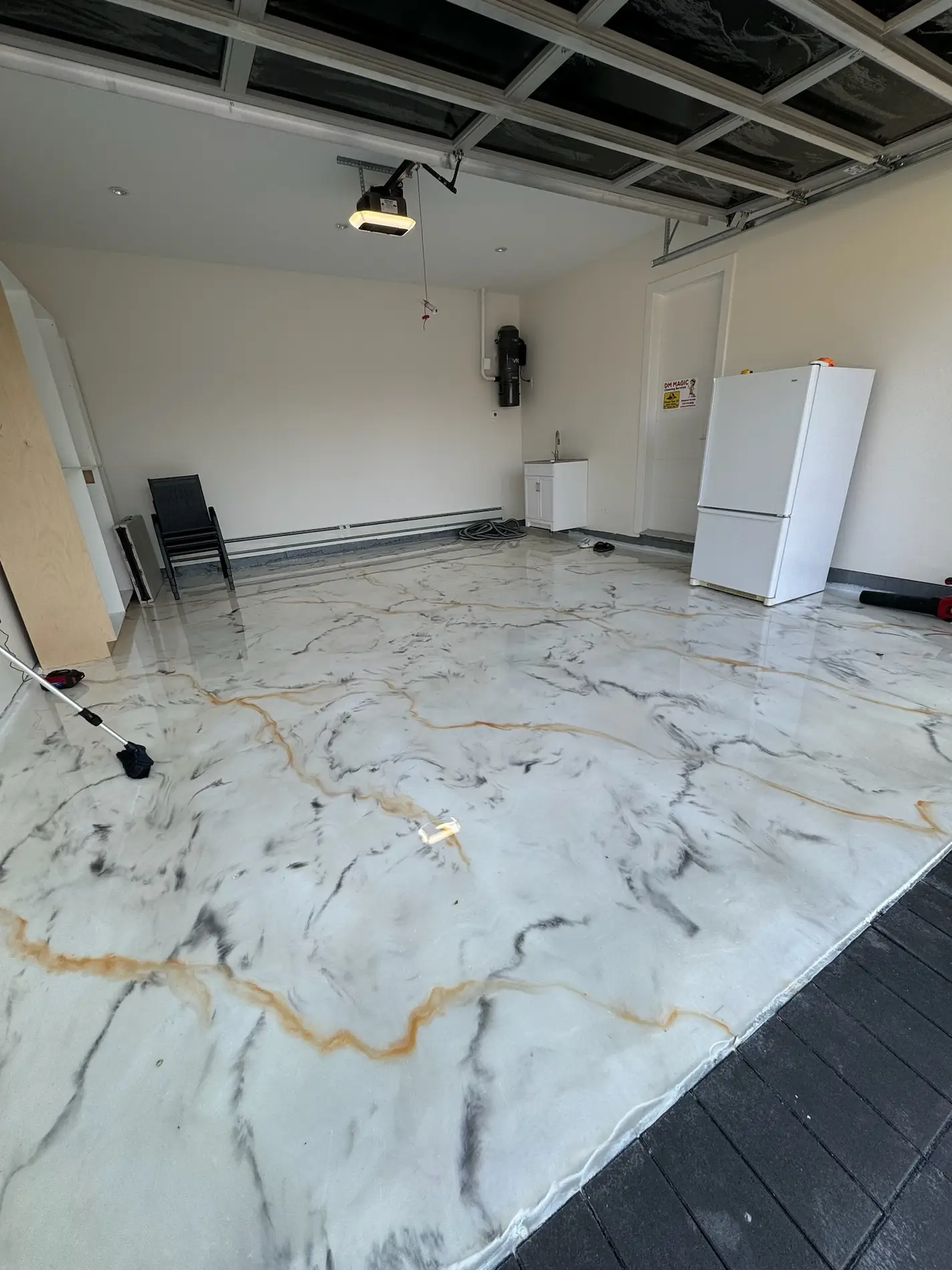
Metallic epoxy systems use pigmented metallic powders mixed into a clear epoxy base to create a reflective, three-dimensional effect. No two metallic floors look the same — the swirling patterns are produced by how the installer works the material. It's popular for showrooms, retail spaces, and residential areas where aesthetics matter as much as durability. See how metallic epoxy flooring is installed.
Commercial epoxy and resinous flooring
Commercial applications — warehouses, auto shops, food-service kitchens, medical facilities — require coatings that can handle heavy equipment, chemical exposure, and strict hygiene requirements. These systems are usually thicker, sometimes include anti-slip aggregates, and need to meet specific safety or building code requirements depending on the use. Explore commercial epoxy flooring systems.
Polished concrete
Polished concrete isn't a coating — it's a mechanical process that grinds and densifies the concrete itself to produce a reflective, low-maintenance surface. It's common in retail, office, and industrial settings where a minimal aesthetic is preferred and long-term maintenance costs need to stay low.
How Do You Compare Quotes?
When you're looking at multiple quotes, price alone is a poor basis for comparison. A lower price often means thinner product, fewer coats, or less prep work — any of which can shorten the floor's life significantly.
Compare quotes on the basis of scope: what surface preparation method is included, which specific products are being used, how many coats are applied, and what the warranty terms are. If one quote is significantly cheaper than the others and the contractor can't explain why, that's worth probing before you commit.
Also consider how the contractor handles the consultation. A professional should be willing to visit the site, assess the concrete condition, and explain what they're recommending and why. A quote given over the phone without a site visit is usually less reliable.
Does Location Matter When Choosing a Contractor?
For epoxy flooring, yes — more than you might expect. A contractor based in the Lower Mainland or Fraser Valley will have direct experience with the soil conditions, building ages, and climate variables that affect how concrete behaves in this region. Older homes in Burnaby or New Westminster often have concrete with different characteristics than a newer slab in a Surrey or Langley suburb.
A local contractor is also easier to reach if you have a concern after the job is done. Warranty work is much simpler to arrange when the contractor isn't travelling from out of province.
FraserPlus Epoxy works throughout Metro Vancouver and the Fraser Valley, including Surrey, Burnaby, Langley, Coquitlam, Richmond, and surrounding communities. If you're not sure whether your location is in our service area, reach out and we'll confirm.
What Should You Expect During the Installation Process?
A professional epoxy installation involves more preparation time than most homeowners expect. The concrete needs to be ground or shot-blasted, cleaned, and allowed to dry. Any cracks or spalls are filled and levelled before coating begins.
Depending on the system, the coating process itself may take one or two days, with curing time before the floor can be walked on or driven on. Your contractor should give you a clear timeline and explain what you need to do to prepare — clearing the space, moving vehicles, and allowing for ventilation.
Don't rush a contractor who says they need more prep time. The preparation phase is where the long-term quality of the floor is determined.
Frequently Asked Questions
How long does an epoxy floor last?
With proper surface preparation and a quality product system, a professionally installed epoxy floor can last many years under normal residential use. Commercial floors subject to heavy equipment or chemical exposure may require maintenance or recoating sooner. The single biggest factor in longevity is surface preparation at the time of installation.
Can epoxy be applied over an existing coating or painted concrete?
Generally, no — not without removing the existing coating first. New epoxy needs to bond directly to bare concrete. A contractor who proposes applying new epoxy over an old coating without grinding it off first is cutting a corner that will likely cause adhesion failure down the line.
Is epoxy flooring slippery when wet?
A plain glossy epoxy surface can be slippery when wet. Most professional installers address this by broadcasting an anti-slip aggregate — typically aluminum oxide or quartz — into the topcoat. If slip resistance is a concern for your application (garage, commercial kitchen, exterior-adjacent area), ask your contractor specifically what anti-slip measures are included.
How much does epoxy flooring cost in Metro Vancouver?
Costs vary depending on floor size, condition of the existing concrete, the coating system chosen, and the complexity of the job. General industry pricing reflects differences between thin consumer-grade coatings and multi-coat commercial systems with mechanical prep. Actual costs vary based on project scope, substrate condition, and site access — contact FraserPlus Epoxy for a personalized assessment.
Ready to get a quote for your garage, commercial space, or renovation project? Contact FraserPlus Epoxy and we'll arrange a free on-site assessment. We serve Metro Vancouver and the Fraser Valley with no-obligation quotes and transparent pricing.
Follow FraserPlus Epoxy on Google — be the first to know about floor coatings, maintenance guides, and project ideas across Metro Vancouver.
Make us your preferred source on Google