
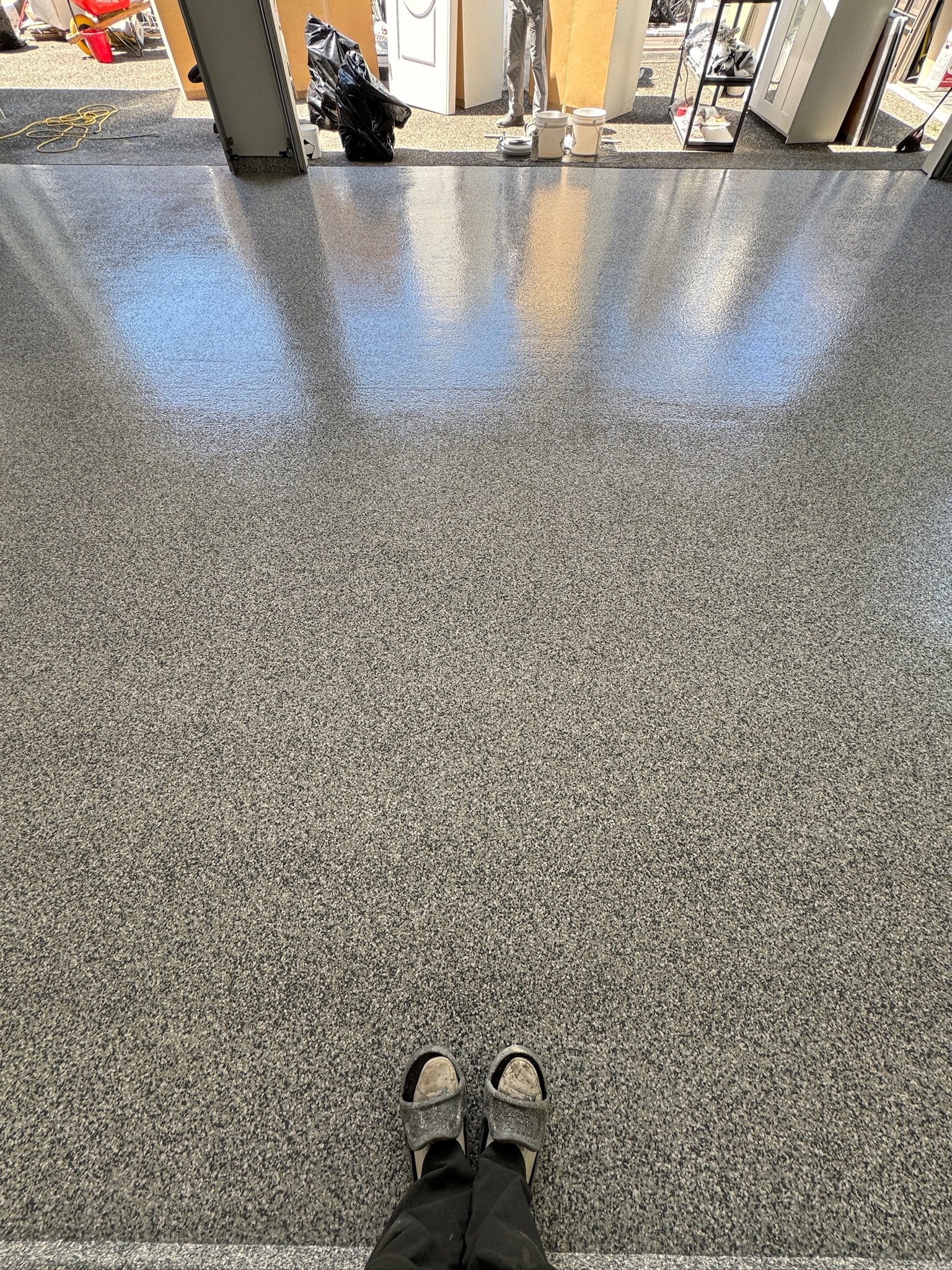
Epoxy Flooring in Langley: What BC Homeowners Should Know
TLDR
- Epoxy bonds directly to concrete, giving garage and commercial floors a hard, cleanable surface that holds up to Langley's wet winters and heavy use.
- Surface preparation — grinding, crack repair, moisture testing — determines whether a coating lasts years or peels within months.
- Different spaces need different systems: residential garages, commercial kitchens, and warehouse floors each call for a different epoxy or polyaspartic chemistry.
- A local contractor who can assess your specific slab is the best starting point before committing to any system.
Why Do Langley Homeowners Choose Epoxy for Their Garage Floors?
The Lower Mainland gets a lot of rain, and Langley garages take the brunt of it — road grit, tire marks, salt tracked in from winter driving, and the general wear that comes with a working garage. Bare concrete absorbs all of it. Epoxy creates a sealed, non-porous surface that's far easier to clean and more resistant to staining.
Beyond function, epoxy comes in a wide range of finishes. Solid colors, metallic effects, and broadcast-flake systems — the chip or flake look most common in residential garages — all give the floor a finished appearance that bare concrete can't match. Many Langley homeowners choose a flake system because it adds texture, which matters in a wet climate where slip resistance is a practical concern.
Epoxy also tolerates the temperature swings common in BC. Garages here go from cold, damp winters to warm summers, and a properly installed epoxy system handles that range without cracking or delaminating. Getting the installation right is the key part — more on that below.
What Types of Epoxy Flooring Systems Are Available?
Not every epoxy product is the same, and the right system depends on the use case.
100% solids epoxy is the thickest, most durable option and is typically used in commercial and industrial settings — warehouses, manufacturing floors, auto shops. It builds meaningful thickness per coat and resists heavy impact and chemical spills.
Water-based epoxy is thinner and lower in VOCs, making it easier to apply and more suitable for spaces without strong ventilation. It's less durable than 100% solids systems and better suited for light-use residential applications.
Polyaspartic coatings are a common topcoat or standalone system. They cure faster than standard epoxy — sometimes in hours rather than days — and hold up well under UV exposure, which matters for garages with lots of natural light. Many professional installs pair a base coat of epoxy with a polyaspartic topcoat for a balance of build thickness and surface durability.
Metallic epoxy uses metallic pigments mixed into the resin to create flowing, three-dimensional effects. Each floor looks different — installers manipulate the pigment while the resin is still wet. It's popular for showrooms, retail spaces, and homeowners who want something visually distinctive. You can see what's possible at FraserPlus Epoxy's metallic flooring page.
How Does BC's Climate Affect Epoxy Flooring?
Moisture is the main challenge. Concrete in the Lower Mainland and Fraser Valley sits in a region with consistently high humidity and frequent rainfall. Concrete is porous and can hold moisture, and if that moisture escapes upward through the slab while a coating is curing, it can cause bubbling, delamination, or adhesion failure.
A reputable installer will test the slab's moisture vapor emission rate (MVER) before applying any coating. If levels are too high, they'll either use a moisture-tolerant primer or recommend waiting. Skipping this step is one of the leading causes of failed garage floor coatings in BC.
Temperature during installation also matters. Epoxy doesn't cure properly when applied to a cold slab or in cold ambient conditions. Many Langley homeowners schedule their garage floor coating in spring or early fall when temperatures are moderate. A contractor familiar with local conditions will know the practical window for installation.
What Does the Epoxy Installation Process Actually Involve?
Surface prep is the most important part of any epoxy installation. On a residential garage floor, this typically means grinding the concrete with a diamond grinder to open the surface and improve adhesion, repairing any cracks or divots, and cleaning thoroughly before coating.
Here's a general sequence for a residential garage install:
- Grinding or shot-blasting the slab surface
- Crack and joint repair with a filler appropriate for the coating system
- Moisture testing
- Application of a primer or base coat
- Optional broadcast of flake or aggregate for texture and appearance
- Topcoat application — often polyaspartic for durability and UV stability
- Cure time before the floor can be driven on
The full process usually takes one to two days across multiple visits depending on the system and cure schedule. Learn more about what's involved in residential work at the garage epoxy flooring page.
For commercial spaces — retail floors, food service kitchens, warehouses — the process is similar but may involve more extensive prep, thicker build coats, anti-slip additives, and coving at wall-floor junctions. More detail is available at FraserPlus Epoxy's commercial flooring page.
How Do You Maintain an Epoxy Floor?
One of the main reasons people choose epoxy is that it's relatively low-maintenance. The sealed surface doesn't absorb oil, dirt, or water the way bare concrete does — spills sit on top and wipe away.
Day-to-day cleaning is straightforward: sweep or dust-mop to remove grit, then mop with a mild pH-neutral cleaner and water. Avoid acidic cleaners, which can dull the topcoat over time, and avoid solvent-based products unless the manufacturer specifies compatibility.
The finish will show wear eventually, particularly in high-traffic areas. A topcoat reapplication — without stripping the base system — can often refresh the surface when it starts to show scratches or dullness. How long this takes depends on traffic volume and the quality of the original install.
For garages, placing mats under vehicles that drip oil and using floor protectors under heavy rolling loads will extend the life of the finish.
What Should You Ask Before Hiring an Epoxy Contractor in Langley?
Not every contractor offering epoxy flooring has the same level of experience or uses the same quality of materials. Here are practical questions worth asking before you commit.
Do you grind or acid-etch the concrete? Diamond grinding is the professional standard. Acid etching alone is less reliable, particularly on denser or harder slabs. If a contractor only acid-etches, that's worth knowing upfront.
What system are you using, and what are the coverage rates? A thin application of a low-solids product won't perform the same way as a professionally specified system. Ask for the product data sheet if you want specifics.
Do you test for moisture? If the answer is no, that's a red flag in a climate like BC's.
What's the cure schedule before vehicle traffic? Different systems have different timelines. A polyaspartic topcoat might be ready in hours; a full epoxy build may need longer. Make sure the timeline works for your situation.
Do you have a portfolio of local work? Seeing completed floors in Langley or the surrounding Fraser Valley gives you a realistic sense of what to expect from your specific climate and substrate conditions.
Actual costs vary based on project scope, substrate condition, and site access — contact FraserPlus Epoxy for a personalized assessment. If you're ready to get a quote or just want to talk through your project, the contact page is the right starting point.
Frequently Asked Questions
Is epoxy flooring suitable for outdoor use in BC?
Standard epoxy is generally not recommended for outdoor surfaces exposed to direct UV light and freeze-thaw cycles. Outdoor coatings require UV-stable products like polyaspartic or aliphatic urethane systems. If you're coating a covered patio or carport, a contractor can advise on appropriate products for that exposure level.
How long does an epoxy garage floor last?
Lifespan depends on the quality of the install, the product system used, and how the floor is used. A properly prepared and installed system in a residential garage can last many years with normal use. Heavy vehicle traffic, chemical exposure, or ongoing moisture issues will shorten that life.
Can epoxy be applied over existing painted or coated concrete?
Generally no — existing coatings need to be removed before a new epoxy system is applied. Coating over an old layer means adhesion is only as strong as the old layer's bond to the concrete. Grinding back to bare concrete gives the new system the best chance of lasting.
What's the difference between epoxy and polished concrete?
Epoxy is a coating applied on top of the concrete slab. Polished concrete uses grinding and densifying to harden and refine the surface of the concrete itself — no coating is added. Polished concrete has a different appearance, ranging from matte to high-gloss with a stone-like quality. Both are durable options; the right choice depends on the look you want, the substrate condition, and the use case.
Follow FraserPlus Epoxy on Google — be the first to know about floor coatings, maintenance guides, and project ideas across Metro Vancouver.
Make us your preferred source on Google