
FraserPlus Epoxy Flooring: Metro Vancouver Guide
Quick summary
- FraserPlus Epoxy installs garage floors, commercial coatings, metallic epoxy, and polished concrete across Metro Vancouver and the Fraser Valley.
- BC's wet climate makes moisture testing essential before any coating goes down.
- Professional installation starts with mechanical surface prep — diamond grinding or shot-blasting, not acid etching alone.
- Long-term performance depends more on prep quality and the right system for your substrate than on brand or topcoat colour alone.
If you've landed on fraserplusepoxy.com looking for FraserPlus Epoxy Flooring options, you're likely weighing choices for a garage makeover, a commercial space, or a decorative resinous floor. This guide covers what to expect: the systems available, how installation works, what BC's climate demands, and how to keep a coated floor looking good for years.
What types of floors does FraserPlus Epoxy install?
FraserPlus Epoxy offers several resinous flooring systems suited to different spaces and goals. The full lineup is on the services page, but here's a plain-language breakdown of the main categories.
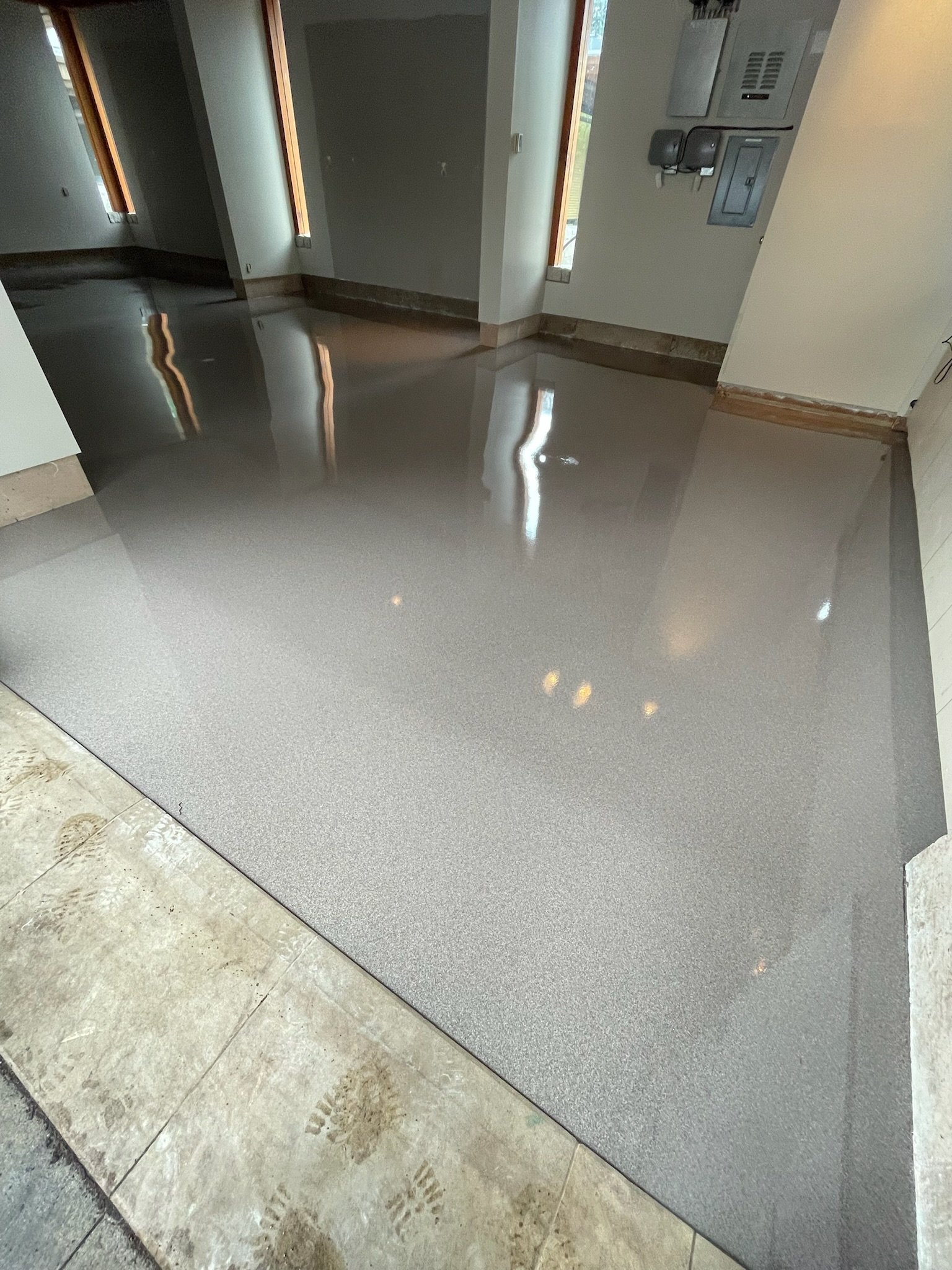
Garage epoxy coatings are the most common residential request. A standard system includes a primer, one or two epoxy body coats, a decorative broadcast of paint chips or quartz flake, and a clear polyurethane or polyaspartic topcoat. The result is a hard, cleanable surface that resists hot tire pickup, oil stains, and the grit that comes with BC roads.
Commercial and industrial epoxy systems are built for heavier use — forklift traffic, chemical exposure, or food-safe environments. These use thicker build coats, anti-slip aggregates, and formulations rated for specific conditions.
Metallic epoxy uses metallic pigments suspended in a clear or tinted epoxy to create a fluid, three-dimensional look. It's popular in showrooms, retail spaces, and residential areas like basements where aesthetics matter alongside durability.
Polished concrete skips the surface coating entirely. The concrete is ground to progressively finer grits, treated with a chemical densifier, then sealed or left as a matte finish. It's durable, low-maintenance, and growing in popularity for both commercial and residential use.
Is epoxy flooring the right fit for a BC garage?
For most Metro Vancouver and Fraser Valley garages, a quality epoxy or polyaspartic system is a practical upgrade — but the condition of your concrete slab matters a great deal. The biggest variable is moisture.
BC garages see a lot of water. Rain tracks in off vehicles, condensation forms on cold slabs in spring and fall, and some older slabs — especially those without a proper vapour barrier — have measurable moisture vapour transmission. If a coating is applied over a slab that's actively transmitting moisture, it can blister, delaminate, or peel within months.
A good installer tests for moisture before quoting. Where moisture is a concern, there are moisture-tolerant primer formulations and polyurea or polyaspartic systems that handle higher vapour emission better than standard water-based epoxies. Getting the system matched to your slab's actual condition matters more than any aesthetic choice. For more on what residential garage installations involve, see the garage epoxy flooring service page.
How does BC's wet climate affect resinous floor coatings?
Metro Vancouver and the Fraser Valley have a temperate oceanic climate — mild but reliably wet from October through April. This affects epoxy installations in a few practical ways.
Application temperature and humidity both matter. Most epoxy formulations require a minimum substrate and air temperature and a maximum relative humidity. During the wettest months, scheduling installs in unheated garages or warehouse spaces can be tricky. Fast-cure polyaspartic coatings handle cooler conditions better than slower-curing epoxy formulations and are often the better choice for off-season work.
The grit and gravel tracked in from BC roads — especially in the Fraser Valley where unpaved roads are more common — can wear softer topcoats faster. A UV-stable polyaspartic or polyurethane topcoat holds up better to abrasion than a straight epoxy topcoat, which can also yellow with sun exposure over time.
In the eastern Fraser Valley and at higher elevations, freeze-thaw cycles are a real factor. Concrete that absorbs water and then freezes can spall, and coating over spalled concrete shortens the life of any system. Repairing damage before coating is part of a proper installation, not an optional upsell.
What does a professional epoxy installation actually involve?
The prep work is where the job is won or lost. A professional installation starts with mechanical surface preparation — diamond grinding with a floor grinder, or shot-blasting for larger commercial areas. This opens the concrete's surface pores so the epoxy bonds mechanically, not just by surface adhesion.
Acid etching alone is increasingly considered inadequate for a full prep. It can leave the surface unevenly prepared and doesn't create as consistent a surface profile as grinding does. Most quality installers now use mechanical prep as their baseline.
After grinding, cracks, spalls, or voids are filled with appropriate patching compounds. The floor is thoroughly vacuumed, and moisture readings are taken before any coating goes down.
The coating layers follow in sequence: a primer or basecoat, a colour or decorative layer, and a protective topcoat. Broadcast systems — paint flake or quartz — are spread into the wet basecoat and then sealed under the topcoat. Cure times vary by product and temperature. Most systems are walk-on ready within 24 hours but reach full hardness over several days. Vehicles are typically kept off for at least 72 hours, depending on the system and ambient temperature.
How do you maintain an epoxy or polished concrete floor?
One of the appeals of a coated floor is how simple upkeep is. For garage floors, a shop broom handles regular debris, and a damp mop with a mild cleaner keeps the surface looking fresh. Avoid harsh solvents, high-concentration bleach, or abrasive scrub pads — these can dull or damage the topcoat over time.
Oil and chemical spills should be cleaned up promptly. Most quality topcoats resist brief chemical contact, but prolonged exposure to brake fluid, battery acid, or certain solvents can soften or stain even a well-installed coating. In commercial settings, knowing which chemicals will be on the floor is part of the system selection process from the start.
Scratches from dropped tools or equipment can often be touched up rather than requiring a full recoat. The floor's longevity depends on coating thickness, topcoat hardness, and how the floor is used every day.
Where does FraserPlus Epoxy work in Metro Vancouver and the Fraser Valley?
FraserPlus Epoxy covers a wide service area, working across Metro Vancouver communities and down through the Fraser Valley. If you're in Surrey, you can find location-specific information on the Surrey epoxy flooring page.
The work varies by area. Garages in South Surrey and North Delta tend to be larger suburban builds. Commercial projects in Burnaby and Richmond often come with tighter scheduling and higher traffic requirements. Fraser Valley clients in Langley, Abbotsford, and Chilliwack frequently need systems that handle agricultural or light-industrial loads and chemical exposure.
Whatever the setting, the fundamentals are the same: proper prep, the right system for the substrate and use case, and a topcoat that holds up to BC conditions.
Frequently asked questions about epoxy flooring
How long does an epoxy garage floor typically last?
Lifespan depends on the system installed, the quality of surface prep, and how the floor is used day to day. A well-prepared floor with a quality topcoat in a typical residential garage can last many years with normal maintenance. Heavy use, harsh chemical exposure, or inadequate prep will shorten that.
Can epoxy be applied over an existing painted floor?
Generally, no — not without removing the old coating first. Existing paint or sealer needs to be ground off to expose bare concrete before a new epoxy system will bond properly. Applying over old coatings is one of the most common causes of early delamination.
What's the difference between epoxy and polyaspartic coatings?
Epoxy forms the body and build of most coating systems — it bonds well to concrete and provides a thick, hard base. Polyaspartic is a fast-curing aliphatic compound often used as a topcoat. It's more UV-stable than epoxy (which can yellow in sunlight), cures faster, and works better in cooler temperatures. Many systems combine both: an epoxy base with a polyaspartic topcoat.
How do I get a quote from FraserPlus Epoxy?
You can reach the team directly through the contact page. Providing details about your space — square footage, current floor condition, and intended use — helps get an accurate estimate. Actual costs vary based on project scope, substrate condition, and site access — contact FraserPlus Epoxy for a personalized assessment.
Follow FraserPlus Epoxy on Google — be the first to know about floor coatings, maintenance guides, and project ideas across Metro Vancouver.
Make us your preferred source on Google