
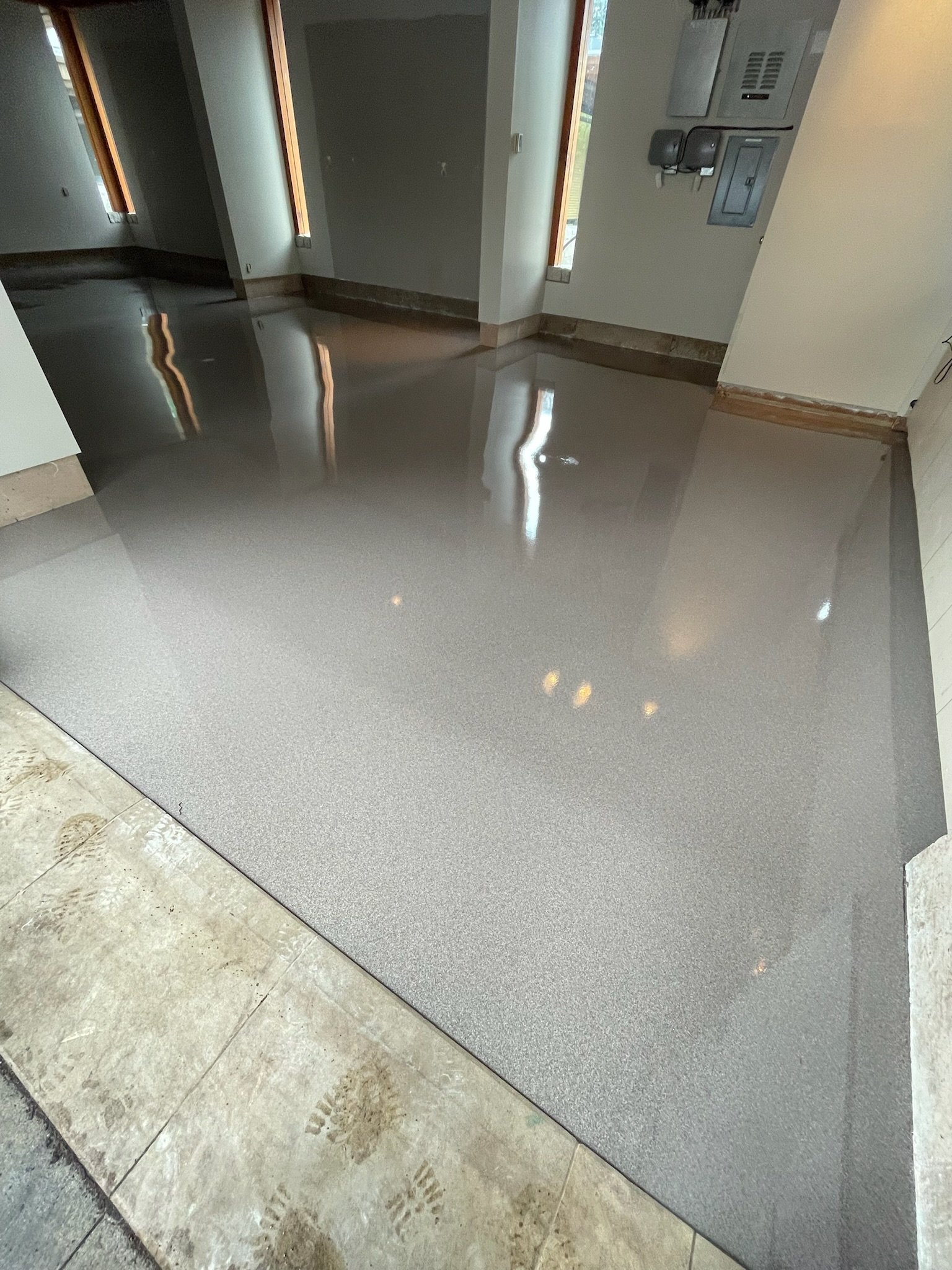
FraserPlus Epoxy Flooring in Metro Vancouver & Fraser Valley
If you've searched for FraserPlus Epoxy or visited fraserplusepoxy.com, you're looking for an epoxy or resinous flooring contractor in Metro Vancouver or the Fraser Valley. This page covers what FraserPlus does, how different flooring systems compare, and what to expect from the process — so you can make an informed decision before reaching out.
Quick Takeaways
- FraserPlus Epoxy serves Metro Vancouver and the Fraser Valley with residential and commercial flooring installations.
- Services include garage floor epoxy, commercial coatings, metallic epoxy, and polished concrete.
- BC's wet climate makes moisture testing and proper concrete prep critical before any coating goes down.
- Project costs depend on slab condition, system type, and square footage — a site visit is required for an accurate quote.
What Services Does FraserPlus Epoxy Provide?
FraserPlus offers a full range of epoxy and resinous flooring services for residential and commercial clients across the Lower Mainland. The work spans everything from single-car garages to large commercial floors.
Garage floor epoxy is the most common residential application. A properly coated garage floor resists motor oil, road salt, and tire wear far better than bare concrete. It's also easier to clean and looks considerably better — which matters if you're using the space as a workshop, home gym, or additional storage area.
For businesses, commercial epoxy flooring systems are rated for heavy foot traffic, vehicle loads, and chemical exposure. Common applications include warehouses, showrooms, automotive shops, gyms, and food-prep areas. System selection depends on the loading and chemical exposure the floor needs to handle.
Metallic epoxy flooring is a decorative resinous system that uses metallic pigments to create a three-dimensional, flowing appearance in the finished floor. It's a popular choice for retail spaces, reception areas, and residential living spaces where the floor is as much a design statement as a surface. No two metallic epoxy floors look exactly alike, which is part of the appeal.
Polished concrete is a distinct process — it mechanically grinds and hones the existing slab using progressively finer diamond tooling, rather than applying a coating on top. The slab is then densified with a chemical hardener and sealed. The result is a durable, reflective surface that can be maintained indefinitely with re-polishing. It works best when the existing concrete is in solid condition, since the process reveals rather than covers the slab.
Why Do Metro Vancouver Homeowners Choose Epoxy for Their Garage Floors?
Metro Vancouver and the Fraser Valley see some of the highest annual rainfall in Canada. Vehicles tracking water, mud, and road salt into a garage repeatedly can degrade bare concrete over time — the surface becomes pitted, dusty, and difficult to clean. An epoxy coating bonds to the slab at a chemical level, creating a surface that sheds moisture rather than absorbing it.
The region also sees freeze-thaw cycles, particularly in the Fraser Valley and at higher elevations. Concrete that absorbs water and then freezes can spall at the surface. A coated slab that's been properly prepped and sealed is better protected against this cycle than an uncoated one.
Practical use of garage space is another factor. Many Metro Vancouver homeowners use their garage as a workspace, home gym, or extension of their living area. A finished floor — clean, sealed, and resistant to staining — makes the space far more functional. For homeowners in Surrey and nearby communities, converting a raw garage into a finished workspace can meaningfully expand how a home is used day to day.
What's the Difference Between Epoxy, Polyaspartic, and Polished Concrete?
These three options differ in chemistry, performance, and installation timeline. Understanding the basics helps you have a more informed conversation with any contractor.
Epoxy is a two-part system — a resin and a hardener — that chemically bonds to concrete when mixed and applied. It builds a thick, durable layer and is available in a wide range of colours and finishes, including broadcast chip systems popular in residential garages. Standard epoxy typically needs 24 hours before light foot traffic and 72 hours or more before vehicle traffic, depending on the product and ambient temperature.
Polyaspartic coatings are a newer chemistry that cures significantly faster, often allowing full use the same day or the next day. They're also more UV-stable, which reduces yellowing in spaces that receive direct sunlight. Many contractors apply polyaspartic as a topcoat over an epoxy base coat — combining the build and adhesion of epoxy with the cure speed and UV-resistance of polyaspartic.
Polished concrete skips the coating entirely. It's a mechanical process that uses diamond-tooled grinding equipment to work through the concrete surface in stages, then applies a chemical densifier and a topical guard. The process takes longer — often two to three days of machine time for a large commercial floor — but the result is extremely durable and can be maintained indefinitely with periodic re-polishing. It's best suited to commercial and industrial environments where a natural, minimal aesthetic is preferred.
How Does BC's Climate Affect Epoxy Floor Performance?
Moisture is the biggest factor in epoxy adhesion failures. Across the Lower Mainland and Fraser Valley, ground moisture migrating up through concrete slabs — moisture vapour transmission — is a common issue, especially in older homes or any slab poured directly on grade without a vapour barrier.
If a coating is applied over a slab with elevated moisture vapour emission, the system can delaminate or bubble within months. A proper installation starts with moisture testing before any product is selected or applied. A calcium chloride test or in-slab relative humidity probe gives a reliable reading. Where levels are elevated, a moisture-mitigating primer or barrier coat is applied first.
Temperature matters too. Most epoxy products have a minimum application temperature — typically around 10°C (50°F) for the substrate itself. An unheated garage in the Fraser Valley during a cold snap can fall below that threshold, which affects both adhesion and cure chemistry. Scheduling installations during appropriate weather conditions — or heating the space first — is part of doing the job properly.
What Should You Expect from the Installation Process?
Surface preparation is the most critical step in any epoxy installation. The concrete needs to be mechanically profiled — typically by diamond grinding or shot-blasting — to open the pores and give the coating a proper mechanical grip. A coating applied to an unprepped slab won't bond correctly, regardless of product quality.
Before prep begins, cracks and damage are assessed. Small hairline cracks and control joints can usually be filled with a polyurea filler. Larger structural cracks may need more attention and can affect which system is appropriate for the space. A contractor should walk you through what they find during the site visit.
Once prep is complete, the installation progresses through primer, base coat, decorative layer (chips, flake broadcast, or metallic pigment if applicable), and a clear topcoat for protection and sheen. For a standard two-car garage, the work typically runs one to two days. Cure time before vehicle traffic adds another one to three days depending on the system used.
The space needs to be fully cleared before the crew arrives — vehicles, stored items, shelving, anything on the floor. Planning the downtime in advance, especially for a single-vehicle household, is worth sorting out when you get your quote.
How Do You Get a Quote from FraserPlus Epoxy?
The starting point is a project inquiry through the FraserPlus Epoxy contact page. Photos of the space are helpful for an initial conversation, but a site visit is almost always necessary for an accurate quote. Slab condition, existing coatings, access logistics, and moisture levels all affect scope and cost — none of which can be reliably assessed from photos alone.
Costs for epoxy and resinous flooring vary by system type, square footage, substrate condition, and project complexity. Actual costs vary based on project scope, substrate condition, and site access — contact FraserPlus Epoxy for a personalized assessment.
Frequently Asked Questions
What areas does FraserPlus Epoxy serve?
FraserPlus Epoxy serves Metro Vancouver and the Fraser Valley, including Surrey, Burnaby, Langley, Coquitlam, Richmond, Abbotsford, and surrounding communities in British Columbia.
How long does an epoxy floor installation take?
A residential garage typically takes one to two days to install, plus additional curing time before full vehicle traffic. Commercial projects vary depending on square footage, system complexity, and the condition of the existing substrate.
Can epoxy be installed over cracked or damaged concrete?
Small cracks and surface imperfections are usually addressed during the prep phase using fillers. Significant structural damage may need repair before any coating system can be applied properly. A site assessment will identify what the slab needs before work begins.
How do I maintain an epoxy floor after installation?
Epoxy floors are low-maintenance. Sweeping and occasional damp mopping with a pH-neutral cleaner is enough for most residential applications. Avoid dragging sharp objects across the surface, and keep strong acids or harsh solvents away from the topcoat to preserve the finish over time.
Follow FraserPlus Epoxy on Google — be the first to know about floor coatings, maintenance guides, and project ideas across Metro Vancouver.
Make us your preferred source on Google