
FraserPlus Epoxy Flooring: What to Expect in Metro Vancouver
FraserPlus Epoxy is a resinous flooring contractor serving homeowners and businesses across Metro Vancouver and the Fraser Valley. From garage floor epoxy to decorative metallic systems and polished concrete, the company installs floor coatings designed to hold up under real BC conditions — including the moisture, temperature swings, and vehicle traffic that come with life on the Lower Mainland.
If you've been searching for fraser plus epoxy flooring or trying to reach fraserplusepoxy.com, this page walks through what FraserPlus offers, how these flooring systems work, and what to ask before you book.
TLDR
- FraserPlus Epoxy installs garage, commercial, metallic, and polished concrete floors across Metro Vancouver and the Fraser Valley
- Epoxy and resinous systems perform well in BC's damp climate when the substrate is properly prepared before coating
- The right system depends on your use case, traffic level, and finish preference — one size doesn't fit all
- Get a site assessment before choosing a product; actual costs vary widely by project
What flooring systems does FraserPlus Epoxy install?
FraserPlus offers a range of resinous flooring services suited to different environments and use cases. The main systems include:
- Garage floor epoxy — a durable coating applied directly to concrete slabs in residential garages. Common in homes across Surrey, Langley, and Coquitlam where attached garages double as workshops or storage areas.
- Commercial epoxy — higher-build coatings engineered for foot traffic, forklift loads, and chemical exposure in warehouses, retail spaces, and light industrial facilities.
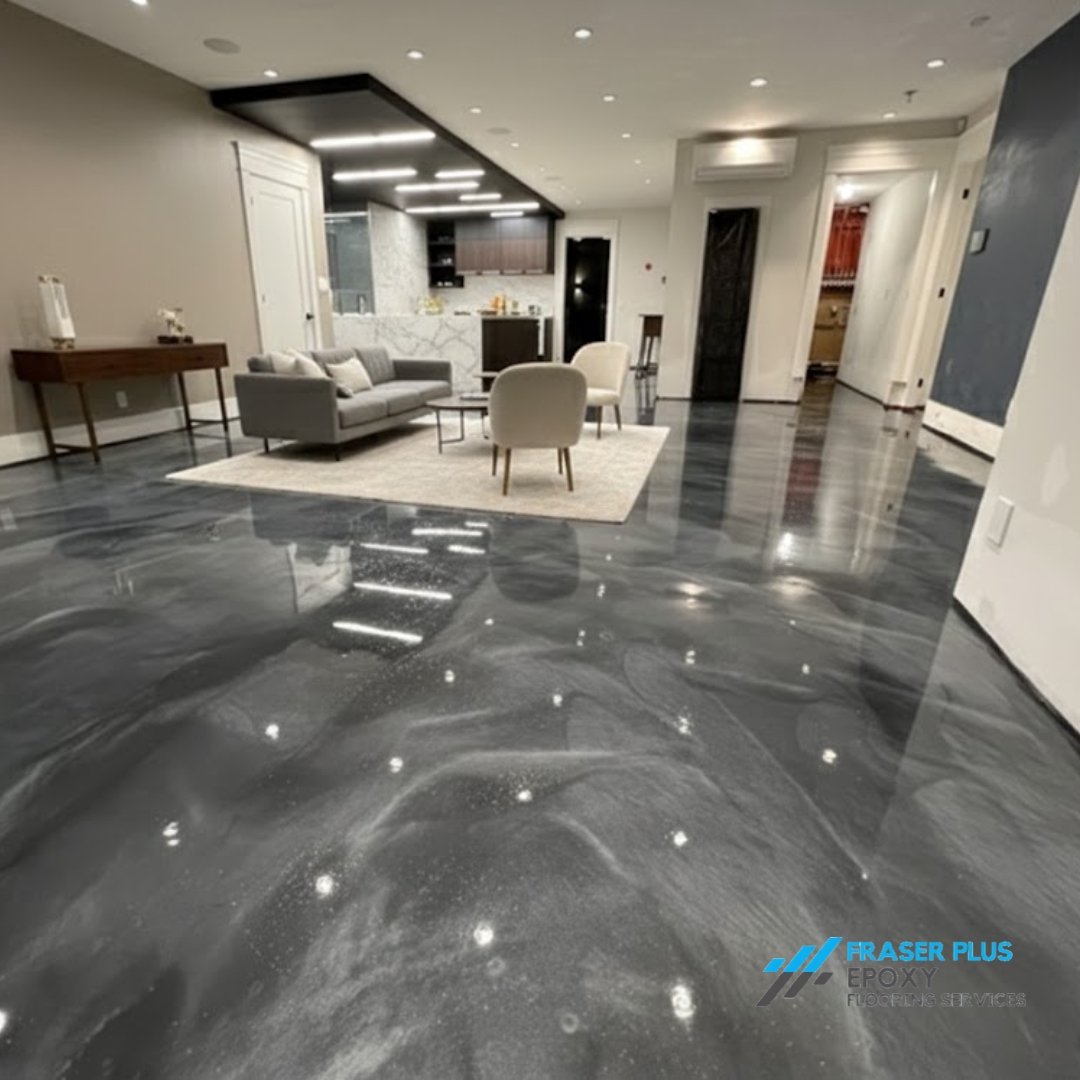
- Metallic epoxy — a decorative system that creates flowing, three-dimensional finishes using pigmented metallic powders suspended in a clear epoxy base.
- Polished concrete — a mechanical grinding and densifying process that transforms raw or previously coated concrete into a low-maintenance, high-sheen floor without adding a thick coating layer.
Each system has a different build thickness, cure window, and maintenance profile. What works well in a residential garage isn't always the right call for a commercial kitchen or a retail showroom.
Why do Metro Vancouver homeowners pick epoxy for their garage floors?
Garage floors in BC take a lot of abuse. Rain, road salt residue, motor oil, and the freeze-thaw cycles common in parts of the Fraser Valley all degrade bare concrete over time. An epoxy coating adds a protective layer that's easier to clean and more resistant to staining than raw concrete.
Vancouver's climate also means garages often carry more moisture than homeowners expect. Concrete is porous — it can absorb water vapor from the ground. A quality garage epoxy flooring installation includes moisture testing and, where needed, a moisture-tolerant primer or vapor barrier before the finish coat goes down. Skipping that step is one of the most common reasons epoxy floors peel or bubble prematurely.
Beyond function, homeowners in communities like Burnaby and Richmond increasingly want their garages to look finished — matching the rest of a renovated home. Epoxy lets you choose colors, add decorative flake blends for texture, or opt for a high-gloss solid. The result is a floor that's both practical and visually clean.
How is a commercial epoxy flooring system different from a residential one?
The chemistry is similar, but the application thickness, surface prep standards, and material specs often differ significantly. Commercial epoxy flooring systems are typically applied at a higher build — meaning more layers and more material — to handle heavier loads and more frequent cleaning cycles in business environments.
In warehouses and food-service facilities, you also need to consider slip resistance, chemical resistance, and sometimes antimicrobial properties. A standard garage chip system isn't engineered for a commercial kitchen. FraserPlus specifies systems based on your actual use case, not a one-size product.
Downtime is another consideration in commercial jobs. A well-planned installation minimizes disruption to operations — but fast-cure systems cost more than standard-cure options. That trade-off is worth discussing before you sign a contract.
What makes metallic epoxy different from standard epoxy systems?
Metallic epoxy flooring uses metallic pigment powders that move and swirl during application, creating organic patterns that look different from every angle. The result is often described as resembling flowing lava, ocean waves, or polished stone — no two floors look exactly alike.
The installation technique is more involved than a standard chip or solid-color epoxy. The applicator uses tools to manipulate the metallic layer while it's still wet, and timing matters. A metallic floor applied in the wrong temperature range or with too much humidity in the air can end up with an unintended texture or color shift.
Metallic systems are popular in showrooms, home studios, and high-end garages where aesthetics matter as much as durability. They're also a common choice in retail or commercial lobby spaces that want a distinctive floor without the cost of natural stone.
What should you know about polished concrete in BC?
Polished concrete is a grinding and chemical hardening process, not a coating. Technicians use progressively finer diamond tooling to mechanically refine the concrete surface, then apply a densifier to harden the slab and a protective guard to resist staining. The finish can range from a matte hone to a high-gloss mirror polish.
One thing to understand: polished concrete reveals your slab. If the concrete has aggregate close to the surface, that aggregate will show. If there are old repairs, cracks, or color variations, those become part of the final look — not hidden under a coating. Whether that's a problem depends on your preference and your slab's condition.
Polished concrete is often chosen for commercial spaces, modern residential interiors, and applications where a thin-profile, low-maintenance floor is the priority. It doesn't add significant height to the substrate, which matters in spaces with tight door clearances or transition thresholds.
How does the installation process typically work?
Most resinous flooring installations follow the same basic sequence: assess the slab, prepare the surface, apply the system, and let it cure. What changes is the depth and specifics of each step.
Surface preparation is the phase that most directly determines how well a coating performs. Shot blasting, diamond grinding, or acid etching opens up the concrete profile so the epoxy can bond properly. If the prep is rushed or skipped, the coating may look fine on day one and fail within months.
After prep, the installer applies a primer layer, then the body coat or decorative layer, then a topcoat for protection. Each layer needs time to cure before the next goes on. Rushing the process to meet a deadline is a common cause of long-term adhesion problems. The timeline from start to foot traffic varies by system and season — colder temperatures in the Fraser Valley can slow cure times considerably.
How do you maintain a resinous floor once it's installed?
Most epoxy and resinous floors are low-maintenance compared to bare concrete or carpet, but they're not zero-maintenance. Regular sweeping and occasional damp mopping with a pH-neutral cleaner keeps them looking their best. Avoid acidic or solvent-based cleaners, which can degrade certain topcoat chemistries over time.
In garages, it's worth keeping an eye on hot tire pickup — a phenomenon where heat from freshly driven tires can soften certain topcoat formulations and cause delamination. Higher-grade polyurethane or polyaspartic topcoats are more resistant to this than standard epoxy topcoats, and they're worth discussing with your installer before you finalize the system spec.
Commercial floors in high-traffic areas may need periodic recoating of the topcoat layer over time, depending on wear. The base system generally lasts much longer than the topcoat. Catching wear before it reaches the substrate is less expensive than a full recoat from scratch.
How do you get in touch with FraserPlus Epoxy?
If you're in Metro Vancouver or the Fraser Valley and you're ready to get a quote, the best first step is a site visit. Epoxy and resinous flooring pricing varies based on square footage, substrate condition, system type, and site access — so a meaningful estimate requires someone looking at your actual floor.
You can contact FraserPlus Epoxy to schedule a consultation. Actual costs vary based on project scope, substrate condition, and site access — contact FraserPlus Epoxy for a personalized assessment.
Frequently Asked Questions
Is epoxy flooring waterproof?
Epoxy coatings are water-resistant but not technically waterproof. They resist liquid penetration from above — spills, washdowns, rain tracked in from outside — but they don't stop moisture vapor transmission from below. If your slab has a moisture issue, that needs to be addressed during the prep phase, not after the coating is applied.
Can epoxy be applied over an existing coating?
Sometimes, but it depends on what's already there and how well it's adhered. A loose, peeling, or contaminated existing coating usually needs to be removed before a new system goes down. Applying new epoxy over a failing old coating is a shortcut that leads to early failure. A site assessment will tell you whether removal is needed.
How long does an epoxy floor installation take?
A residential garage typically takes one to two days for installation plus cure time before you can drive on it. Commercial jobs vary significantly based on square footage, system type, and whether the space needs to be phased to keep business running. Your installer should give you a realistic timeline before work starts, not after.
Does FraserPlus Epoxy serve the Fraser Valley?
Yes. FraserPlus Epoxy serves Metro Vancouver and the Fraser Valley. If you're in a community like Langley, Surrey, or the surrounding region, reach out directly to confirm availability and scheduling for your project.
Follow FraserPlus Epoxy on Google — be the first to know about floor coatings, maintenance guides, and project ideas across Metro Vancouver.
Make us your preferred source on Google