
How to Choose a Commercial Epoxy Flooring Contractor
Commercial epoxy flooring contractors near you install resinous coating systems on concrete floors in warehouses, auto shops, retail spaces, food-processing facilities, and other commercial environments. A qualified contractor handles everything from surface preparation through final topcoat — and each step directly affects how long the floor holds up. If you're in Metro Vancouver or the Fraser Valley, here's what to look for before you commit to anyone.
- Commercial epoxy suits warehouses, auto shops, retail floors, and food-service spaces that need a durable, easy-to-clean surface.
- Surface preparation — grinding and profiling the concrete — is the most critical step; poor prep leads to delamination.
- Ask any contractor about their prep process, the products they use, and what warranty (if any) they offer.
- In BC, humidity and temperature swings affect epoxy curing; a contractor who knows local conditions will plan around them.
What Does a Commercial Epoxy Flooring Contractor Actually Do?
The job starts well before any resin touches the floor. A professional contractor assesses the existing concrete slab for moisture, cracks, previous coatings, and surface profile before anything else happens on site.
From there, the process typically involves diamond grinding or shot blasting to open the concrete and create a profile the epoxy can grip. Skipping or rushing this step is the most common reason epoxy floors fail early — the coating simply lifts away from the slab.
Once the surface is ready, the crew applies a primer, then the base coat, any broadcast materials like quartz aggregate or vinyl flake, and finishes with a clear protective topcoat. The number of coats and the specific products depend on how the space is used and the level of traffic the floor needs to handle.
What Types of Commercial Spaces Use Epoxy Flooring?
Epoxy and resinous coatings appear across a wide range of commercial and industrial settings. Common applications include:
- Warehouses and distribution centres — abrasion-resistant coatings hold up under forklifts, pallet jacks, and constant foot traffic.
- Auto dealerships and service bays — chemical resistance matters where oils, solvents, and brake fluid are part of the daily routine.
- Retail and showroom floors — a polished or decorative finish improves the look of a space while keeping maintenance straightforward.
- Commercial kitchens and food-processing facilities — non-porous surfaces are easier to sanitize and reduce contamination risk.
- Medical offices and laboratories — smooth coatings support cleanliness standards and resist chemical spills.
Across Metro Vancouver and the Fraser Valley, epoxy flooring shows up in everything from Langley auto shops to Burnaby warehouses to Richmond food-processing plants. The coating system varies by environment, but the core principles of preparation and installation stay consistent.
What Should You Ask a Commercial Epoxy Contractor Before Hiring?
A few direct questions will separate contractors who do the job right from those who cut corners.
What's your surface preparation process? The answer should include mechanical preparation — diamond grinding or shot blasting. If a contractor can't explain their prep approach clearly, that's a warning sign worth taking seriously.
What products do you use? Commercial-grade epoxy and polyurethane products differ significantly from big-box store coatings. Ask for product data sheets if you want to verify what's going on your floor.
Do you offer a warranty? Warranty terms vary widely across contractors. Understand what's covered — adhesion failure, peeling, delamination — and what would void coverage before you sign anything.
How do you handle moisture in the slab? In BC, concrete slabs — especially in older industrial buildings or those near the coast — can have elevated moisture levels. A contractor who doesn't test for moisture vapour emission before coating is taking a risk that often ends in failure down the road.
Can you provide references or site examples? Any established contractor should be able to point you to recent commercial projects. If they can't, that's worth asking about before you proceed.
Learn more about what a professional installation includes on the commercial epoxy flooring services page.
How Does BC's Climate Affect Commercial Epoxy Flooring?
British Columbia's wet winters and humid summers create specific challenges for epoxy installation and long-term performance.
Temperature and relative humidity directly affect how epoxy cures. Most commercial epoxy products specify application windows for both — installing outside those ranges can lead to adhesion issues, surface cloudiness, or a finish that never fully cures. A contractor working in BC year-round should account for this in their scheduling and product selection.
Moisture in the concrete is especially common in older buildings with slab-on-grade construction. If the original moisture barrier was compromised, or if drainage around the building directs water toward the foundation, you may have elevated moisture vapour emission in the slab. This needs to be addressed — often with a moisture-mitigation primer — before any coating goes down.
Indoor spaces like parkades and underground warehouses also face thermal cycling, where floor temperatures shift between seasons. This puts different demands on the coating's flexibility and bond strength over time.
How Much Does Commercial Epoxy Flooring Cost?
Commercial epoxy flooring is typically priced per square foot, with the final number depending on several variables:
- The condition of the existing concrete — repairs, patching, and additional grinding add to the scope
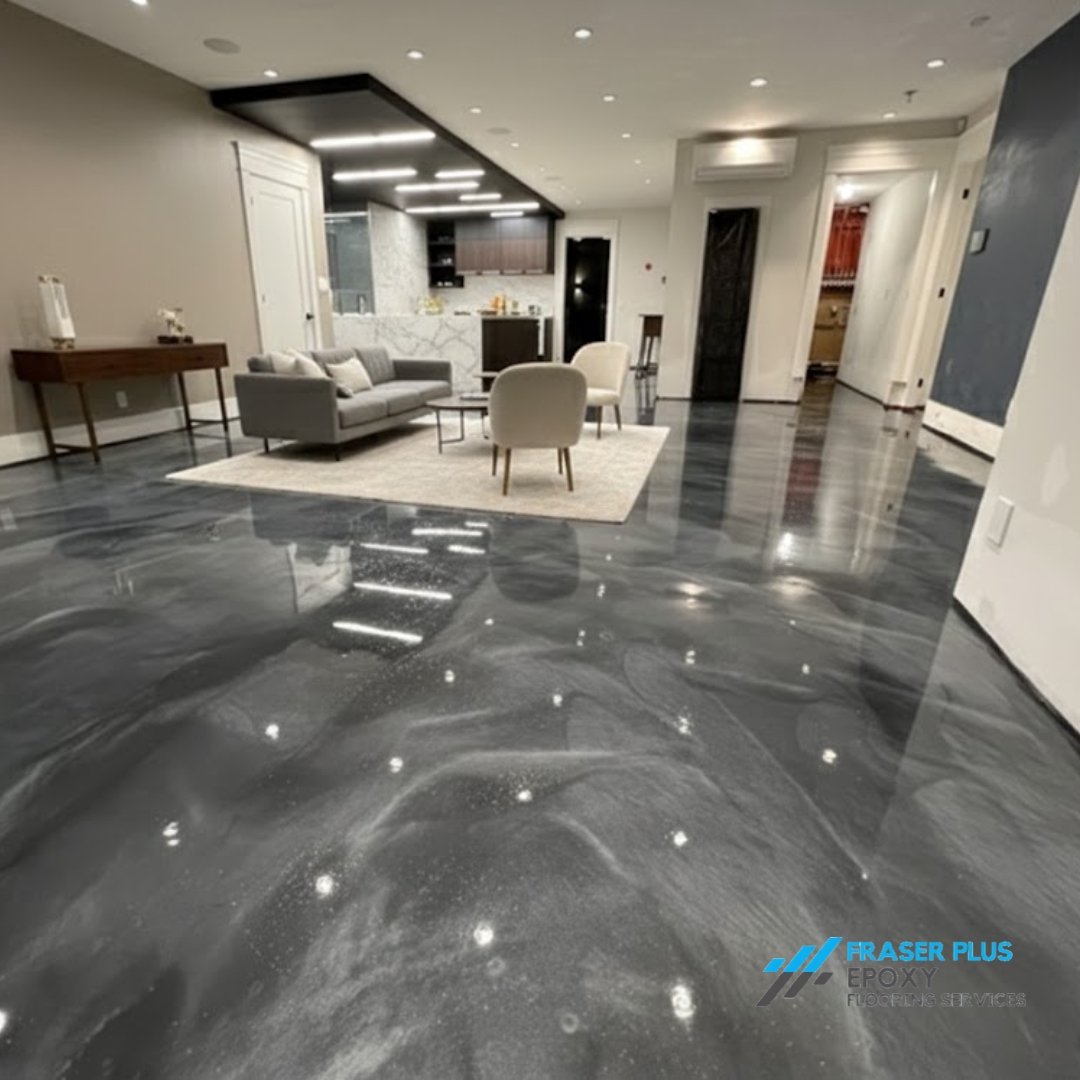
- The type of coating system — standard epoxy, broadcast flake, metallic, polyaspartic, or polished concrete all carry different material and labour profiles
- Project size and site logistics — access hours, phased installation around active operations, and floor drains or equipment pads all factor in
- The number of coats and product grades specified for the environment
In general, commercial applications involve more preparation and more durable product systems than residential garage floors, which typically means a higher installed cost per square foot. Actual costs vary based on project scope, substrate condition, and site access — contact FraserPlus Epoxy for a personalized assessment.
What's the Difference Between Epoxy and Other Commercial Floor Coatings?
Epoxy is one of several resinous flooring options. Understanding the differences helps you choose the right system for your space.
Epoxy cures as a hard, chemical-resistant surface suited for industrial environments. It's sensitive to UV exposure and can yellow in sun-exposed areas — for most interior commercial spaces, this isn't an issue.
Polyaspartic coatings cure faster than epoxy and offer better UV stability. They're sometimes used as a topcoat over an epoxy base, or as a standalone system for spaces that need a short cure window and fast return to service.
Polyurethane is commonly applied as a topcoat for its scratch resistance and slight flexibility, which helps in environments with thermal cycling.
Polished concrete is a mechanical process rather than a coating — the slab is ground and refined to a smooth, reflective finish. It's popular in retail and commercial spaces where a lower-profile, low-maintenance floor fits the design.
If you're unsure which system fits your environment, the services overview covers each option, or you can get in touch for a recommendation based on your specific space.
When Should You Get Multiple Quotes?
For most commercial flooring projects, getting two or three quotes is sensible — not because price should drive the decision, but because the quoting process reveals a lot about how a contractor approaches the work.
A thorough contractor will want to visit the site, inspect the slab, and ask how the space is used before putting a number together. A quote submitted without a site visit should raise questions — prep requirements alone can vary significantly once someone actually looks at the floor.
Pay close attention to what each quote includes in its scope. Lower-priced quotes often exclude crack repair, floor drain detailing, or multiple coats. Make sure you're comparing the same scope before making a final call.
Frequently Asked Questions
What is commercial epoxy flooring?
Commercial epoxy flooring is a multi-layer resinous coating system applied to concrete in commercial and industrial settings. It creates a hard, non-porous surface that resists chemicals, abrasion, and heavy traffic.
How long does a commercial epoxy floor last?
Lifespan depends on the quality of the prep work, the product system used, and how the floor is maintained. A properly installed commercial system holds up well under sustained use — but heavy chemical exposure or impact without an appropriate topcoat will shorten that window.
Can epoxy be applied over existing concrete in BC commercial buildings?
Yes, in most cases. The key variable is the slab's condition. Old coatings need to be removed, cracks repaired, and moisture levels tested before any installation begins. A contractor should assess the floor before quoting scope or timeline.
How long does installation take for a commercial space?
Timeline varies with project size, coating system, and cure requirements. A single-coat system in a smaller space can be finished in a day or two; a multi-layer system in a large warehouse may take several days. Your contractor should give you a realistic timeline upfront, including when the floor can safely return to service.
Follow FraserPlus Epoxy on Google — be the first to know about floor coatings, maintenance guides, and project ideas across Metro Vancouver.
Make us your preferred source on Google