
How to Choose an Epoxy Company in Metro Vancouver
TLDR
- BC's wet climate and temperature swings affect which epoxy systems perform best — a local company understands these conditions firsthand.
- Different projects need different coatings: garage floor epoxy, commercial systems, metallic finishes, and polished concrete all have distinct requirements.
- Surface preparation makes or breaks any floor coating job — ask every contractor how they prep before you commit.
- Getting two or three detailed quotes lets you compare scope and process, not just price.
Searching for an "epoxy company near me" usually means you're staring at a concrete floor that's seen better days. Maybe it's a garage with oil stains and surface pitting, a commercial space that needs something durable and easy to clean, or a basement floor that takes on moisture every rainy season. Whatever the situation, the right local contractor makes a real difference.
This guide walks through what to look for, what to ask, and why working with a contractor who knows Metro Vancouver and the Fraser Valley matters more than you might expect.
What Does an Epoxy Company Near You Actually Do?
An epoxy flooring contractor installs resinous coating systems — epoxy, polyaspartic, polyurea, or a combination — directly onto concrete substrates. The work goes well beyond rolling on a coat of paint. It involves diagnosing the existing concrete, addressing cracks or spalling, mechanically profiling the surface, applying a primer, and laying the finish system under the right conditions.
A full-service company offers a range of flooring services and helps you match the right system to your substrate, traffic level, and intended use. The goal is a coating that stays bonded and functional for years — not just something that looks good on day one.
Why Does Location Matter When Choosing an Epoxy Contractor?
BC's climate adds variables you don't see in drier parts of Canada. Metro Vancouver and the Fraser Valley experience high ambient humidity year-round, significant rainfall, and temperature swings that stress concrete. These conditions affect how coatings cure, how long they last, and which product systems perform best in local applications.
A local epoxy company understands the difference between installing a coating in a Langley garage in July versus a Coquitlam warehouse slab in February. Ambient temperature and relative humidity during application directly affect how epoxy reacts — if conditions are off, adhesion suffers and delamination becomes a real risk down the road.
Local contractors also encounter the typical construction characteristics of the region. Many older Metro Vancouver slabs were poured without a vapour barrier, which can cause moisture vapour transmission issues that push coatings off from below. A contractor who works in the area regularly has likely dealt with this before and knows how to test for it before work begins.
What Types of Epoxy Flooring Can a Local Company Install?
Not every job is a residential garage. A full-service epoxy company typically covers several categories:
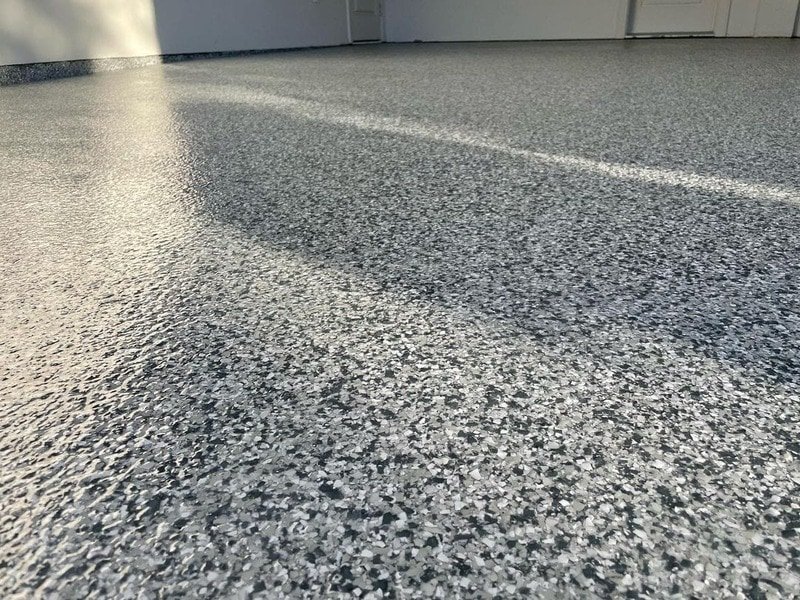
- Garage floor epoxy: The most common residential application. A proper garage epoxy flooring system uses a broadcast flake or solid colour finish over a prepared slab. It handles vehicle traffic, oil, road salt tracked in from BC winters, and the general abuse a garage floor takes.
- Commercial and industrial epoxy: Warehouses, production facilities, retail spaces, and food-service environments need systems that hold up to heavy foot traffic, equipment loads, and in some cases chemical exposure. Commercial epoxy flooring systems are typically thicker and formulated for higher demands than residential products.
- Metallic epoxy: A decorative finish that creates a swirling, three-dimensional look using metallic pigments suspended in a clear epoxy carrier. Popular in showrooms, studios, and feature floors. Metallic epoxy flooring is more technique-sensitive than standard systems — the installer's skill shows clearly in the final result.
- Polished concrete: Not a coating, but a mechanical process that grinds and hones the concrete itself to a smooth, reflective finish. Lower maintenance than coated systems over the long run, and it won't peel or delaminate. A practical option for large commercial or retail spaces.
- Polyaspartic and polyurea topcoats: Faster-curing alternatives to traditional epoxy, often used as protective topcoats over an epoxy base. They're UV-stable, which matters when the floor gets direct sunlight — standard epoxy yellows in UV exposure over time.
How Do You Evaluate an Epoxy Company Before Hiring?
The flooring industry isn't heavily regulated, so quality varies. Here's what to look at when comparing contractors:
- Surface preparation method: This is the most important factor in coating longevity. Ask whether they use diamond grinding or shot blasting — mechanical prep — or just acid etching. Mechanical prep properly profiles the concrete; acid etching alone is generally considered insufficient for sound adhesion on older or contaminated slabs.
- Product transparency: A credible contractor can tell you the manufacturer and product line they're using, and why they chose it for your project. Vague answers here are a warning sign.
- Moisture testing: Ask whether they test for moisture vapour transmission before starting. Installing over a slab with high moisture transmission without the right primer or barrier system is one of the most common causes of bubbling and peeling.
- Documented past work: Photos of completed jobs in the region are more useful than generic portfolio images. Look for examples similar to your project in setting, finish type, and scale.
- Written scope of work: A detailed quote should describe exactly what prep steps are included, how many coats, which products, and what's excluded. Verbal-only bids make it hard to compare contractors or hold anyone to a standard.
What Questions Should You Ask Before Signing a Quote?
You don't need to be an expert to ask smart questions. A few worth raising before any contract is signed:
- What does surface prep include, and will you profile the concrete mechanically?
- Are you testing for moisture vapour transmission before you start?
- What product system are you using, and who makes it?
- How many coats does this include, and what's the total dry film thickness?
- What conditions do I need to maintain after installation — temperature hold, foot traffic timing?
- What does the warranty cover, and what voids it?
A contractor with real experience will answer these directly. If the response is vague or evasive, that's useful information before you've committed to anything.
What Does the Installation Process Actually Look Like?
A properly executed epoxy floor project typically follows a clear sequence:
- Assessment: The contractor examines the slab — checking for cracks, previous coatings, contamination, and moisture levels.
- Surface preparation: Mechanical grinding or shot blasting to profile the concrete and remove contaminants. Cracks and divots are patched as needed.
- Primer: A penetrating epoxy primer seals the concrete and creates a solid bonding layer for the coats above.
- Base coat and broadcast: The colour coat is applied, and in flake systems, vinyl chips are broadcast into the wet coating before it begins to set.
- Topcoat: A clear sealer or polyaspartic topcoat protects the surface and sets the final sheen level.
- Cure and hold-off: Your contractor will give you a specific schedule based on the products used and site conditions. Don't rush this step, especially in cooler weather.
For Surrey and surrounding Fraser Valley communities, contractors often plan around cooler overnight temperatures in fall and winter, when concrete surface temperatures can drop into ranges that slow curing significantly.
How Much Does Epoxy Flooring Cost in Metro Vancouver?
Cost varies based on the size of the area, the condition of the existing concrete, the coating system chosen, and site access. A garage floor application is priced differently than a large commercial installation, and a metallic finish involves more labour than a standard broadcast flake system.
Actual costs vary based on project scope, substrate condition, and site access — contact FraserPlus Epoxy for a personalized assessment.
When comparing quotes, look at what's included rather than just the total. A lower number that excludes crack repair, skips mechanical prep, or uses a thinner product system may not hold up as well — and the cost of redoing a failed floor typically exceeds the cost of doing it correctly the first time.
Frequently Asked Questions
How do I know if my concrete is ready for epoxy?
A qualified contractor will assess this during a site visit. Key factors include the age and cure status of the concrete, moisture vapour transmission levels, existing sealers or previous coatings, and surface contamination. Some slabs need patching or crack repair before any coating goes down. Installing over a compromised substrate is the most common cause of premature coating failure, so don't skip this step.
Can epoxy be installed in winter in BC?
Yes, with the right precautions. Epoxy requires minimum ambient and surface temperatures to cure correctly, and the concrete surface needs to be warmer than the dew point to prevent moisture condensation that can compromise adhesion. A contractor experienced with BC winters will check these conditions before starting and may use supplemental heating or plan around the weather forecast.
How long does an epoxy floor last?
Longevity depends on the product system, the quality of surface preparation, traffic levels, and how the floor is maintained. The single biggest factor in coating lifespan is the prep work — not the brand of product. A well-installed system in a typical residential setting can provide years of reliable service; high-traffic commercial environments generally require more frequent maintenance or recoating cycles.
Is epoxy slippery when wet?
A smooth, sealed epoxy surface can be slippery when wet — similar to polished tile. Most contractors address this by adding an anti-slip aggregate, typically aluminum oxide or fine silica, to the topcoat. If slip resistance matters for your application, ask your contractor to include it in the topcoat specification when reviewing your quote.
Follow FraserPlus Epoxy on Google — be the first to know about floor coatings, maintenance guides, and project ideas across Metro Vancouver.
Make us your preferred source on Google