
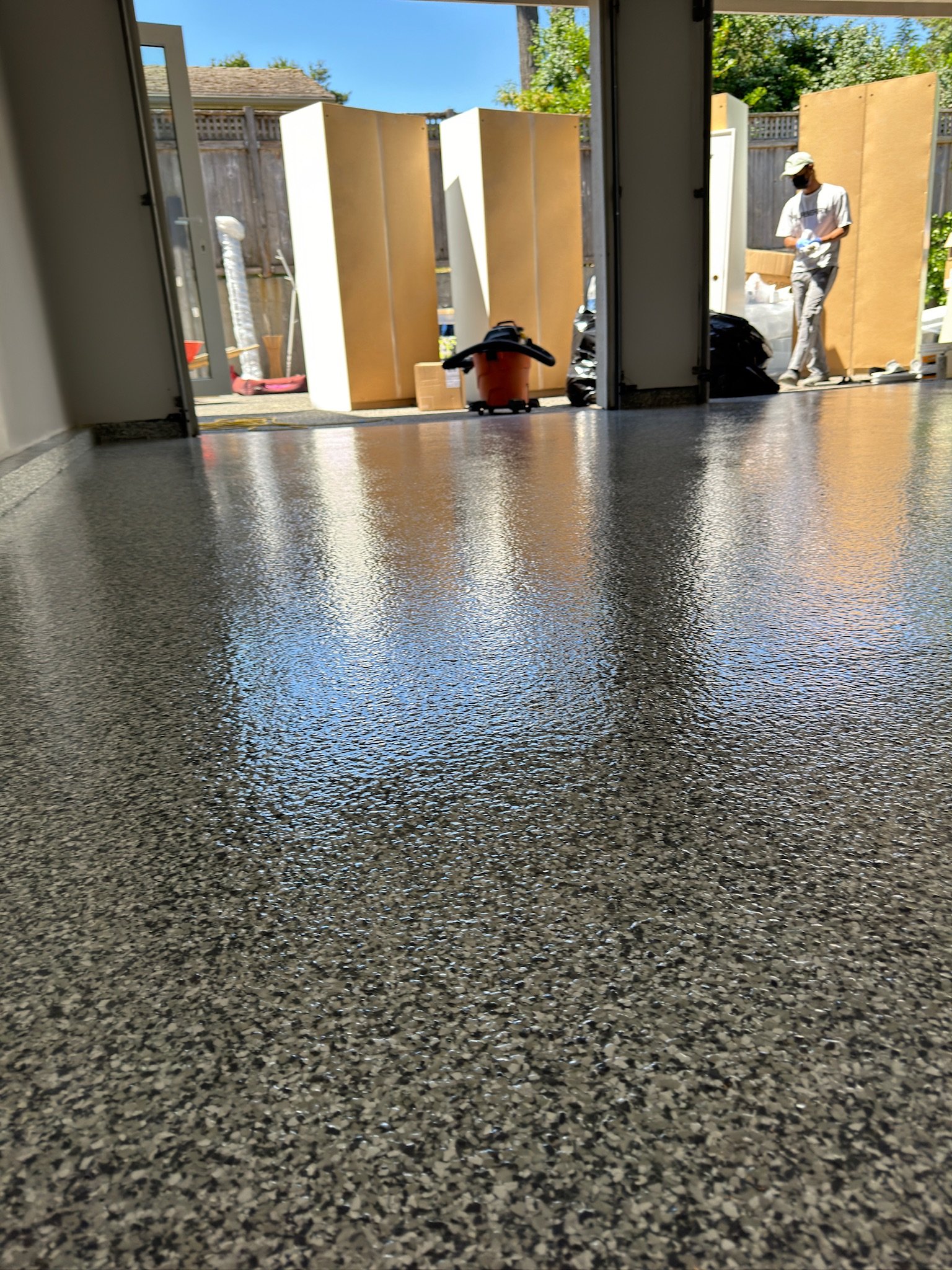
How to Vet Commercial Epoxy Flooring Contractors
Commercial epoxy flooring contractors should be judged on four things before you sign anything: proven experience with commercial-scale concrete, a written scope of work that names each coating layer, a cure-and-return-to-service schedule that fits your operating hours, and a real walkthrough of surface prep before any resin gets mixed.
- Ask for a written scope of work, not just a price — layer count, product type, and coverage should all be listed.
- Surface prep (grinding, moisture testing, crack repair) affects the finished floor more than the topcoat brand does.
- Cure and return-to-service timing varies by product and shop conditions, so get that schedule in writing.
- A site walkthrough before quoting is a good sign. A phone-only quote for a commercial space usually isn't.
What Makes Commercial Epoxy Flooring Different From a Garage Floor?
Commercial floors see more consistent traffic, heavier loads, and longer daily use than a residential garage floor. A warehouse aisle, a retail showroom, or a food-service kitchen each puts different stress on a coating — abrasion from forklift traffic, chemical exposure from cleaning products, or constant foot traffic in soft-soled shoes.
Because of that, commercial epoxy flooring systems are usually specified with more coats, higher film thickness, or a different topcoat chemistry than what goes into a two-car garage. A contractor who treats every job the same way — regardless of use case — is worth a second look.
What Should a Contractor Inspect Before Quoting a Commercial Job?
A proper quote starts with a look at the existing slab, not a guess from a photo. Things a contractor should check on site include:
- Concrete age, condition, and any visible cracking or spalling
- Existing coatings, sealers, or adhesive residue that need to be removed
- Moisture readings, since concrete moisture is a common cause of coating failure
- Expected traffic type — foot, cart, forklift, or vehicle — and any chemical exposure
- Site access and whether the space can be closed for the full install and cure window
If a contractor skips this step and quotes off square footage alone, ask why. Substrate condition is usually the biggest variable in how long a coating system lasts.
How Does the Lower Mainland Climate Affect Epoxy Installation?
Metro Vancouver and the Fraser Valley run humid for a lot of the year, and that matters for epoxy work. High relative humidity and slab moisture can interfere with how resin cures and how well it bonds to concrete, which is part of why moisture testing is a standard step rather than an optional one.
Facilities in Surrey, Burnaby, Langley, and Coquitlam all deal with the same regional climate pattern, so the prep and scheduling considerations are similar across the region. A contractor working in this area should be factoring seasonal humidity and temperature into the install timeline, not just the calendar.
What Questions Should You Ask Before Hiring a Commercial Epoxy Contractor?
A short list of questions can tell you a lot before you sign a contract:
- What products and coating system are you specifying, and why for this space?
- What does your surface prep process look like, step by step?
- How will you handle moisture testing, and what happens if a reading comes back high?
- What's the realistic timeline from prep to full return-to-service?
- What does the warranty or workmanship guarantee actually cover, in writing?
- Can you provide references from other commercial jobs of a similar size or use case?
A contractor who answers these clearly, in plain language, is generally easier to work with once the job starts.
How Long Does Commercial Epoxy Installation and Cure Take?
Timelines depend on floor size, the number of coating layers, ambient temperature, and the specific product system used. As a general pattern, epoxy and resinous coatings typically allow light foot traffic sooner than full vehicle or heavy-cart traffic — the manufacturer's technical data sheet for the specific product will list exact windows, and a contractor should confirm that schedule with you in writing rather than giving a verbal estimate.
For a commercial space, planning around a closure window matters as much as the install itself. Ask early whether the job can be phased — section by section — to keep part of the space operating, or whether a full shutdown is required.
What Does Commercial Epoxy Flooring Cost?
Cost depends on substrate condition, square footage, the coating system specified, and site access. Industry pricing for commercial and resinous flooring is generally quoted per square foot and can vary widely based on how much repair the existing slab needs and how many coating layers the space requires.
Actual costs vary based on project scope, substrate condition, and site access — contact FraserPlus Epoxy for a personalized assessment.
How Does Metallic Epoxy Compare to Standard Epoxy for a Commercial Space?
Metallic epoxy uses pigments that create a marbled, dimensional look, and it's often chosen for showrooms, lobbies, or retail spaces where appearance matters as much as durability. Standard epoxy systems — solid color or flake — tend to be the more common choice for warehouses, back-of-house areas, and spaces where consistent, easy-to-clean performance is the main goal.
Neither option is automatically the better system. The right choice comes down to how the space is used, how much traffic it sees, and what the business wants the floor to communicate to customers or staff walking through it.
What Should You Expect During the Installation Process?
A typical commercial job moves through a few general stages: surface prep (grinding or shot-blasting to open the concrete pore structure), repair of cracks or low spots, moisture and condition checks, a primer coat, the base coat (with any color, flake, or metallic pigment), and one or more topcoats for durability and chemical resistance.
Ventilation, odor, and site access all matter during this window, especially in an occupied commercial building. A contractor should walk you through what to expect day by day, not just hand over a start date and an end date.
How Do You Choose the Right Contractor for Your Space?
The floor a business ends up with reflects the prep work far more than the topcoat color. Whether you're comparing quotes for a warehouse in Richmond, a retail unit in Burnaby, or a production floor in Langley, the same questions apply: what's the substrate condition, what system is being specified, and what's the realistic schedule to get back to full operation.
FraserPlus Epoxy works across commercial and residential flooring projects throughout Metro Vancouver and the Fraser Valley. If you're comparing contractors for a commercial space, get in touch to talk through your site's specifics.
Frequently Asked Questions
Is commercial epoxy flooring different from residential epoxy?
The core materials are similar, but commercial jobs are typically specified with more coating layers, higher film thickness, or different topcoat chemistry to handle heavier and more constant traffic than a residential garage sees.
How soon can we reopen the space to foot and vehicle traffic?
It depends on the specific product system and ambient conditions. Ask your contractor for the manufacturer's technical data sheet and a written return-to-service schedule before work begins.
Can commercial epoxy go over old tile or vinyl?
Existing flooring generally needs to be removed and the slab prepped down to bare, sound concrete. A contractor should confirm this during the site inspection rather than assuming it during the quote.
What's the difference between epoxy and polished concrete for a commercial space?
Epoxy adds a coating layer on top of the slab, which allows for color, flake, or metallic finishes and added chemical resistance. Polished concrete works with the existing slab itself through mechanical grinding, giving a different look and maintenance profile. Which one fits depends on the space's use and appearance goals.
Follow FraserPlus Epoxy on Google — be the first to know about floor coatings, maintenance guides, and project ideas across Metro Vancouver.
Make us your preferred source on Google