
5 Questions to Ask Before Hiring an Epoxy Contractor
When you search for an "epoxy company near me," the results can feel overwhelming. There's no shortage of contractors claiming to offer the best work in Metro Vancouver and the Fraser Valley — but not all installations are equal.
- Substrate preparation is what separates a lasting floor from one that peels early — not the brand or color of the coating.
- BC's coastal humidity and seasonal temperature changes affect how and when epoxy can be properly applied. Local experience with these conditions matters.
- The right contractor will assess your slab in person before quoting. Anyone pricing a job by phone without a site visit is likely skipping important steps.
- Coating type matters: garage epoxy, commercial systems, and decorative finishes like metallic epoxy have different performance requirements and installation processes.
What Should You Actually Look for in a Local Epoxy Company?
The most important thing to look for isn't the lowest quote or a polished website. It's how the contractor talks about surface preparation. Mechanical grinding, shot blasting, crack repair, and moisture testing are the steps that determine whether your floor lasts for years or starts to delaminate early.
Ask any contractor you're considering: "How do you prepare the substrate before coating?" If you get a vague answer, or the question gets brushed past, that's a warning sign. A contractor who leads with prep understands how epoxy actually works.
You also want someone who specifies their products clearly. There's a significant difference between consumer-grade box store kits and commercial-grade, two-part epoxy systems. A professional should be able to tell you exactly what they're installing and why it's the right fit for your space.
Why Does "Near Me" Actually Matter When Choosing an Epoxy Contractor?
Proximity isn't just about convenience. A contractor based in Metro Vancouver or the Fraser Valley understands the specific conditions your slab deals with — including the high ambient humidity along BC's coast and the moisture levels common in below-grade or slab-on-grade floors in this region.
Epoxy is sensitive to temperature and humidity during application. If the dew point is too close to the surface temperature, or the concrete is too cold, proper adhesion becomes much harder to achieve. A local contractor who works in these conditions regularly knows how to schedule and adjust accordingly.
There's also the matter of accountability after the job is done. If something needs attention under warranty, a local company can get there quickly. A contractor from outside the area is harder to reach and harder to hold to their commitments.
What Questions Should You Ask Before Hiring an Epoxy Flooring Company?
Before you sign anything, here are the questions worth asking every contractor:
- Will you do a site visit and moisture test before quoting? Moisture in a concrete slab is the most common cause of epoxy delamination. Any contractor skipping this step is cutting corners from the start.
- What surface preparation method do you use? Grinding and shot blasting open the concrete profile for better adhesion. Acid etching alone is generally considered insufficient for professional-grade coatings.
- What specific product system are you installing? Ask for the product name and technical data sheet. This tells you the mil thickness, expected cure times, and chemical resistance properties.
- What does your warranty cover, and for how long? Understand exactly what failure modes are included versus excluded before you commit.
- Can you share references or examples of similar past projects? Photos and client contacts give you a realistic sense of their actual results.
If a contractor can't answer these questions clearly and confidently, that tells you something important about how they run their work.
What's the Difference Between Garage Epoxy, Commercial Epoxy, and Metallic Epoxy?
Not every epoxy system is designed for the same environment, and the coating that works for a residential garage may not be appropriate for an industrial warehouse or a retail showroom. Understanding the basic differences helps you have a more informed conversation with any contractor.
Garage epoxy is typically a two-part system designed to handle vehicle traffic, oil and chemical drips, hot tire pickup resistance, and the freeze-thaw cycles common in BC garages. A properly prepped and coated residential garage floor should hold up well under normal daily use. Learn more about what a quality installation involves on the garage epoxy flooring services page.
Commercial epoxy is engineered for heavier demands — forklifts, industrial equipment, chemical resistance, heavy foot traffic, and regulatory requirements for slip resistance in food service or healthcare environments. The coating thickness, system build, and surface profile requirements are typically more involved than a residential garage install. Details on what commercial projects involve are on the commercial epoxy flooring services page.
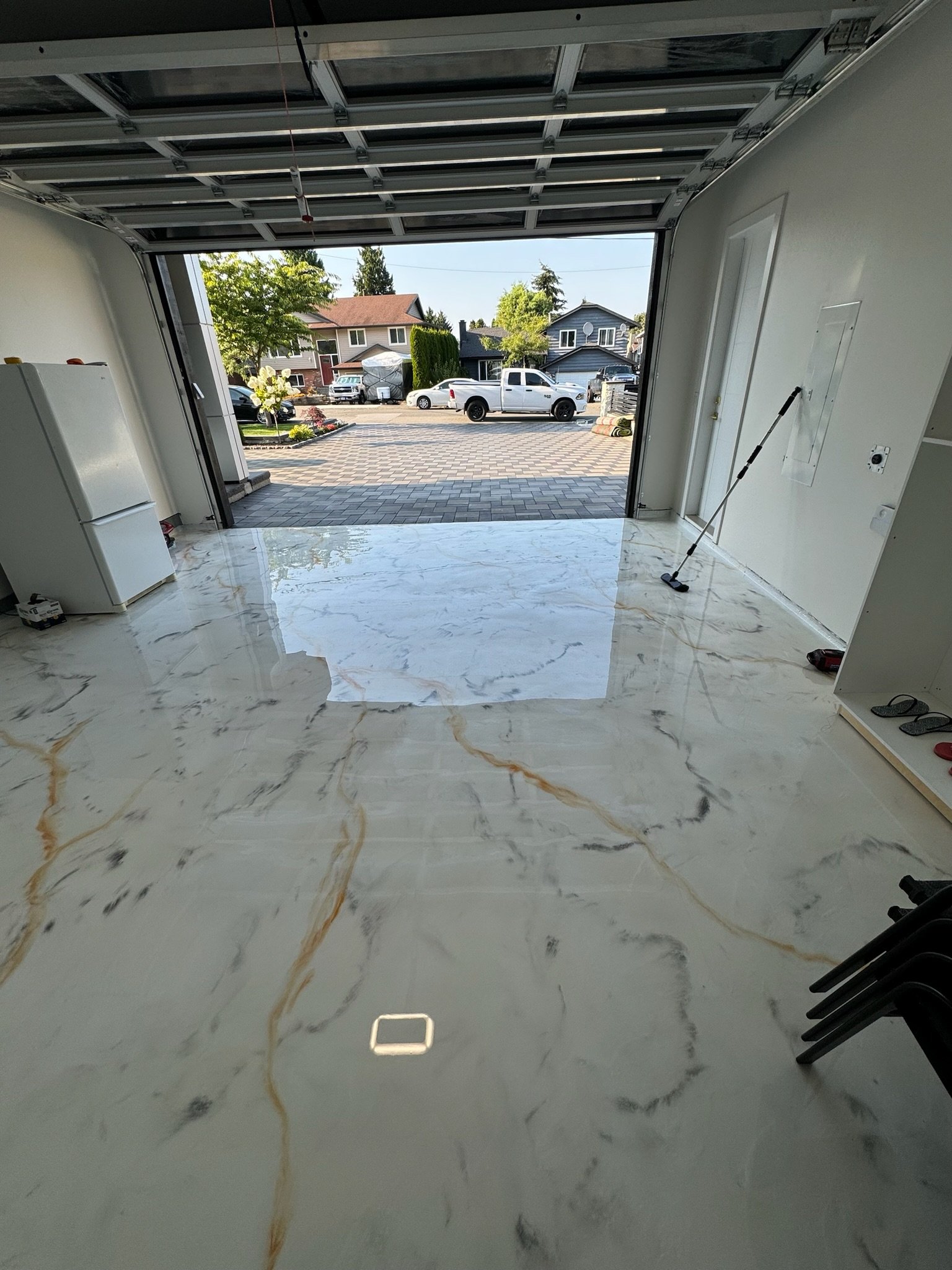
Metallic epoxy is a decorative system that creates a three-dimensional, flowing effect using metallic pigments suspended in an epoxy or polyurethane base. It's popular for showrooms, high-end residential spaces, and retail environments where appearance is a priority alongside durability. The install requires specific technique and experience — it's not a standard base coat and broadcast.
Choosing the right system starts with being clear about how the space will actually be used, what traffic or loads it will see, and what your expectations are for long-term performance.
How Do BC's Climate Conditions Affect an Epoxy Installation?
The Lower Mainland and Fraser Valley get a lot of rain and maintain relatively high ambient humidity year-round. This has real implications for epoxy installations.
Concrete slabs in BC — especially in older buildings or homes — often carry higher moisture vapor transmission rates than slabs in drier climates. Before coating, a contractor should perform moisture testing using calcium chloride or relative humidity in-situ probes. Skipping this and applying epoxy over a high-moisture slab is a reliable way to end up with a delaminating floor.
Application temperature windows also matter. Most professional epoxy systems have minimum and maximum requirements for both air and substrate temperature. Contractors working through BC's shoulder seasons — late fall or early spring — need to plan installations carefully and may need to use supplemental heating or adjust their schedule to hit the right window.
Garages in BC also deal with vehicles that bring in wet, salt-laden road spray in winter. A quality garage coating needs to handle repeated moisture exposure without surface degradation or adhesion loss along the perimeter.
What Are the Warning Signs of a Poor Epoxy Installation?
Knowing what to watch for helps you ask better questions when hiring and recognize problems early if they develop.
- Peeling or delamination — usually caused by inadequate surface preparation, moisture in the slab at the time of application, or both.
- Bubbling or pinhole formation — can result from outgassing through the concrete when the slab wasn't properly profiled, or when coating was applied too thick in a single pass.
- Uneven color or texture — often a sign of inconsistent application technique or improperly mixed product.
- Hot tire pickup — when the coating softens and sticks to warm tires, the product wasn't formulated for vehicle traffic, or the wrong system was specified for the environment.
- Single-coat installations — most professional systems involve a primer, base coat, and topcoat. Single-coat applications are generally not durable enough for regular vehicle or foot traffic.
How Should You Compare Quotes from Different Epoxy Companies?
A quote isn't just a number — it's a scope of work. When comparing proposals from different contractors, look at what's actually included:
- What surface preparation method is specified, and is it itemized in the quote?
- What product system is being installed, how many coats, and at what mil thickness?
- Are crack repairs, joint filling, or floor leveling included, or excluded and priced separately?
- What does the warranty cover, and does it include both materials and labor?
- Is moisture testing part of the scope, and what's the plan if elevated moisture is found?
A lower quote that skips prep or uses a thinner coating system will often cost more in the long run when the floor needs to be stripped and re-done. Compare scopes, not just price. Actual costs vary based on project scope, substrate condition, and site access — contact FraserPlus Epoxy for a personalized on-site assessment.
Frequently Asked Questions
How long does epoxy flooring typically last?
Longevity depends on the quality of the installation, the coating system used, and how the floor is maintained. A professionally installed, commercial-grade system on a properly prepared substrate can last many years under normal use. Floors that see heavy traffic or harsh chemical exposure may need recoating sooner. Inadequate substrate preparation is the most common reason floors fail early.
Can epoxy be applied over existing concrete in a BC garage?
In most cases, yes — but the slab has to be assessed first. The concrete needs to be structurally sound, free of active moisture issues, and properly profiled for adhesion. Old coatings, sealers, and contamination like oil or grease must be removed before any coating goes down. A thorough in-person assessment before quoting is the only way to know what you're actually working with.
How long does a typical epoxy installation take?
Timelines vary depending on the system, the size of the space, and cure requirements for the specific products used. A standard residential garage might take one to two days of active work, followed by a cure period before the floor can accept vehicle traffic. Multi-layer commercial systems take longer. Your contractor should give you a clear timeline as part of the proposal.
What's the difference between epoxy and polyaspartic floor coatings?
Polyaspartic coatings are a type of polyurea that cure faster than traditional epoxy and can be applied across a wider temperature range. They're often used as a topcoat over an epoxy base, or as a standalone system where a faster return-to-service time matters. They're not inherently better or worse than epoxy — the right choice depends on the project conditions, timeline, and intended use of the floor. A knowledgeable contractor can walk you through the trade-offs for your specific situation.
Follow FraserPlus Epoxy on Google — be the first to know about floor coatings, maintenance guides, and project ideas across Metro Vancouver.
Make us your preferred source on Google