
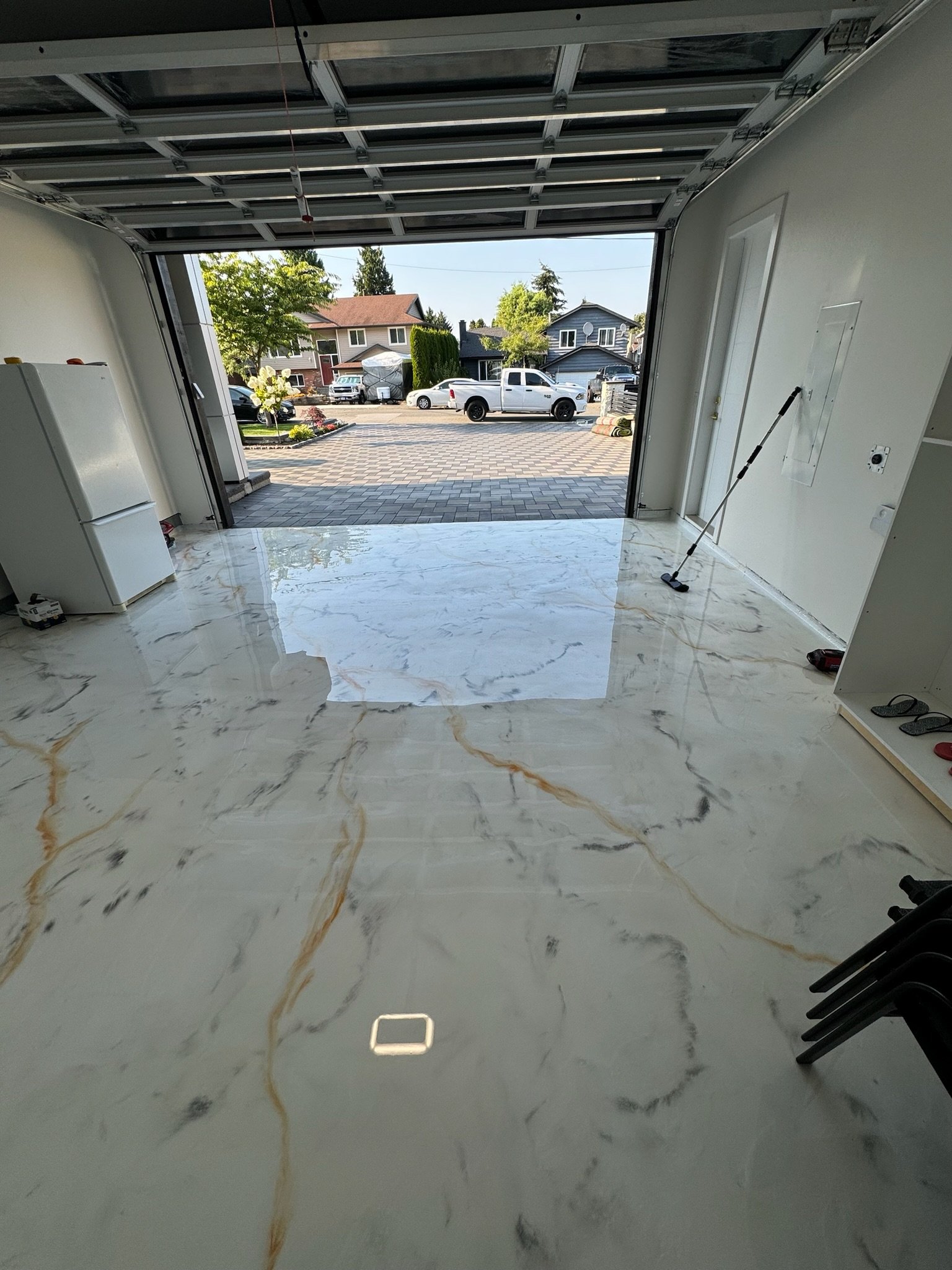
5 Questions to Ask Before Hiring an Epoxy Company in BC
When you type epoxy company near me into a search bar, you're likely looking at a garage floor that's started to dust, pit, or stain — or a commercial space that needs a floor that can actually keep up with the work. The search is easy. Choosing the right contractor isn't.
Here's what to understand before you call for quotes in Metro Vancouver or the Fraser Valley.
TLDR
- Not all epoxy companies offer the same systems — garage coatings, metallic epoxy, and polished concrete are different trades with different skill sets.
- BC's wet winters and temperature swings affect which products perform and when they can be applied.
- Surface prep matters more than the topcoat — that's where most installation failures start.
- Asking a few targeted questions before you hire can save you from a costly re-do.
Why Do Results for Epoxy Companies Near Me Vary So Much in Quality?
The epoxy flooring industry has a low barrier to entry. Anyone can pick up a big-box garage kit and call themselves a floor coating contractor. That gap between a weekend installer and a trained applicator isn't visible in search results — it shows up in the finished floor.
Professional resinous flooring involves surface preparation (typically diamond grinding or shot blasting), moisture testing, primer selection, broadcast technique, and topcoat application. Each step has its own failure points. A contractor who rushes or skips prep is the most common reason floors peel within the first year or two.
When you're comparing quotes across the Lower Mainland, you're often comparing very different scopes of work under the same label.
What Types of Epoxy Flooring Does a Full-Service Company Offer?
Not every company does every type of floor. Some focus on residential garages. Others work primarily in commercial and industrial settings. A smaller number specialize in decorative resinous systems. Knowing the main categories helps you ask smarter questions when you call.
The main flooring services available through a full-service epoxy company:
- Garage floor epoxy: Polyaspartic and epoxy coatings for residential garages. These need to handle tire marks, road salt tracked in from BC winters, and the thermal cycling that happens in attached garages through cold months.
- Commercial epoxy flooring: Warehouses, restaurants, retail spaces, and medical facilities each carry different requirements for slip resistance, chemical resistance, and long-term durability. See commercial epoxy flooring options.
- Metallic epoxy: A decorative system that produces a three-dimensional marbled or liquid-metal appearance. It's common in showrooms, studios, and upscale residential spaces.
- Polished concrete: Mechanical grinding and densification of the existing slab with no coating added. The result is a hard, low-maintenance surface that works with the character of the concrete itself.
Does BC's Climate Change Which Epoxy Products Work Best?
Yes, and it's worth understanding why. Epoxy resins are temperature-sensitive during application. If the surface or ambient temperature drops too low, the chemical cure slows or stops entirely. In Greater Vancouver and the Fraser Valley, that usable window closes earlier in fall and opens later in spring than it does in drier, warmer climates.
Concrete in the Lower Mainland also tends to hold more moisture than slabs in drier regions. Moisture vapor transmission — water moving up through the slab from below — is one of the main reasons epoxy delaminate from concrete. A contractor who doesn't test for moisture before grinding is taking a real risk with your floor.
Products like polyaspartic coatings cure faster and tolerate lower application temperatures than traditional 100% solids epoxy. In a region with short dry-weather windows, that scheduling flexibility matters. Ask what products your contractor is using and why — that conversation tells you a lot about their experience level.
What Does Good Surface Preparation Actually Look Like?
Prep is where most quality shortcuts happen — and it's the phase that's hardest to verify once the topcoat goes on. Good substrate preparation typically includes:
- Diamond grinding or shot blasting the entire floor surface, not just the damaged sections
- Filling cracks and divots with the appropriate filler for the system and use type
- Testing concrete moisture levels before primer application
- Applying a penetrating primer that bonds into the concrete rather than sitting on top of it
Before you sign anything, ask the contractor to walk you through their prep process. A confident, specific answer is a good sign. Vague answers like "we'll rough it up and go" are a warning.
What Accounts for Large Price Differences Between Quotes?
When prices vary significantly for the same job, the difference almost always comes down to a few things:
- Product quality: Thin water-based coatings cost less than thick 100% solids systems. They may look similar on day one and fail much sooner under real use.
- Prep depth: A full diamond grind takes more time and equipment than a light acid etch. Contractors who skip it save money on the bid; the floor pays for it in peeling and delamination later.
- Number of coats: A single topcoat isn't the same as a primer, base coat, and topcoat system.
- What the scope includes: Some quotes assume an empty, unobstructed space. Others account for moving equipment or working around active business hours.
Getting two or three quotes with itemized scopes — not just totals — is the most reliable way to understand what you're actually comparing.
How Much Does Epoxy Flooring Cost in Metro Vancouver?
Epoxy flooring costs in BC depend on the system selected, the area being coated, the condition of the existing slab, and site-specific factors like accessibility or active business operations. Applying a general average to a specific project rarely gives you a useful number. Substrate condition alone can shift the total significantly — a heavily pitted warehouse floor requires more prep hours than a clean new residential slab.
Actual costs vary based on project scope, substrate condition, and site access — contact FraserPlus Epoxy for a personalized assessment.
What Should You Ask a Local Epoxy Company Before Hiring?
A few questions that separate contractors who know their trade from those who don't:
- What prep method do you use, and why? Diamond grinding is the standard for adhesion. If they can't explain their method clearly, that's worth paying attention to.
- What products are you installing, and what's the solids content? Higher solids content generally means more film build and better long-term durability.
- How do you handle moisture in the slab? They should test for it and have a protocol based on what the reading shows, not a one-size approach for every job.
- Can you show photos of comparable jobs? A residential garage floor and a large commercial warehouse are very different projects. Seeing similar work gives you realistic expectations for your own space.
Is a Local Epoxy Company Better Than a National Chain?
Contractors serving Metro Vancouver and the Fraser Valley tend to know the regional conditions — the moisture levels, the temperature windows for installation, and the substrate challenges common in BC's building stock. A national brand that deploys subcontractors may or may not bring that regional experience to your job.
Company size alone doesn't determine quality. What matters is who's actually on-site, what products they're using, and how thorough their prep process is. For projects anywhere in the Lower Mainland, local availability for walk-throughs and any follow-up visits also factors into the equation.
FAQ
Can epoxy be applied over an existing floor coating or paint?
In most cases, the old layer needs to come off first. Applying epoxy over an existing coating is one of the most common causes of delamination. A qualified contractor will assess the current surface and recommend the right removal method before anything new goes down.
How long before I can use the floor after it's been coated?
Cure times vary by product type and ambient temperature. Most systems need at least 24 hours before light foot traffic, with vehicle traffic typically requiring a longer wait. Your contractor should give you a specific timeline based on the product and the site conditions on the day of the job.
Does epoxy hold up through a cold BC winter in a garage?
Professional-grade coatings handle cold temperatures well once they've fully cured. The sensitivity is during application — epoxy doesn't cure properly when it's too cold. Experienced contractors in the Lower Mainland either schedule around temperature windows or use cold-weather-compatible products like polyaspartic to keep projects moving reliably year-round.
What's the difference between epoxy and polyaspartic flooring?
Both are resinous floor coatings, but polyaspartic cures significantly faster and is less sensitive to low application temperatures. Polyaspartic is often used as the topcoat over an epoxy base, combining epoxy's adhesion properties with polyaspartic's UV stability and faster return-to-service time — a common pairing for garage and commercial jobs in BC.
Follow FraserPlus Epoxy on Google — be the first to know about floor coatings, maintenance guides, and project ideas across Metro Vancouver.
Make us your preferred source on Google