
5 Questions to Ask Before Hiring an Epoxy Contractor
If you're searching for an "epoxy company near me" in Metro Vancouver or the Fraser Valley, you're not short on options — but the quality difference between contractors is significant. Knowing what to look for before you sign a contract can save you from a coating that peels or fails within a year.
Quick Takeaways
- Surface preparation — not the coating itself — is the biggest factor in how long an epoxy floor lasts.
- In BC's coastal climate, moisture testing before application is non-negotiable.
- Different spaces need different systems: garage floors, commercial floors, and metallic finishes all have unique requirements.
- A reputable epoxy company should be transparent about their prep process, product lines, and what to realistically expect.
What Does an Epoxy Flooring Company Actually Do?
An epoxy flooring contractor applies resinous coatings to concrete substrates — everything from residential garage slabs to large commercial floors. The work isn't just pouring product onto concrete. A proper installation involves surface grinding or shot blasting, moisture testing, crack repair, priming, and multiple coating layers depending on the system.
Most companies offering epoxy also work with related systems: polyurea, polyaspartic, urethane cement, and polished concrete. These are all different chemistries with different performance profiles, so a knowledgeable contractor will help you match the right system to your specific use case rather than defaulting to a single product.
Why Does Location Matter When Choosing an Epoxy Contractor?
A local epoxy company understands the specific conditions in your area — and in Metro Vancouver and the Fraser Valley, that matters more than most homeowners realize. BC's coastal climate brings high ambient humidity, significant temperature swings between seasons, and a long rainy period. All of these affect how concrete behaves and what surface preparation steps are necessary before any coating goes down.
A contractor unfamiliar with the region might skip humidity or moisture-vapor testing — a common cause of delamination and early coating failure. Local experience also means familiarity with typical slab conditions in Lower Mainland construction, whether the project is in Surrey, Burnaby, Langley, or further into the valley.
What Should You Look for in an Epoxy Company Near You?
Not all epoxy contractors work the same way. Here are the factors that separate a quality installation from one you'll need to redo in a few years.
Surface Preparation
This is the single most important step in the process. A professional contractor should use mechanical preparation — typically diamond grinding or shot blasting — to open the concrete's pores and create a proper bond profile. If a company skips mechanical prep or relies only on acid etching, that's a warning sign worth taking seriously.
Moisture Testing
Concrete in BC can hold significant moisture, especially in basements and ground-level slabs. A reputable company will test for moisture-vapor emission before any coating is applied. Installing epoxy over a slab with excessive moisture is one of the most common causes of premature failure and delamination.
Product Transparency
Ask what products the contractor is using and why. Consumer-grade epoxy kits from hardware stores are very different from commercial-grade, high-solids epoxy systems. A professional should be able to explain the product line they're using and what performance characteristics you can expect in plain language.
Realistic Expectations
No coating lasts forever, and no honest contractor will promise a maintenance-free floor for life. A good company will walk you through realistic maintenance requirements, what causes premature wear, and what's covered if problems arise after installation.
What Types of Epoxy Services Should a Good Company Offer?
Different applications call for different systems. A full-service epoxy company should be able to handle a range of project types. Here's a quick breakdown of the main categories you're likely to encounter.
Garage Floor Epoxy
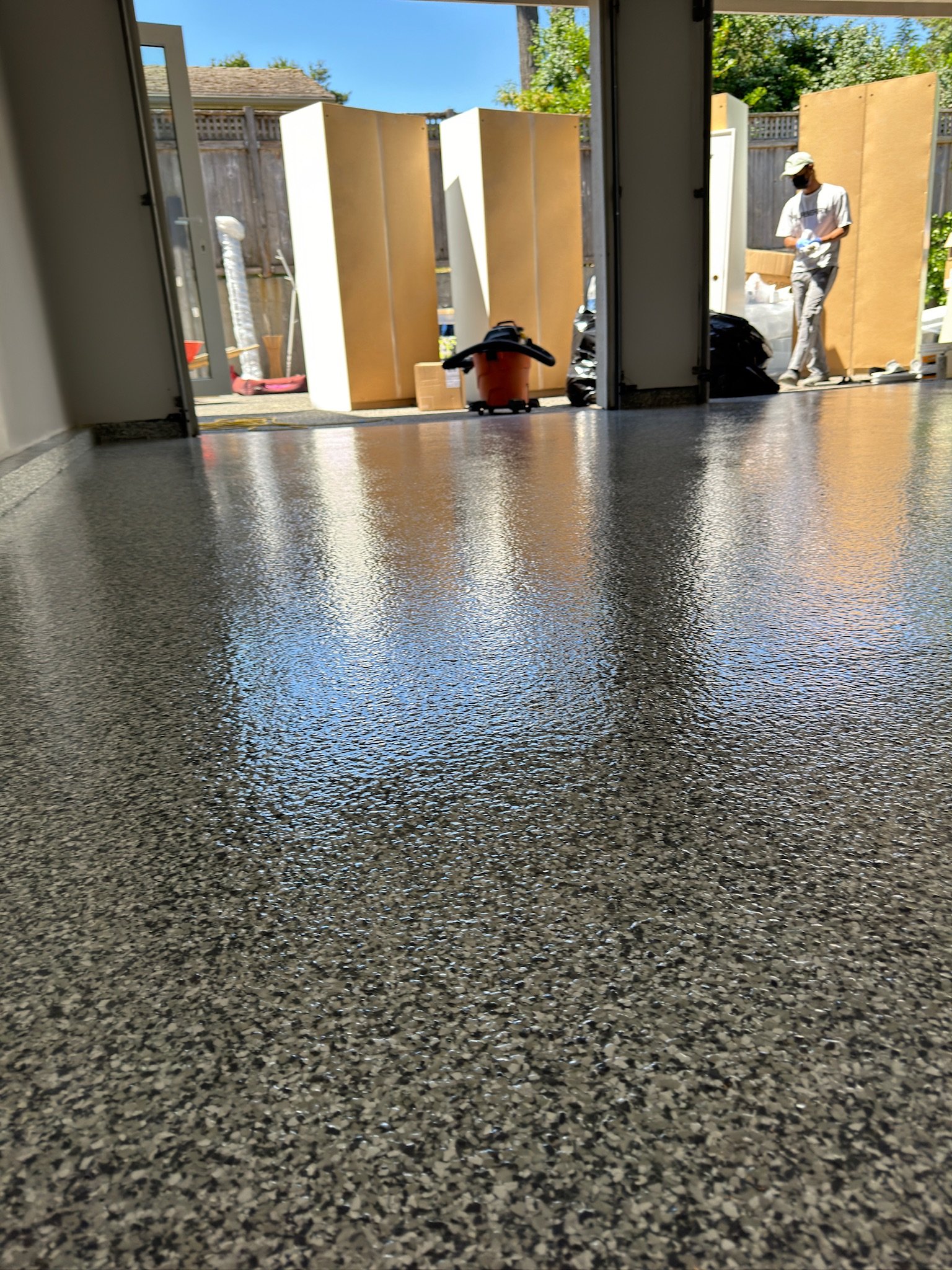
Residential garages are the most common application for epoxy coatings. A garage epoxy floor needs to handle vehicle traffic, oil and chemical exposure, and BC's temperature fluctuations. Polyaspartic topcoats are popular in this application because they cure faster and hold up to UV exposure better than standard epoxy alone.
Commercial Epoxy Flooring
Commercial and industrial environments require higher-performance systems designed for heavy use. Commercial epoxy flooring in warehouses, light manufacturing, retail, and food-service environments often calls for broadcast systems, slip-resistant additives, or chemical-resistant topcoats. The prep and application requirements are more demanding than a residential garage job.
Metallic Epoxy
Metallic epoxy is a decorative system that uses metallic pigments suspended in epoxy resin to create a distinctive, flowing visual effect. It's popular in showrooms, retail spaces, and upscale residential interiors. The application is more technique-dependent than a standard broadcast system, so it requires an applicator with hands-on experience in this specific finish.
Polished Concrete
Polished concrete is a different process altogether — it mechanically grinds and refines the concrete surface itself rather than applying a coating on top. The result is a durable, low-maintenance finish that works well in both commercial and residential settings. Some contractors offer both polished concrete and epoxy, which is useful if you want to compare options before committing.
How Do Epoxy Floors Hold Up in Metro Vancouver's Climate?
The Lower Mainland and Fraser Valley have a climate that can be tough on concrete coatings. Cold, wet winters followed by warmer summers create thermal cycling — concrete expands and contracts with temperature, which puts ongoing stress on any coating system. A quality installation accounts for this through thorough surface prep, the right product selection, and adequate film thickness.
Garages in BC also get significant moisture tracked in from rain and snow, along with the occasional freeze in colder pockets of the Fraser Valley. A good garage floor coating should shed water easily and resist salt and mild chemical exposure from vehicle fluids. When comparing contractors, ask specifically how their recommended system is designed to perform in wet, cold, and thermally variable conditions.
What Questions Should You Ask an Epoxy Company Before Hiring?
Before committing to any contractor, a few direct questions will tell you a lot about how they work and whether they'll do the job properly.
- How do you prepare the surface? The answer should mention mechanical grinding or shot blasting, not just a chemical wash.
- Do you test for moisture before applying? In BC, this step shouldn't be optional or skipped to save time.
- What products are you using, and what are their specs? A professional contractor can answer this clearly and specifically.
- What's the cure time before the floor can be used? This directly affects your scheduling and access to the space.
- What's your process if the coating fails or delaminate? Understand what recourse you have before the work starts.
For a full look at what FraserPlus Epoxy offers across Metro Vancouver and the Fraser Valley, visit the services overview or reach out for a site assessment.
How Do Epoxy Flooring Costs Generally Compare in BC?
Epoxy flooring costs vary widely depending on the system, the size of the space, surface condition, and what preparation the slab requires. A basic single-color garage system costs less than a decorative metallic installation. Commercial projects with broadcast flake systems, chemical-resistant topcoats, or floor marking add additional complexity and material cost.
Actual costs vary based on project scope, substrate condition, and site access — contact FraserPlus Epoxy for a personalized assessment.
Frequently Asked Questions
How long does a professionally installed epoxy floor last?
With proper surface preparation and routine maintenance, a professionally installed epoxy floor can hold up for many years under normal use. The lifespan depends heavily on the type of system, the quality of prep, the volume of traffic the floor sees, and how the surface is maintained. Thin consumer-grade coatings wear out considerably faster than commercial-grade systems installed by experienced contractors.
Can epoxy be applied over existing concrete in a Metro Vancouver home?
Yes, in most cases. The key factors are the concrete's condition and its moisture content. A contractor will check for cracks, spalling, surface contamination, and moisture-vapor emission rates before confirming the substrate is suitable. Some slabs may need repairs or additional prep work before coating can proceed, which a site visit will clarify.
What's the difference between epoxy and polyaspartic flooring?
Epoxy is the base coating most commonly used in these floor systems. Polyaspartic is a type of polyurea often used as a topcoat over epoxy because it cures significantly faster, handles UV exposure better (important for garages with natural light), and can be applied in cooler temperatures — relevant in the Fraser Valley during fall and early spring. Many professional installations use both in a layered system to get the performance benefits of each chemistry.
Is metallic epoxy a practical choice for a working garage?
It can be, depending on how the garage is used and what finish you're after. Metallic epoxy performs well in terms of durability when it's installed correctly, but it shows wear patterns differently than a broadcast vinyl flake system. It's worth talking through your specific usage — vehicles, tools, foot traffic, moisture — with a contractor before choosing it for a space that sees daily work use.
Follow FraserPlus Epoxy on Google — be the first to know about floor coatings, maintenance guides, and project ideas across Metro Vancouver.
Make us your preferred source on Google