
What to Ask a Commercial Epoxy Flooring Contractor
Searching for commercial epoxy flooring contractors near you? Finding the right crew for a commercial job is a different process than hiring someone to coat a garage floor. The stakes are higher — downtime costs money, and a floor that fails early in a warehouse, restaurant, or retail space means expensive rework.
What You Need to Know
- Surface preparation is the single biggest factor in how long a commercial epoxy floor lasts — a credible contractor will always insist on it.
- Not every contractor works with every coating system; confirm they specialize in the type of flooring your project requires.
- Ask for a written spec sheet, product data sheets, and warranty terms before work begins.
- BC's coastal humidity and Fraser Valley freeze-thaw patterns affect curing and adhesion — experienced local contractors account for this in their process.
Why Does It Matter Which Commercial Epoxy Contractor You Hire?
Commercial flooring jobs involve more substrate variability, larger surface areas, and higher traffic demands than residential work. A coating that performs well in a garage may not hold up under forklifts, chemical spills, or continuous foot traffic in a food-processing facility.
The contractor you choose determines how well the coating bonds, how long it lasts, and how safely your team can operate on it once it's cured. Cutting costs on labour or materials in this context tends to cost more over the life of the floor.
What Should You Look for When Evaluating Contractors Near You?
Start with their experience on projects similar to yours. A contractor who primarily does residential garage coatings may not have the equipment, crew size, or product knowledge to handle a large commercial or industrial floor efficiently.
Ask whether they own their shot blasting or diamond grinding equipment. Surface preparation is the foundation of any epoxy installation, and contractors who rent equipment on an as-needed basis may not prioritize it the way a dedicated crew does.
Look for contractors who can provide product data sheets (PDS) and safety data sheets (SDS) for the coatings they use. This confirms they're working with commercial-grade materials, not consumer-level products from a hardware store.
If your project is in Metro Vancouver or the Fraser Valley, it's worth working with a contractor who knows local building conditions. FraserPlus Epoxy's commercial flooring services are built around BC's specific substrate and climate conditions.
What Questions Should You Ask a Contractor Before Signing?
Before you commit to any contractor, ask these questions directly:
- What's your surface preparation process? Any credible contractor will describe shot blasting, diamond grinding, or acid etching — and will test the concrete's moisture vapour emission rate (MVER) before applying coatings. Skipping this step is the leading cause of delamination.
- What coatings system are you using? Ask for the brand and product line. Commercial projects typically call for 100% solids epoxy or polyurethane topcoats, not water-based systems designed for light residential use.
- What's the minimum cure time before foot traffic and equipment? This matters for scheduling around your business operations.
- Do you carry liability insurance and WCB coverage in BC? Never hire a contractor who can't confirm both.
- What does the warranty cover and for how long? Get this in writing and ask specifically what voids it.
How Does BC's Climate Affect Commercial Epoxy Flooring?
Epoxy coatings are temperature and humidity sensitive during application and curing. In the Lower Mainland and Fraser Valley, high ambient humidity — particularly in fall and winter — can affect how a coating bonds to concrete if proper precautions aren't taken.
Moisture vapour transmission through concrete slabs is a known challenge in BC, especially in older buildings or facilities built on grade without adequate vapour barriers. A contractor who skips moisture testing is taking a risk that the client often ends up paying for in premature coating failure.
Freeze-thaw cycles, common in inland Fraser Valley areas like Langley, Abbotsford, and Chilliwack, also affect industrial floors where loading docks or drive-through bays experience temperature swings. The right coating system needs to account for this kind of movement in the slab.
Businesses in the Surrey area and across the Fraser Valley should ask their contractor how they handle elevated moisture conditions and what steps they take if slab moisture readings are above acceptable limits before coating goes down.
What Are the Most Common Commercial Applications for Epoxy Flooring?
Epoxy and resinous coatings are used across a wide range of industries in Metro Vancouver and the Fraser Valley:
- Warehouses and distribution centres — high-build epoxy or polyurethane systems that resist heavy equipment, pallet jacks, and constant traffic
- Food and beverage production — continuous, non-porous surfaces that meet health authority requirements and resist cleaning chemicals
- Automotive shops and dealerships — chemical-resistant coatings that handle oil, solvents, and brake fluid without staining or degrading
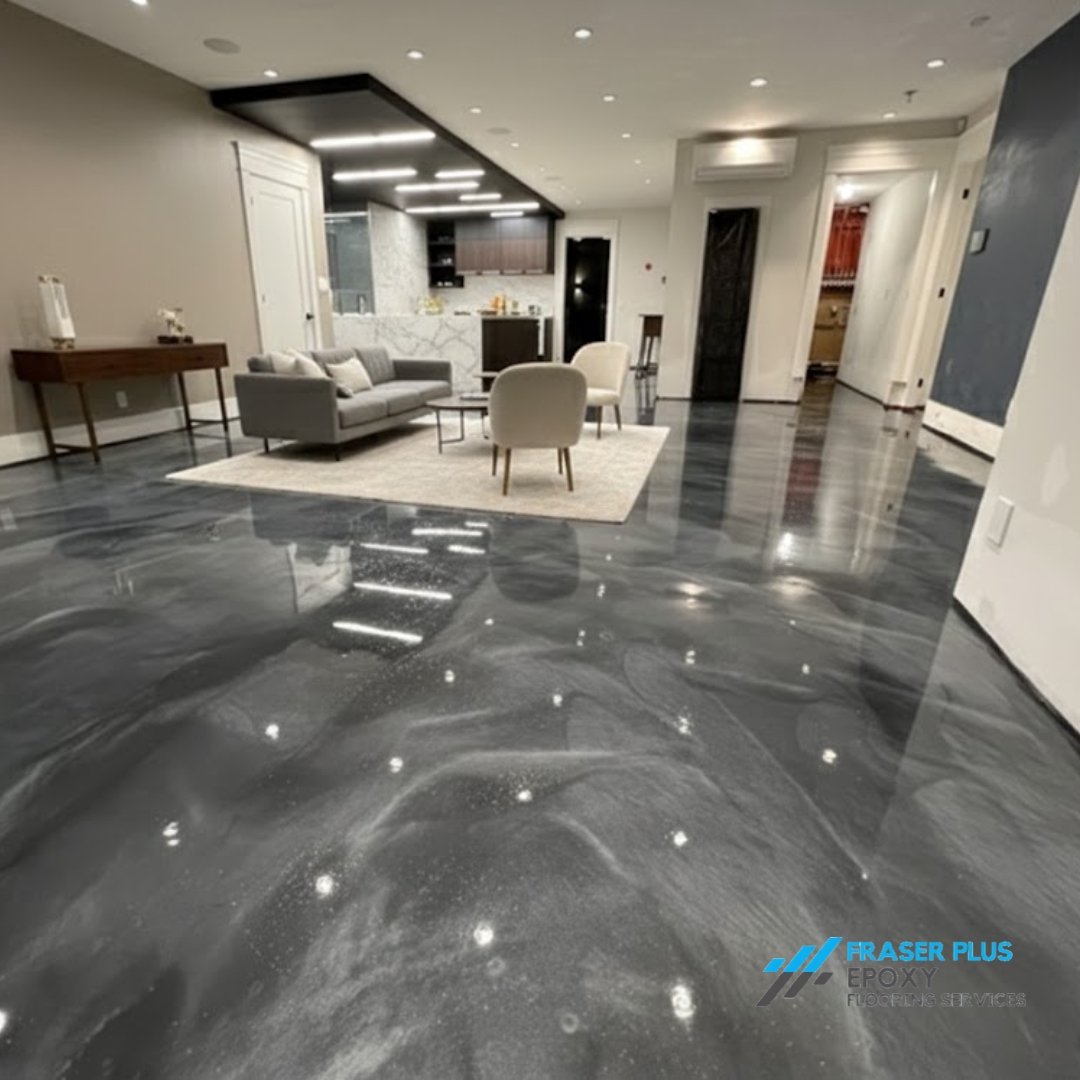
- Retail and showrooms — polished concrete or decorative metallic epoxy for a clean, professional appearance
- Healthcare and pharmaceutical facilities — antimicrobial, easy-clean surface systems
- Breweries and commercial kitchens — slip-resistant broadcast finishes over epoxy base coats
Each application has different requirements in terms of coating thickness, topcoat chemistry, and slip resistance rating. The right contractor will ask about your specific use case before recommending a system, not default to a single product for every job.
How Long Does a Commercial Epoxy Floor Installation Take?
Timeline depends on the size of the space, the condition of the existing concrete, and the coating system being applied. A basic two-coat epoxy system on a prepared slab might be completed in a few days including cure time. More complex systems — broadcast quartz, metallic epoxy, or multi-layer industrial builds — take longer and involve waiting periods between coats.
Surface preparation often takes as long as the coating application itself. If a slab has cracks, oil contamination, or elevated moisture, remediation adds time before any product goes down.
Most commercial clients plan installation around low-traffic periods — evenings, weekends, or phased shutdowns — to reduce disruption. Talk to your contractor early about scheduling so there's a realistic plan in place before the crew shows up.
What Does Commercial Epoxy Flooring Generally Cost?
Pricing in the commercial flooring industry varies based on the type of coating system, the condition of the existing slab, total square footage, and site access. More complex systems — like broadcast quartz or polyaspartic topcoats — cost more per square foot than a basic two-coat epoxy.
Substrate remediation such as crack repair, oil decontamination, or moisture mitigation is often handled separately and can add significantly to the overall project cost depending on what the concrete assessment reveals.
Actual costs vary based on project scope, substrate condition, and site access — contact FraserPlus Epoxy for a personalized assessment.
How Do You Narrow Down Contractors in Your Area?
A few practical steps help separate credible commercial flooring contractors from general handymen who apply coatings occasionally:
- Ask to visit a completed commercial project in person. Photos can be staged; walking through a real floor tells you much more about quality and finish.
- Request references from commercial clients specifically — not just residential customers.
- Confirm they've worked on projects of similar scale and use type to yours.
- Check their Google Business Profile reviews and look for mentions of commercial project experience.
Ready to talk through your project? Get in touch with FraserPlus Epoxy to discuss your commercial flooring needs in Metro Vancouver or the Fraser Valley.
Frequently Asked Questions
Is epoxy flooring suitable for all commercial environments?
Epoxy works well in most commercial environments, but not every coating system is right for every situation. Facilities with heavy UV exposure may need a polyaspartic or polyurethane topcoat that resists yellowing. High-heat environments require heat-resistant formulations. A qualified contractor will specify the right system for your conditions rather than defaulting to a single product for every project.
How do I know if my concrete is ready for an epoxy coating?
Concrete needs to be clean, structurally sound, and dry enough to accept a coating. A qualified contractor will test surface profile using CSP (concrete surface profile) standards, check for contaminants like oil or curing compounds, and measure moisture vapour emission before applying anything. Skipping this testing is one of the most common causes of early coating failure.
Can commercial epoxy floors be repaired after damage?
Yes, most commercial epoxy floors can be partially repaired if sections delaminate or crack — but the repair is only as good as the prep work underneath it. If the original installation had substrate issues, patching without addressing the root cause tends to produce the same problem again. Full or partial recoats are also possible once a floor has worn over time.
What's the difference between epoxy flooring and polished concrete?
Epoxy is a coating applied on top of concrete; polished concrete is the slab itself, mechanically ground and refined to a smooth, reflective finish. Polished concrete doesn't delaminate because there's no separate layer — it is the floor. Epoxy offers more design flexibility and can add chemical resistance that polished concrete alone doesn't provide. Many commercial projects combine both: a prepared slab with an epoxy or polyurethane topcoat for durability and appearance.
Follow FraserPlus Epoxy on Google — be the first to know about floor coatings, maintenance guides, and project ideas across Metro Vancouver.
Make us your preferred source on Google