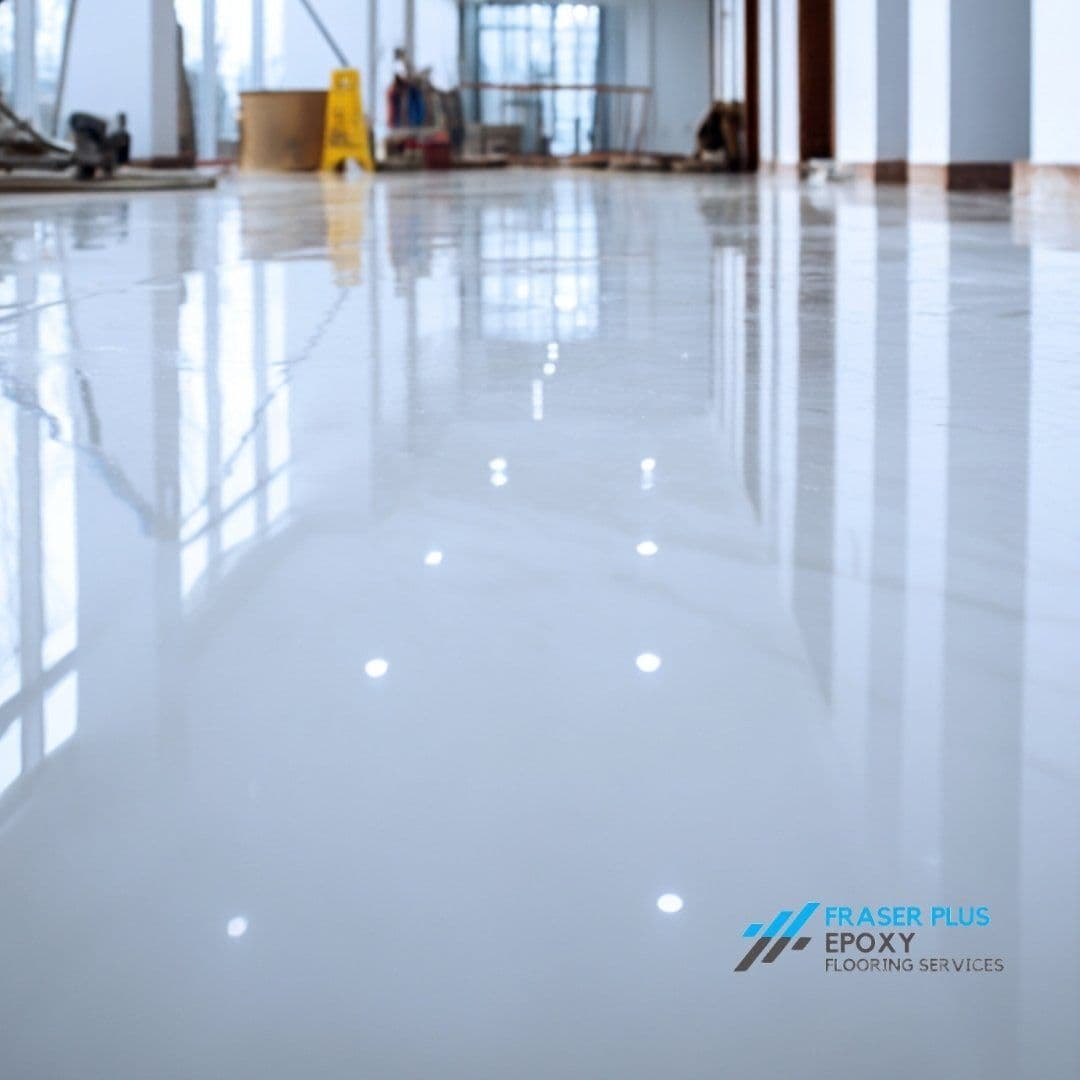
How Thick Can You Pour Self-Leveling Epoxy Flooring?
TL;DR
Self-leveling epoxy can be poured from 1/16 inch up to 1/4 inch in a single lift, with thicker pours of 3/8 inch or more done in multiple coats. Learn the right thickness for your Vancouver garage, basement, or commercial floor.
Quick Answer (TLDR)
Self-leveling epoxy is typically poured 1/8" to 1/4" thick in a single lift, with the absolute maximum of 3/8" requiring multiple coats. Thicker is not always better — pouring beyond manufacturer specs causes cracking, exotherm cure issues, and adhesion failure. For most residential and light-commercial floors in Vancouver, 1/8" is the sweet spot.
FraserPlus Epoxy has poured self-leveling systems from Sherwin-Williams, Sika, and Westcoat on more than 400 projects across Metro Vancouver and the Fraser Valley since 2014 — including high-spec data centers, restaurant kitchens in downtown Vancouver, and luxury basement conversions in West Vancouver. We mix to manufacturer ratios and gauge-rake every pour.
When it comes to achieving flawless, durable, and ultra-smooth floors in Vancouver BC, self-leveling epoxy is the undisputed champion. Whether you’re resurfacing a worn commercial concrete slab or creating a custom, seamless finish for a residential space, knowing the recommended pour thickness is vital to success—both for performance and aesthetics.
As a leader in epoxy flooring solutions, Fraser Plus Epoxy is committed to educating clients with up-to-date, data-driven guidance rooted in years of practical expertise.
What Is Self-Leveling Epoxy Flooring?
Self-leveling epoxy refers to a specialized two-part resinous flooring system designed to automatically flow and flatten, producing a uniform, glass-like surface.
After mixing resin and hardener, the compound is poured and spreads evenly without manual troweling, thanks to its unique rheology (flowability) and surface tension properties. This technology is ideal for spaces where absolute flatness, reflectivity, and chemical resistance are mandatory.
Studies demonstrate that polymer-modified self-leveling mortars, including epoxy systems, achieve optimal adhesion and mechanical properties at typical application thicknesses, with performance comparable to conventional thermosetting resins used in floor finishes.
Key Benefits for Vancouver BC Floors
Effortless Lippage Elimination: Fills minor imperfections, evening out slabs regardless of old concrete variabilities.
High Compressive Strength: Resists impact, abrasion, and heavy rolling loads common in warehouses or garages.
Easy Sterilization: Superior hygiene due to seamless, poreless finish—crucial for food prep, medical, and high-traffic facilities.
VOC Compliance: Modern self-leveling epoxy formulas meet Vancouver’s environmental regulations for volatile organic compounds—ideal for green building targets.
Minimum and Maximum Recommended Pour Thickness of Self-Leveling Epoxy Flooring
Standard Practice
Minimum thickness: 3mm (1/8 inch)
This is the lowest advisable pour depth for self-leveling epoxy. Anything less can result in weak adhesion and premature wear.
Optimal Range: 3mm–6mm (1/8–1/4 inch)
For the vast majority of residential and commercial projects in Metro Vancouver, this spectrum delivers superior durability without introducing curing complications or excessive material consumption.
Heavy-Duty Applications: Up to 25mm (1 inch)
Industrial environments enduring high mechanical or chemical abuse (think breweries, production plants) may require buildups of multiple layers, culminating in total pours up to 25mm. In these situations, each layer must cure fully for optimal strength; rapid bulk pours risk exothermic reactions and improper sets.
Consider the Science
Pouring beyond 6mm in a single application heightens the risk of:
Heat buildup (exotherm), causing cracks or yellowing.
Entrapped air (bubbles), jeopardizing both appearance and integrity.
Extended cure times, slowing overall project delivery.
Vancouver-Specific Requirements
Due to the Pacific Northwest’s unique climatic swings—humidity, temperature variances, and building codes—self-leveling epoxy pours must balance performance and safety. Local projects typically specify a 3–6mm thickness for commercial traffic zones, and up to 10mm if extreme chemical/spill resistance is needed.
Consult Fraser Plus Epoxy for site-specific recommendations tailored to Vancouver’s regulatory environment and subfloor conditions.
Pouring in Layers: Best Practices
For deployments requiring thickness beyond standard recommendations, experienced installers—like Fraser Plus—advocate a multi-stage layering approach:
First base layer: 3–6mm self-leveling pour, ensuring full cure (typically 24–48 hours).
Subsequent layers: Repeat, maintaining total buildup below manufacturer’s max allowable recommendations for the selected product.
Surface preparation: Every additional layer must be bonded with mechanical or chemical prep to avoid inter-coat delamination.
Monitoring exothermic reactions: Using strategic pour timing and temperature control to prevent substrate damage or finish compromise.
Epoxy Thickness Ranges
Application Type
Typical Thickness
Notes / Suitability
General residential/commercial
3–6mm
Smooth, durable, easy-maintenance aesthetics
Heavy-duty/industrial
6–25mm
Requires staged pours for maximum performance
Minimal exposure/low traffic
~2mm
Not recommended for most public or load-bearing areas
The Critical Role in Floor Performance
Thickness = Longevity: Thicker, properly-cured self-leveling epoxy increases resistance to gouging, delamination, and thermal shock.
Thin is risky: Going below 3mm is a false economy—expect premature wear, microcracks, and peeling.
Custom Solutions: Each project warrants professional assessment—Fraser Plus delivers tailored solutions based on site traffic, chemical exposure, substrate condition, and client aesthetic goals.
Self-Leveling Epoxy Flooring | Fraser Plus Epoxy
The biggest mistake in self-leveling epoxy installations? Ignoring pour thickness recommendations. Achieving optimal, long-life, and regulation-compliant surfaces in Vancouver BC hinges on sticking to best practice: 3–6mm for most needs, staged multi-layered builds for industrial operations, and meticulous attention to cure schedules.
For seamless, trouble-free floors that ‘wow’ at first glance and perform for years, trust your project to Vancouver’s epoxy authorities. Contact us today for a consultation or technical site survey. When poured right—at just the right thickness—self-leveling epoxy transforms floors from forgettable to indestructible.
FAQs
Can self-leveling epoxy be applied over old, cracked concrete floors in Vancouver?
Yes—self-leveling epoxy can be applied over aged or moderately cracked concrete, provided the surface is properly prepped (cleaned, degreased, and stabilized). Minor cracks are usually filled by the self-leveling compound itself, while larger cracks may need preliminary repair. For optimal results in Vancouver’s humid conditions, always consult a professional like Fraser Plus Epoxy to assess your subfloor and ensure long-term adhesion and performance.
Is it possible to customize the color and finish of a self-leveling epoxy floor?
Absolutely. Self-leveling epoxy systems are available in a range of decorative colors, metallic effects, and even quartz-infused finishes for both residential and commercial spaces. Fraser Plus Epoxy specializes in custom color matching and creative design solutions to transform your floor into a seamless, eye-catching surface that fits your brand or home decor.
Why choose Fraser Plus Epoxy over DIY kits for your self-leveling epoxy project?
DIY epoxy kits often lack the technical consistency, durability, and UV resistance of professional-grade systems. Fraser Plus Epoxy’s certified installers use premium materials, precise application techniques, and rigorous quality control—ensuring a flawless, long-lasting finish that withstands Vancouver’s climate and traffic demands. Plus, our warranty and post-installation support offer peace of mind you won’t get from a box-store product.
How long does a self-leveling epoxy floor take to cure in Vancouver’s climate?
Cure times vary with temperature, humidity, and thickness, but most self-leveling epoxy floors in Metro Vancouver are fully cured within 24–48 hours for light foot traffic, and up to 72 hours for heavy loads. Fraser Plus Epoxy tailors each project to local weather patterns, using advanced formulations that minimize downtime without compromising strength.
What maintenance does a self-leveling epoxy floor require in commercial settings?
Self-leveling epoxy floors are renowned for low maintenance—regular sweeping and occasional damp mopping are typically all that’s needed. For high-traffic commercial environments, periodic professional re-coating may be recommended after several years. Fraser Plus Epoxy offers maintenance plans to keep your floors looking new and performing at their best, year after year.
People Also Ask
Are self-leveling epoxy floors safe for food processing or medical facilities in Vancouver?
Yes—modern self-leveling epoxy systems can be formulated for food-safe and medical-grade compliance, offering seamless, non-porous surfaces that resist bacteria and chemicals. Fraser Plus Epoxy works closely with facility managers to select and install coatings that meet Health Canada and Vancouver Coastal Health specifications.
Can self-leveling epoxy be used outdoors in Vancouver’s rainy climate?
Standard self-leveling epoxy is not recommended for full outdoor exposure due to UV degradation and thermal cycling. However, specially formulated UV-stable and weather-resistant epoxies are available for covered patios, parking garages, and other semi-protected areas. Always consult an expert like Fraser Plus Epoxy for advice on outdoor applications in Metro Vancouver.
What’s the difference between self-leveling epoxy and epoxy paint for garage floors?
Epoxy paint is a thin, decorative coating with limited durability, while self-leveling epoxy is a thicker, poured system that creates a seamless, impact-resistant, and chemically durable surface. For Vancouver garages dealing with salt, moisture, and heavy use, self-leveling epoxy from Fraser Plus Epoxy is the superior, long-term solution.
Does installing self-leveling epoxy require moving out of my home or business?
In most cases, no full relocation is needed—properly ventilated areas can be occupied within 24–48 hours after application, depending on product and conditions. Fraser Plus Epoxy uses low-odor, fast-cure systems to minimize disruption for homeowners and businesses throughout the Lower Mainland.
How does self-leveling epoxy compare to polished concrete for commercial spaces in Vancouver?
Self-leveling epoxy provides a smoother, more consistent finish and greater chemical resistance than polished concrete, with fewer joints and imperfections. It’s also faster to install and easier to maintain. However, polished concrete offers a different aesthetic and may be preferred in some heritage or industrial contexts. Fraser Plus Epoxy can advise on the best solution for your specific needs and budget.
Explore Our Epoxy Services
For deep self-leveling pours that need a finished decorative look, our metallic epoxy systems use 1/8" base coats with a self-leveling pigmented topcoat.
Commercial kitchens, breweries, and food-processing facilities benefit from commercial epoxy installations poured at 1/4" with anti-slip aggregate.
For severely uneven slabs, decorative concrete and overlays may be a better solution than building up epoxy thickness.
Want our installation team to walk through your project? Book a free on-site assessment anywhere in Metro Vancouver or the Fraser Valley.
Serving North Vancouver, West Vancouver, Vancouver, Burnaby, and the entire Lower Mainland.
Frequently Asked Questions
Can I pour self-leveling epoxy 1/2 inch thick in one go?
No. Most self-leveling epoxies cap a single lift at 1/4 inch, and pouring 1/2 inch in one shot causes a runaway exotherm reaction — the resin generates so much heat as it cures that it cracks, smokes, or even ignites. For 1/2 inch builds, do two 1/4 inch pours 8-12 hours apart.
How thick does self-leveling epoxy need to be to fix an uneven concrete floor?
For slabs that are out of level by less than 1/4 inch over 10 feet, a 1/8 inch self-leveling pour will hide most of the variation. For larger deviations, we recommend grinding the high spots first or using a cementitious self-leveler like Ardex or Mapei as a base, then applying decorative epoxy on top.
How long does self-leveling epoxy take to cure at 1/4 inch thickness?
Foot traffic in 8-12 hours, light vehicle traffic in 24 hours, full chemical cure in 5-7 days. In Metro Vancouver's cooler garages we extend cure times by 24 hours. Polyaspartic topcoats can shorten the foot-traffic time to 1-2 hours.
What does 1/8 inch self-leveling epoxy cost per square foot in Vancouver?
Installed self-leveling epoxy at 1/8 inch typically runs $9-$14 per square foot in Metro Vancouver, including grinding, primer, base coat, and topcoat. Decorative metallic systems at the same thickness run $12-$18 per square foot.
Will self-leveling epoxy fill cracks in my concrete?
It will fill hairline cracks (under 1/16 inch) but will telegraph through any structural crack wider than that. Active cracks must be routed out and filled with a flexible polyurethane sealant before the epoxy is poured, otherwise the epoxy will crack along the same line within months.
Metro Vancouver & Fraser Valley
Ready for a Fixed-Price Quote?
FraserPlus installs premium epoxy flooring across Metro Vancouver and the Fraser Valley. No surprises, no markups — just a price that holds.
Get a Free Quote →